
Level:
Correct: 0
Incorrect: 0
Marks: 0/0
Exam Practice
Course:
Topics:
OCR GCSE Maths (Foundation non-calculator) Smart practice A mixed round aimed at your weak spots
Unit 1
Number Operations and Integers
Unit 2
Fractions, Decimals and Percentages
Unit 3
Indices and Surds
Unit 4
Approximation and Estimation
Unit 5
Ratio, Proportion and Rates of Change
Unit 6
Algebra
Unit 7
Graphs of Equations and Functions
Unit 8
Basic Geometry
Unit 9
Congruence and Similarity
Unit 10
Mensuration
Unit 11
Probability
Unit 12
Statistics
Avg
score:
–
Topics
done:
0/100

Translations

Practise 13 exam-style questions on Translations for OCR GCSE Maths (Foundation non-calculator). Write your answer as you would in the exam and get it marked in seconds against the mark scheme, point by point, with the Study Helper on hand if you get stuck.

  • 13 questions
  • 1–5 marks each
  • Instant marking
  • No sign-up needed
13 questions, marked as you go

Sample questions with model answers

Here are 4 of the questions in this topic, each with a model answer, an explanation of why it earns the marks and the mark scheme an examiner would use.

Question 1

1 mark

In a computer game, a character on a grid is moved by the translation \(\begin{pmatrix} 0 \\ -5 \end{pmatrix}\).

Describe this movement in words.

Model answer

The top number is 0, so the character does not move left or right.
The bottom number is \(-5\), so it moves 5 down.
The character moves 5 squares down.

Explanation

The top number of a column vector gives the movement across and the bottom number the movement up or down. A 0 on top means no movement across, and a negative bottom number means downwards. Mixing up the two numbers gives '5 left', a common error.

Mark scheme
  1. 1 mark

    B1 for 5 (squares or units) down

    Accept '5 down and 0 across', 'moves down 5'. Do not accept '5 left' or '5 up'.
Question 2

2 marks

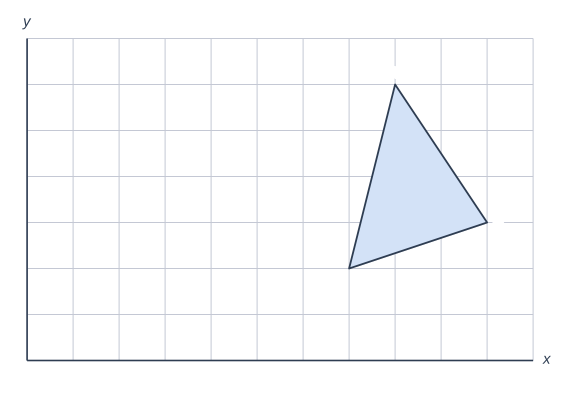
The diagram shows triangle PQR on a coordinate grid.

The triangle is translated by the vector \(\begin{pmatrix} -5 \\ 1 \end{pmatrix}\).

Write down the coordinates of the image of P and the coordinates of the image of Q.

A coordinate grid with x from 0 to 11 and y from 0 to 7; each grid square is 1 unit across, and the axes cross at the origin O. Triangle PQR (shaded) is drawn with vertices P(7, 2), Q(10, 3) and R(8, 6).

Model answer

\(\begin{pmatrix} -5 \\ 1 \end{pmatrix}\) means 5 to the left and 1 up.
P is \((7, 2)\): image \((7 - 5, 2 + 1) = (2, 3)\)
Q is \((10, 3)\): image \((10 - 5, 3 + 1) = (5, 4)\)

Explanation

Add the top number of the vector to the x-coordinate and the bottom number to the y-coordinate. Here 5 is taken off each x-coordinate and 1 is added to each y-coordinate. A common error is to move right instead of left.

Mark scheme
  1. 1 mark

    B1 for image of P at \((2, 3)\)

    Condone missing brackets; correct answer with no working scores full marks

  2. 1 mark

    B1 for image of Q at \((5, 4)\)

    Condone missing brackets. If 0 scored, SC1 for both images from moving 5 right and 1 up, \((12, 3)\) and \((15, 4)\), or from moving 1 across and 5 down.

Question 3

2 marks

A translation maps the point \((2, 3)\) onto the point \((6, 1)\).

The same translation is used on each of the points \((5, 2)\), \((1, 4)\) and \((-2, 3)\).

Which one of these three points is mapped onto the x-axis?

Model answer

From \((2, 3)\) to \((6, 1)\): 4 right and 2 down, so the vector is \(\begin{pmatrix} 4 \\ -2 \end{pmatrix}\).
\((5, 2) \rightarrow (9, 0)\)
\((1, 4) \rightarrow (5, 2)\)
\((-2, 3) \rightarrow (2, 1)\)
The image of \((5, 2)\) has y-coordinate 0, so it is on the x-axis.
\((5, 2)\)

Explanation

First find the translation from the point and its image, then apply it to each point. A point is on the x-axis when its y-coordinate is 0, so the point needed has y-coordinate 2 before moving 2 down. A common error is to give the image (9, 0) instead of the original point.

Mark scheme
  1. 1 mark

    B1 for vector \(\begin{pmatrix} 4 \\ -2 \end{pmatrix}\) soi

    Implied by any one correct image: \((9, 0)\), \((5, 2)\) or \((2, 1)\), or by 'y goes down by 2'; correct answer with no working scores full marks

  2. 1 mark

    B1 for \((5, 2)\)

    Answer \((9, 0)\) (the image, not the point) scores B1 B0.

Question 4

4 marks

A wallpaper pattern is made from motifs.

Motif 1 has its top vertex at the point \((1, 5)\).
Each new motif is the motif before it translated by the vector \(\begin{pmatrix} 4 \\ -1 \end{pmatrix}\).
So motif 2 has its top vertex at \((5, 4)\).

Which motif has its top vertex at \((25, -1)\)?

One motif has its top vertex on the x-axis.
Write down the coordinates of this vertex.

Model answer

Each new motif is 4 right and 1 down from the one before.
Top vertices: motif 1 \((1, 5)\), motif 2 \((5, 4)\), motif 3 \((9, 3)\), motif 4 \((13, 2)\), motif 5 \((17, 1)\), motif 6 \((21, 0)\), motif 7 \((25, -1)\)
From \((1, 5)\) to \((25, -1)\) is \(24 \div 4 = 6\) translations, so it is motif \(1 + 6 = 7\).
The top vertex on the x-axis has y-coordinate 0: motif 6, at \((21, 0)\).

Explanation

Each translation adds 4 to the x-coordinate and takes 1 off the y-coordinate. Count how many translations are needed, then remember motif 1 has had no translations, so add 1. A common error is to give the number of translations, 6, instead of the motif number, 7.

Mark scheme
  1. 1 mark

    M1 for \((25 - 1) \div 4\) or 6 translations, or a correct list of top vertices reaching \((25, -1)\)

    Accept \(5 - (-1) = 6\) moves down. A list must be correct as far as it goes; correct answer with no working scores full marks

  2. 1 mark

    A1 for motif 7

    6 (the number of translations) scores M1 A0.

  3. 1 mark

    M1 for 5 translations to reach \(y = 0\), or a correct list reaching \(y = 0\)

    Accept \(1 + 5 \times 4\) or \(5 \div 1 = 5\) moves.

  4. 1 mark

    A1 for \((21, 0)\)

    Condone missing brackets. A fully correct answer with no working (not from wrong working) scores full marks (4).

Ready to try the rest? Every answer you write is marked against the mark scheme, so you can see exactly where the marks are.

Study Helper Hints first, answers after you try

Stuck on this one? Ask for a hint and I’ll point you in the right direction, without giving the answer away. Once you’ve checked your answer, I’ll show you how the marks are awarded.