Practise 14 exam-style questions on Quadratic equations for OCR GCSE Maths (Foundation non-calculator). Write your answer as you would in the exam and get it marked in seconds against the mark scheme, point by point, with the Study Helper on hand if you get stuck.
14 questions
1–4 marks each
Instant marking
No sign-up needed
14 questions, marked as you go
Sample questions with model answers
Here are 4 of the questions in this topic, each with a model answer, an explanation of why it earns the marks and the mark scheme an examiner would use.
Question 1
2 marks
Solve.
\((x - 3)(x + 8) = 0\)
Model answer
If two numbers multiply to give 0, one of them must be 0. \(x - 3 = 0\) gives \(x = 3\) \(x + 8 = 0\) gives \(x = -8\) \(x = 3\) or \(x = -8\)
Explanation
The product of the two brackets is 0, so one bracket must equal 0. Set each bracket equal to 0 and solve. A common error is to reverse the signs and write x = −3 or x = 8; check by substituting: (3 − 3)(3 + 8) = 0 × 11 = 0.
Mark scheme
1 mark
B1 for \(x = 3\)
correct answer with no working scores full marks
1 mark
B1 for \(x = -8\)
Answers −3 and 8 (signs reversed) score 0. Ignore any expansion of the brackets.
Question 2
2 marks
Sam says,
"The equation \(x^2 + 6x + 9 = 0\) has two different solutions."
Is Sam correct? Show how you decide.
Model answer
\(x^2 + 6x + 9 = (x + 3)(x + 3) = 0\) Both brackets give \(x + 3 = 0\), so \(x = -3\). The equation has only one solution, \(x = -3\), so Sam is not correct.
Explanation
The two numbers that multiply to 9 and add to 6 are 3 and 3, so both brackets are the same. Setting each bracket equal to 0 gives the same value, x = −3, so there is only one solution, not two different ones.
Mark scheme
1 mark
M1 for \((x + 3)(x + 3) = 0\) or \((x + 3)^2 = 0\)
1 mark
A1 for No, with a reason such as both brackets give the same solution, so the only solution is \(x = -3\)
Must say No (or Sam is not correct) and state the single solution −3 or that both brackets are the same. 'No' with no working scores 0.
Question 3
3 marks
Solve.
\(x^2 = 6x + 16\)
Model answer
\(x^2 = 6x + 16\) \(x^2 - 6x - 16 = 0\) Two numbers that multiply to −16 and add to −6 are −8 and 2. \((x - 8)(x + 2) = 0\) \(x = 8\) or \(x = -2\)
Explanation
Before you factorise, rearrange the equation so that one side is 0: subtract 6x and 16 from both sides. Then find two numbers with product −16 and sum −6. Check: 8² = 64 and 6 × 8 + 16 = 64; (−2)² = 4 and 6 × (−2) + 16 = 4.
Mark scheme
1 mark
M1 for \(x^2 - 6x - 16 = 0\)
All terms on one side, equal to 0. Accept \(0 = -x^2 + 6x + 16\); correct answer with no working scores full marks
1 mark
M1 for \((x - 8)(x + 2)\)
FT their three-term quadratic if it factorises: correct factors of their quadratic.
1 mark
A1 for \(x = 8\) and \(x = -2\)
Correct answers with no working score 3 marks. 8 and −2 must both be given. −8 and 2 scores M1 M1 A0.
Question 4
4 marks
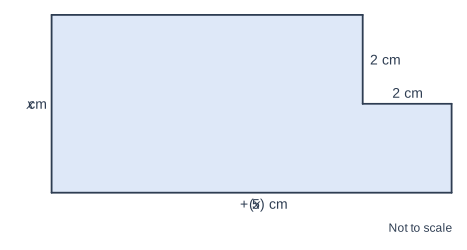
The diagram shows a rectangle measuring \((x + 5)\) cm by \(x\) cm. A square of side 2 cm has been cut from one corner.
The area of the shape that is left is 32 cm².
Show that \(x^2 + 5x - 36 = 0\). Work out the value of \(x\).
Model answer
Area of the rectangle \(= x(x + 5) = x^2 + 5x\) Area of the square cut out \(= 2 \times 2 = 4\) Area left \(= x^2 + 5x - 4\) \(x^2 + 5x - 4 = 32\) \(x^2 + 5x - 36 = 0\) \((x + 9)(x - 4) = 0\) \(x = -9\) or \(x = 4\) A length cannot be negative, so \(x = 4\).
Explanation
The area left is the area of the whole rectangle minus the 4 cm² square. Forming the equation and subtracting 32 from both sides gives the quadratic. Factorise and reject the negative solution because x is a length. Check: 4 × 9 − 4 = 32.
Mark scheme
1 mark
M1 for \(x(x + 5) - 4\) or \(x^2 + 5x - 4\)
An expression for the area of the shape (area of the rectangle minus 2 × 2). Splitting into two rectangles is fine, e.g. \(2(x + 3) + (x - 2)(x + 5)\).
1 mark
A1 for \(x^2 + 5x - 4 = 32\) leading to \(x^2 + 5x - 36 = 0\) correctly
This is a show that: the equation must be formed and rearranged with no errors.
1 mark
M1 for \((x + 9)(x - 4)\)
Independent of the first two marks.
1 mark
A1 for \(x = 4\) only
−9 must be rejected or not given as the final answer (a length cannot be negative). 4 and −9 both given scores M1 A0 for this part.
Ready to try the rest? Every answer you write is marked against the mark scheme, so you can see exactly where the marks are.
Ctrl + Enter to check
Study HelperHints first, answers after you try
Stuck on this one? Ask for a hint and I’ll point you in the right direction, without giving the answer away. Once you’ve checked your answer, I’ll show you how the marks are awarded.