Level:
Correct: 0
Incorrect: 0
Marks: 0/0
Exam Practice
Course:
Topics:
OCR GCSE Maths (Foundation non-calculator) Smart practice A mixed round aimed at your weak spots
Unit 1
Number Operations and Integers
Unit 2
Fractions, Decimals and Percentages
Unit 3
Indices and Surds
Unit 4
Approximation and Estimation
Unit 5
Ratio, Proportion and Rates of Change
Unit 6
Algebra
Unit 7
Graphs of Equations and Functions
Unit 8
Basic Geometry
Unit 9
Congruence and Similarity
Unit 10
Mensuration
Unit 11
Probability
Unit 12
Statistics
Avg
score:
–
Topics
done:
0/100

Gradients and rates of change

Practise 13 exam-style questions on Gradients and rates of change for OCR GCSE Maths (Foundation non-calculator). Write your answer as you would in the exam and get it marked in seconds against the mark scheme, point by point, with the Study Helper on hand if you get stuck.

  • 13 questions
  • 1–4 marks each
  • Instant marking
  • No sign-up needed
13 questions, marked as you go

Sample questions with model answers

Here are 4 of the questions in this topic, each with a model answer, an explanation of why it earns the marks and the mark scheme an examiner would use.

Question 1

2 marks

The diagram shows the side view of a staircase.
Each step is 18 cm high and 24 cm deep.

Work out the gradient of the staircase.
Give your answer as a fraction in its simplest form.
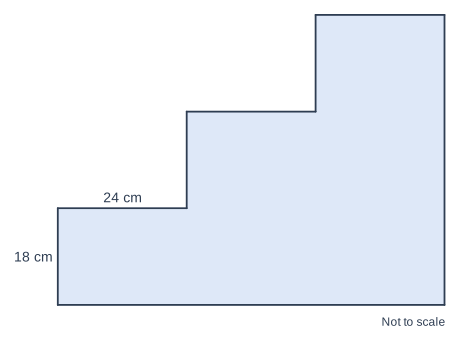
Geometry diagram, marked "Not to scale". A staircase (its vertices are not labelled) (shaded). The unlabelled side going upwards is labelled 18 cm. The unlabelled side going to the right is labelled 24 cm.

Model answer

Gradient = vertical rise ÷ horizontal distance
\(\dfrac{18}{24} = \dfrac{3}{4}\)

Explanation

The gradient compares how far the staircase rises with how far it goes across: rise ÷ across, here 18 ÷ 24. Divide the top and bottom by 6 to simplify. A common error is to divide the wrong way round and give \(\dfrac{4}{3}\).

Mark scheme
  1. 1 mark

    M1 for \(\dfrac{18}{24}\) oe

    Or for 18 : 24 oe, or 0.75. \(\dfrac{24}{18}\) or \(\dfrac{4}{3}\) scores M0 A0; correct answer with no working scores full marks

  2. 1 mark

    A1 for \(\dfrac{3}{4}\)

    0.75 as the final answer scores M1 A0 (the question asks for a fraction).
Question 2

2 marks

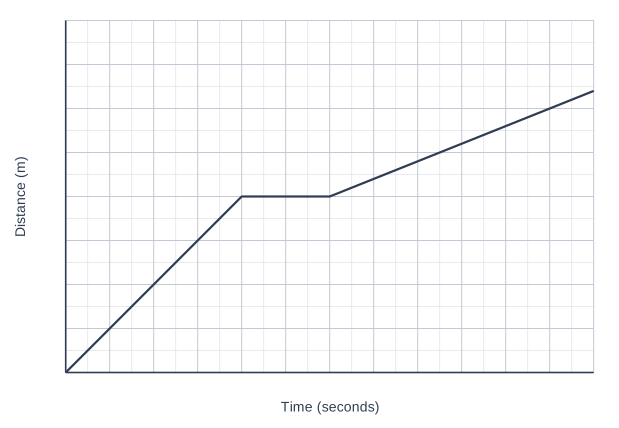
Lucy goes for a run.

The graph shows the distance she has run.

Work out Lucy's speed, in metres per second, for the first 40 seconds.

A graph of Distance (m) (vertical axis, 0 to 400, marked every 50) against Time (seconds) (horizontal axis, 0 to 120, marked every 10), on a grid with 2 small squares to each large square. The graph is made of straight-line sections; its values can be read from the grid.

Model answer

In the first 40 seconds Lucy runs 200 m.
Speed = distance ÷ time
\(200 \div 40 = 5\) m/s

Explanation

On a distance-time graph the gradient of a straight section is the speed: distance travelled ÷ time taken. Read the distance at 40 seconds (200 m) and divide by 40. A common error is to divide the time by the distance.

Mark scheme
  1. 1 mark

    M1 for \(200 \div 40\)

    Or for any correct distance read from the first section divided by its time, e.g. \(100 \div 20\); correct answer with no working scores full marks

  2. 1 mark

    A1 for 5

    Units not required. 8 (from \(40 \div 5\)) or 0.2 (from \(40 \div 200\)) scores M0 A0.

Question 3

2 marks

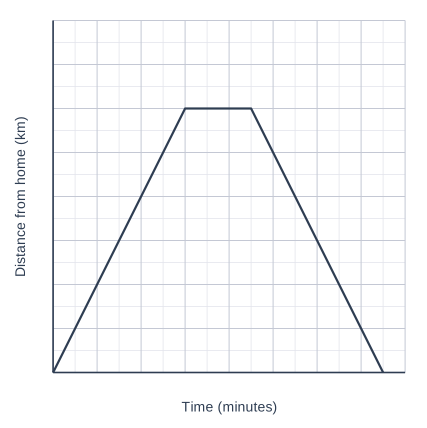
Sophie cycles from her home to the park and back.

The graph shows her distance from home.

Sophie works out her speed for the first 30 minutes.
Here is her working.

Speed = \(6 \div 30 = 0.2\) km/h

Explain the mistake Sophie has made and work out her correct speed in km/h.

A graph of Distance from home (km) (vertical axis, 0 to 8, marked every 1) against Time (minutes) (horizontal axis, 0 to 80, marked every 10), on a grid with 2 small squares to each large square. The graph is made of straight-line sections; its values can be read from the grid.

Model answer

Sophie has divided by 30 minutes, but the speed is in km per hour, so the time must be in hours.
30 minutes = 0.5 hours
\(6 \div 0.5 = 12\) km/h

Explanation

The gradient of a distance-time graph gives the speed in the units of the axes: km per minute here. To get km/h, the time must be in hours (or multiply km per minute by 60). Sophie's 0.2 is her speed in km per minute, and \(0.2 \times 60 = 12\) km/h.

Mark scheme
  1. 1 mark

    B1 for she has used the time in minutes instead of hours oe

    Accept '30 minutes is 0.5 hours, not 30', 'she should divide by 0.5'. Do not accept 'she should multiply' with no reference to the units of time.

  2. 1 mark

    B1 for 12

    Units not required.

Question 4

4 marks

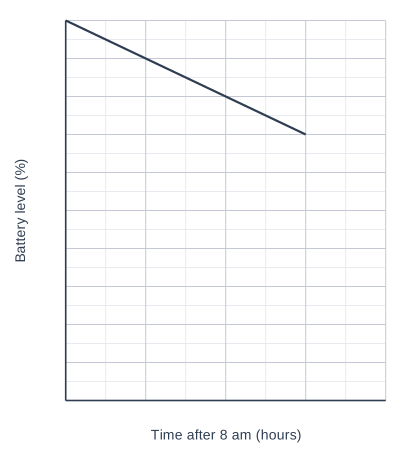
Ewan fully charges his phone and unplugs it at 8 am.

The graph shows the battery level of the phone for the next 3 hours.

The battery level continues to go down at the same rate.
Ewan will charge his phone again when the battery level reaches 10%.

At what time will the battery level reach 10%?

A graph of Battery level (%) (vertical axis, 0 to 100, marked every 10) against Time after 8 am (hours) (horizontal axis, 0 to 4, marked every 1), on a grid with 2 small squares to each large square. The graph is a straight line; its values can be read from the grid.

Model answer

In 3 hours the battery level goes down from 100% to 70%.
Rate = \(30 \div 3 = 10\%\) per hour
From 100% to 10% is a drop of 90%.
\(90 \div 10 = 9\) hours
8 am + 9 hours = 5 pm

Explanation

The gradient of the line is the rate at which the battery level falls, 10% per hour. Find how long the full drop takes and add it to the start time. A common error is to give the number of hours (9) instead of the time, or to add the 9 hours to 11 am instead of 8 am.

Mark scheme
  1. 1 mark

    M1 for \((100 - 70) \div 3\) oe

    Or a correct pair of readings used to find the rate, e.g. \((100 - 90) \div 1\); correct answer with no working scores full marks

  2. 1 mark

    A1 for 10 (% per hour)

  3. 1 mark

    M1 for \((100 - 10) \div\) their 10 or \((70 - 10) \div\) their 10

    Implied by 9 hours after 8 am or 6 hours after 11 am.

  4. 1 mark

    A1 for 5 pm

    Accept 17:00, 17 00, 5:00 pm. 9 alone or 9 hours scores M1 A1 M1 A0.

Ready to try the rest? Every answer you write is marked against the mark scheme, so you can see exactly where the marks are.

Study Helper Hints first, answers after you try

Stuck on this one? Ask for a hint and I’ll point you in the right direction, without giving the answer away. Once you’ve checked your answer, I’ll show you how the marks are awarded.