
Level:
Correct: 0
Incorrect: 0
Marks: 0/0
Exam Practice
Course:
Topics:
OCR GCSE Maths (Foundation non-calculator) Smart practice A mixed round aimed at your weak spots
Unit 1
Number Operations and Integers
Unit 2
Fractions, Decimals and Percentages
Unit 3
Indices and Surds
Unit 4
Approximation and Estimation
Unit 5
Ratio, Proportion and Rates of Change
Unit 6
Algebra
Unit 7
Graphs of Equations and Functions
Unit 8
Basic Geometry
Unit 9
Congruence and Similarity
Unit 10
Mensuration
Unit 11
Probability
Unit 12
Statistics
Avg
score:
–
Topics
done:
0/100

Angles at a point and on a straight line

Practise 15 exam-style questions on Angles at a point and on a straight line for OCR GCSE Maths (Foundation non-calculator). Write your answer as you would in the exam and get it marked in seconds against the mark scheme, point by point, with the Study Helper on hand if you get stuck.

  • 15 questions
  • 1–4 marks each
  • Instant marking
  • No sign-up needed
15 questions, marked as you go

Sample questions with model answers

Here are 4 of the questions in this topic, each with a model answer, an explanation of why it earns the marks and the mark scheme an examiner would use.

Question 1

1 mark

The diagram is drawn accurately.

Measure the size of the angle marked \(x\).
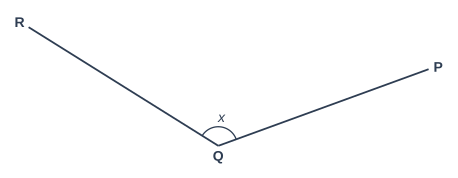
Geometry diagram, drawn accurately to scale. Line segments QP and QR are drawn. Angle PQR is marked x (its size can be measured on the accurate drawing).

Model answer

Put the centre of the protractor on Q, with the zero line along QP, and read the scale that starts at 0 on QP.
\(x = 128^\circ\)

Explanation

The angle is obtuse, so the answer must be between 90° and 180°: this is a quick check that you have used the correct scale. The most common error is to read the other scale on the protractor and give 52°.

Mark scheme
  1. 1 mark

    B1 for 126 to 130

    Accept answers in the range 126° to 130° inclusive. 50 to 54 (reading the wrong scale of the protractor) scores 0.
Question 2

2 marks

Sam says,

"Three angles of 125°, 85° and 140° fit together exactly around a point."

Is Sam correct?
Show how you decide.

Model answer

\(125 + 85 + 140 = 350^\circ\)
Angles around a point add up to 360°.
350° is not 360°, so the angles do not fit exactly.
No, Sam is not correct.

Explanation

Angles that fit together exactly around a point always add up to 360°. These add up to 350°, which leaves a gap of 10°. Check the sum carefully: an arithmetic slip could make the angles appear to fit.

Mark scheme
  1. 1 mark

    M1 for 125 + 85 + 140 or 350

    Or 360 − 125 − 85 − 140 = 10.

  2. 1 mark

    A1 for No, because angles at a point add up to 360° and 350 ≠ 360

    Must say No and compare with 360. 'No' with 180 used as the angle sum scores M1 A0.

Question 3

3 marks

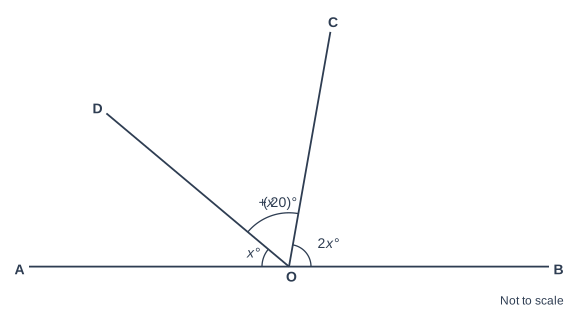
In the diagram, AOB is a straight line.

Work out the value of \(x\).

Geometry diagram, marked "Not to scale". Line segments AB, OC and OD are drawn. O lies on AB. Angle BOC is marked 2x°. Angle COD is marked (x + 20)°. Angle DOA is marked x°.

Model answer

Angles on a straight line add up to 180°.
\(x + (x + 20) + 2x = 180\)
\(4x + 20 = 180\)
\(4x = 160\)
\(x = 40\)

Explanation

The three angles make up the straight line AOB, so their sum is 180°. Collect the x terms (x + x + 2x = 4x) and solve the equation. Check: 40 + 60 + 80 = 180. A common error is to use 360°, which is the sum of angles at a point, not on a line.

Mark scheme
  1. 1 mark

    M1 for x + x + 20 + 2x = 180 oe

    Or 4x + 20 = 180; correct answer with no working scores full marks

  2. 1 mark

    M1 for 4x = 160 or x = 160 ÷ 4

    FT their equation of the form ax + b = 180 or 360 for this mark.

  3. 1 mark

    A1 for 40

    Accept x = 40. 85 (from 4x + 20 = 360) scores M0 M1 A0.

Question 4

4 marks

A circular flower bed is split into three parts by straight edges from its centre.
Roses, tulips and grass are planted in the three parts.

The angle at the centre for the roses is 40° more than the angle for the tulips.
The angle at the centre for the grass is twice the angle for the roses.

Work out the angle at the centre for the grass.

Model answer

Let the tulip angle be \(t\).
Roses: \(t + 40\). Grass: \(2(t + 40) = 2t + 80\).
Angles at a point add up to 360°:
\(t + (t + 40) + (2t + 80) = 360\)
\(4t + 120 = 360\)
\(4t = 240\)
\(t = 60\)
Roses = 100°, grass = \(2 \times 100 = 200^\circ\).

Explanation

The three angles at the centre fit around a point, so they add up to 360°. Write each angle in terms of one unknown, form an equation and solve it. Check: 60 + 100 + 200 = 360. A common error is to write the grass angle as 2t + 40 instead of 2(t + 40).

Mark scheme
  1. 1 mark

    M1 for expressions for roses and grass, e.g. tulips t, roses t + 40, grass 2(t + 40)

    Any letter. Or a correct trial using three angles that add to 360; correct answer with no working scores full marks

  2. 1 mark

    M1 for t + t + 40 + 2(t + 40) = 360 oe

    Or 4t + 120 = 360. FT their expressions.

  3. 1 mark

    A1 for t = 60 or roses = 100

  4. 1 mark

    A1 for 200

    Accept 200°. Correct answer from correct working or a correct trial (60, 100, 200) scores 4. 60 or 100 as the final answer scores M2 A1 A0.

Ready to try the rest? Every answer you write is marked against the mark scheme, so you can see exactly where the marks are.

Study Helper Hints first, answers after you try

Stuck on this one? Ask for a hint and I’ll point you in the right direction, without giving the answer away. Once you’ve checked your answer, I’ll show you how the marks are awarded.