Level:
Correct: 0
Incorrect: 0
Marks: 0/0
Exam Practice
Course:
Topics:
OCR GCSE Maths (Foundation non-calculator) Smart practice A mixed round aimed at your weak spots
Unit 1
Number Operations and Integers
Unit 2
Fractions, Decimals and Percentages
Unit 3
Indices and Surds
Unit 4
Approximation and Estimation
Unit 5
Ratio, Proportion and Rates of Change
Unit 6
Algebra
Unit 7
Graphs of Equations and Functions
Unit 8
Basic Geometry
Unit 9
Congruence and Similarity
Unit 10
Mensuration
Unit 11
Probability
Unit 12
Statistics
Avg
score:
–
Topics
done:
0/100

Compound units

Practise 17 exam-style questions on Compound units for OCR GCSE Maths (Foundation non-calculator). Write your answer as you would in the exam and get it marked in seconds against the mark scheme, point by point, with the Study Helper on hand if you get stuck.

  • 17 questions
  • 1–4 marks each
  • Instant marking
  • No sign-up needed
17 questions, marked as you go

Sample questions with model answers

Here are 4 of the questions in this topic, each with a model answer, an explanation of why it earns the marks and the mark scheme an examiner would use.

Question 1

1 mark

Petrol costs £1.40 per litre.

Work out the cost of 10 litres of petrol.

Model answer

Cost = \(10 \times 1.40 = 14\)
£14

Explanation

£1.40 per litre means each litre costs £1.40, so multiply by the number of litres. Multiplying by 10 moves the digits one place to the left: £1.40 becomes £14.00.

Mark scheme
  1. 1 mark

    B1 for £14

    Accept 14 or £14.00. 0.14 or 140 scores 0.
Question 2

2 marks

Mia is offered two jobs.
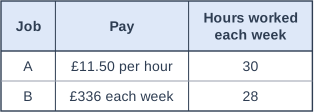
The table shows information about the two jobs.

Which job pays more for each hour worked?
Show how you decide.

Table with columns "Job", "Pay", "Hours worked each week". Job: A; Pay: £11.50 per hour; Hours worked each week: 30 | Job: B; Pay: £336 each week; Hours worked each week: 28.

Model answer

Job A pays £11.50 per hour.
Job B: \(336 \div 28 = 12\), so £12 per hour.
£12 is more than £11.50, so job B pays more for each hour worked.

Explanation

To compare rates of pay, find the pay for one hour in each job. Job B pays £336 for 28 hours, which is £12 an hour. Job A pays more each week only because it has more hours, so comparing weekly pay does not answer the question.

Mark scheme
  1. 1 mark

    M1 for \(336 \div 28\)

    Implied by 12. Or for \(11.50 \times 28 = 322\) compared with 336.

  2. 1 mark

    A1 for Job B, with £12 per hour compared with £11.50 per hour oe

    Job B with no working scores 0. Comparing only the weekly pay (£345 and £336) and choosing job A scores 0.

Question 3

2 marks

A bus travels 18 km in 45 minutes.

Hana works out the average speed of the bus.
She writes,

\(18 \div 45 = 0.4\), so the average speed is 0.4 km/h.

Explain Hana's mistake.
Work out the average speed of the bus in km/h.

Model answer

Hana divided by 45 minutes, so 0.4 is the distance in km per minute, not per hour.
45 minutes = 0.75 hours
Average speed = \(18 \div 0.75 = 24\) km/h
(Or: 0.4 km per minute \(\times 60 = 24\) km/h.)

Explanation

For a speed in km/h the time must be in hours, so 45 minutes is 0.75 hours. Another way: 45 minutes is three quarters of an hour, so in a quarter of an hour the bus goes 6 km and in a whole hour it goes 24 km. A speed of 0.4 km/h would be far too slow for a bus.

Mark scheme
  1. 1 mark

    B1 for she has divided by the time in minutes, not hours oe

    Accept 'her answer is in km per minute, not km per hour' or '45 minutes should be 0.75 hours'.

  2. 1 mark

    B1 for 24 (km/h)

    Independent of the explanation. E.g. from \(18 \div 0.75\) or \(0.4 \times 60\).

Question 4

3 marks

A solid cube has edges of length 2 cm.
The mass of the cube is 84 g.
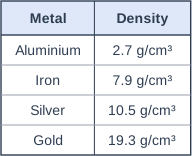
The cube is made from one of the metals in the table.

Ryan says,

"The cube is made of iron."

Is Ryan correct?
Show how you decide.

Table with columns "Metal", "Density". Metal: Aluminium; Density: 2.7 g/cm³ | Metal: Iron; Density: 7.9 g/cm³ | Metal: Silver; Density: 10.5 g/cm³ | Metal: Gold; Density: 19.3 g/cm³.

Model answer

Volume of the cube = \(2 \times 2 \times 2 = 8\) cm³
\(\text{density} = \text{mass} \div \text{volume} = 84 \div 8 = 10.5\) g/cm³
The density of iron is 7.9 g/cm³, not 10.5 g/cm³.
The cube is made of silver, so Ryan is not correct.

Explanation

Work out the volume of the cube (8 cm³), then its density, mass divided by volume, which is 10.5 g/cm³. This matches silver in the table, not iron. A common error is to use \(2 \times 2 = 4\) or \(2 \times 3 = 6\) for the volume of the cube.

Mark scheme
  1. 1 mark

    B1 for volume = 8 (cm³)

    From \(2 \times 2 \times 2\).

  2. 1 mark

    M1 for \(84 \div\) their 8

    Or for \(8 \times 7.9 = 63.2\) (the mass of an iron cube) compared with 84.

  3. 1 mark

    A1 for No, the density is 10.5 g/cm³ so it is silver

    Or No, an iron cube would have a mass of 63.2 g, not 84 g. No with no valid working scores 0. Using a volume of 6 or 4 scores B0.

Ready to try the rest? Every answer you write is marked against the mark scheme, so you can see exactly where the marks are.

Study Helper Hints first, answers after you try

Stuck on this one? Ask for a hint and I’ll point you in the right direction, without giving the answer away. Once you’ve checked your answer, I’ll show you how the marks are awarded.