Practise 14 exam-style questions on Direct proportion for OCR GCSE Maths (Foundation non-calculator). Write your answer as you would in the exam and get it marked in seconds against the mark scheme, point by point, with the Study Helper on hand if you get stuck.
14 questions
1–4 marks each
Instant marking
No sign-up needed
14 questions, marked as you go
Sample questions with model answers
Here are 4 of the questions in this topic, each with a model answer, an explanation of why it earns the marks and the mark scheme an examiner would use.
Question 1
1 mark
\(y\) is directly proportional to \(x\). The value of \(x\) is multiplied by 4.
Describe what happens to the value of \(y\).
Model answer
\(y = kx\), so if \(x\) is multiplied by 4, then \(y\) is multiplied by 4 as well. \(y\) is multiplied by 4.
Explanation
When y is directly proportional to x, y = kx, so whatever x is multiplied by, y is multiplied by the same number. A common error is to say that y goes up by 4, which confuses multiplying with adding.
Mark scheme
1 mark
B1 for \(y\) is multiplied by 4 oe
Accept 'y is 4 times as big' or 'y is quadrupled'. Do not accept 'y increases by 4', 'y increases' or 'y is multiplied by 16'.
Question 2
2 marks
Ella changes £200 into euros. The exchange rate is £1 = 1.15 euros.
On holiday she spends 150 euros.
How many euros does Ella have left?
Model answer
£200 = \(200 \times 1.15 = 230\) euros Euros left = \(230 - 150 = 80\) Ella has 80 euros left.
Explanation
£1 is worth 1.15 euros, so £200 is worth \(200 \times 1.15 = 230\) euros. Then subtract the 150 euros she spends. When changing pounds into euros at this rate you multiply, because each pound gives more than one euro.
Mark scheme
1 mark
M1 for \(200 \times 1.15\) (= 230)
correct answer with no working scores full marks
1 mark
A1 for 80 (euros)
80 with no working scores 2 marks. Dividing 200 by 1.15 scores 0.
Question 3
3 marks
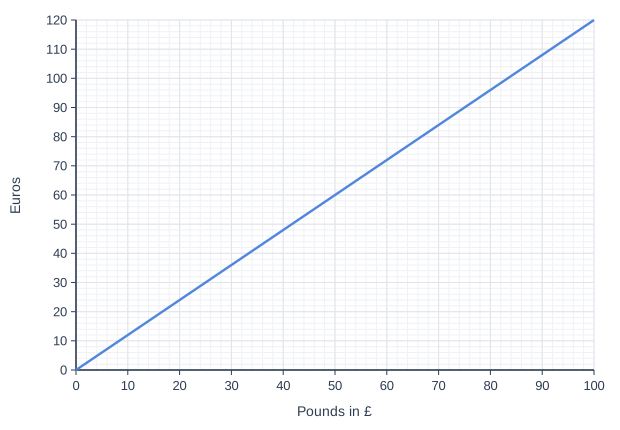
This conversion graph can be used to change between pounds (£) and euros.
Kai has 300 euros.
Use the graph to work out how many pounds this is worth.
Model answer
From the graph, 60 euros = £50. \(300 \div 60 = 5\) 300 euros = \(50 \times 5 = 250\) pounds Kai's euros are worth £250.
Explanation
300 euros is off the graph, so read a pair of values that is easy to scale, such as 60 euros = £50. 300 euros is 5 times 60 euros, so it is worth 5 times £50. A common error is to read the graph the wrong way, treating 300 as pounds.
Mark scheme
1 mark
B1 for a correct pair of values read from the graph, e.g. £50 = 60 euros or £100 = 120 euros
Any correct pair, e.g. £25 = 30 euros; correct answer with no working scores full marks
1 mark
M1 for scaling their pair to 300 euros, e.g. \(50 \times 5\) or \(100 \times 2.5\) or \(100 + 100 + 50\)
Their scale factor must come from dividing 300 by their number of euros.
1 mark
A1 for 250
Accept £250. 250 with no working scores 3 marks. 360 (changing 300 as if it were pounds) scores 0.
Question 4
4 marks
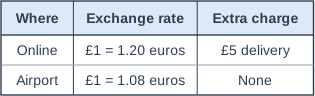
Sam needs 270 euros for a holiday. He can buy the euros online or at the airport. The table shows the exchange rate and the extra charge for each.
Which is the cheaper way for Sam to buy 270 euros? How much cheaper is it?
Model answer
Online: \(270 \div 1.20 = 225\), so £225 With the delivery charge: \(225 + 5 = 230\), so £230 Airport: \(270 \div 1.08 = 250\), so £250 \(250 - 230 = 20\) Online is cheaper, by £20.
Explanation
Sam knows how many euros he needs, so divide 270 by each rate to find the cost in pounds, and add the £5 charge to the online cost. Online costs £230 and the airport costs £250. A common error is to forget the delivery charge or to multiply by the exchange rate.
Mark scheme
1 mark
M1 for \(270 \div 1.20\) (= 225)
correct answer with no working scores full marks
1 mark
M1 for \(270 \div 1.08\) (= 250)
1 mark
M1 for their 225 + 5 (= 230) compared with their 250
The £5 must be added to the online cost.
1 mark
A1 for online, by £20
Both the choice and £20 needed. Online by £25 (charge not included) scores M1 M1 M0 A0. Multiplying 270 by the rates scores 0. Online, by £20 with no working scores 4 marks.
Ready to try the rest? Every answer you write is marked against the mark scheme, so you can see exactly where the marks are.
Ctrl + Enter to check
Study HelperHints first, answers after you try
Stuck on this one? Ask for a hint and I’ll point you in the right direction, without giving the answer away. Once you’ve checked your answer, I’ll show you how the marks are awarded.