Practise 15 exam-style questions on Simplifying expressions for OCR GCSE Maths (Foundation non-calculator). Write your answer as you would in the exam and get it marked in seconds against the mark scheme, point by point, with the Study Helper on hand if you get stuck.
15 questions
1–4 marks each
Instant marking
No sign-up needed
15 questions, marked as you go
Sample questions with model answers
Here are 4 of the questions in this topic, each with a model answer, an explanation of why it earns the marks and the mark scheme an examiner would use.
Question 1
1 mark
Simplify.
\(n \times n \times n \times 5\)
Model answer
\(n \times n \times n = n^3\) So \(n \times n \times n \times 5 = 5n^3\)
Explanation
Multiplying a letter by itself three times gives the third power, \(n^3\). The number is written in front of the letters, so the answer is \(5n^3\). A common error is to count the \(n\)s and write \(3n\), which means \(n + n + n\).
Mark scheme
1 mark
B1 for \(5n^3\)
Accept \(5 \times n^3\). Do not accept \(15n\), \(3n + 5\) or \(5 + n^3\).
Question 2
2 marks
Simplify.
\(2a^2 \times 5ab\)
Model answer
Numbers: \(2 \times 5 = 10\) \(a^2 \times a = a^3\) \(b\) stays as \(b\) Answer: \(10a^3b\)
Explanation
Multiply the numbers, then deal with each letter: \(a^2 \times a = a \times a \times a = a^3\), adding the powers 2 and 1. The \(b\) appears once, so it stays as \(b\). Common errors are adding the numbers (7) or forgetting that \(a\) on its own means \(a^1\).
Mark scheme
2 marks
B2 for \(10a^3b\)
Accept \(10ba^3\). B1 for a single term with two of the three parts \(10\), \(a^3\), \(b\) correct, e.g. \(10a^2b\), \(7a^3b\), \(10a^3\).
Question 3
2 marks
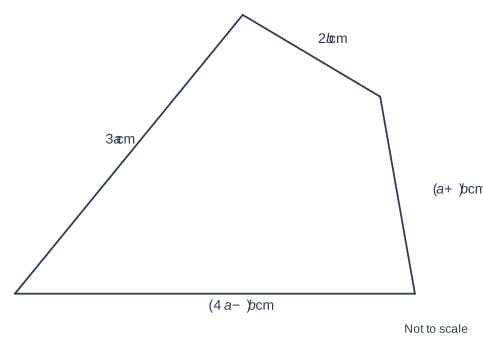
The diagram shows a quadrilateral. The lengths of its sides are given in centimetres.
Find an expression for the perimeter of the quadrilateral. Give your answer in its simplest form.
Model answer
Perimeter \(= 3a + 2b + (a + b) + (4a - b)\) \(a\) terms: \(3a + a + 4a = 8a\) \(b\) terms: \(2b + b - b = 2b\) Perimeter \(= 8a + 2b\) cm
Explanation
Add all four sides, then collect the \(a\) terms and the \(b\) terms separately. The \(-b\) from the last side cancels one of the \(b\)s, leaving \(2b\). A common error is to ignore the minus sign and get \(4b\).
Mark scheme
2 marks
B2 for \(8a + 2b\)
Ignore units. Accept \(2(4a + b)\). B1 for \(8a + kb\) or \(ka + 2b\), or for \(3a + 2b + a + b + 4a - b\) oe seen.
Question 4
4 marks
The perimeter of a rectangle is \((10a + 6b)\) cm. The length of the rectangle is \((3a + 2b)\) cm.
Find an expression for the width of the rectangle. Give your answer in its simplest form.
The perimeter is two lengths plus two widths. Take away both lengths, then halve what is left to get one width; or halve the perimeter first (one length plus one width) and take away one length. A common error is to subtract only one length from the whole perimeter.
Mark scheme
1 mark
M1 for \(2 \times (3a + 2b)\) or \(6a + 4b\)
The two lengths together. Alternative method: M2 for half the perimeter \(5a + 3b\), then M1 for \(5a + 3b - (3a + 2b)\), A1 for \(2a + b\); correct answer with no working scores full marks
1 mark
M1 for \(10a + 6b - (6a + 4b)\) or \(4a + 2b\)
FT their total of the two lengths.
1 mark
M1 for their \((4a + 2b) \div 2\)
Dividing the remaining perimeter between the two widths.
1 mark
A1 for \(2a + b\)
Ignore units. Common wrong answers: \(7a + 4b\) (subtracting only one length from the perimeter) and \(3.5a + 2b\) (subtracting one length, then halving) each score 0.
Ready to try the rest? Every answer you write is marked against the mark scheme, so you can see exactly where the marks are.
Ctrl + Enter to check
Study HelperHints first, answers after you try
Stuck on this one? Ask for a hint and I’ll point you in the right direction, without giving the answer away. Once you’ve checked your answer, I’ll show you how the marks are awarded.