
Level:
Correct: 0
Incorrect: 0
Marks: 0/0
Exam Practice
Course:
Topics:
OCR GCSE Maths (Foundation non-calculator) Smart practice A mixed round aimed at your weak spots
Unit 1
Number Operations and Integers
Unit 2
Fractions, Decimals and Percentages
Unit 3
Indices and Surds
Unit 4
Approximation and Estimation
Unit 5
Ratio, Proportion and Rates of Change
Unit 6
Algebra
Unit 7
Graphs of Equations and Functions
Unit 8
Basic Geometry
Unit 9
Congruence and Similarity
Unit 10
Mensuration
Unit 11
Probability
Unit 12
Statistics
Avg
score:
–
Topics
done:
0/100

Fractions of an amount

Practise 15 exam-style questions on Fractions of an amount for OCR GCSE Maths (Foundation non-calculator). Write your answer as you would in the exam and get it marked in seconds against the mark scheme, point by point, with the Study Helper on hand if you get stuck.

  • 15 questions
  • 1–4 marks each
  • Instant marking
  • No sign-up needed
15 questions, marked as you go

Sample questions with model answers

Here are 4 of the questions in this topic, each with a model answer, an explanation of why it earns the marks and the mark scheme an examiner would use.

Question 1

1 mark

How many minutes are there in \(\dfrac{2}{3}\) of an hour?

Model answer

1 hour = 60 minutes
\(60 \div 3 = 20\)
\(20 \times 2 = 40\) minutes

Explanation

An hour is 60 minutes. Find one third (divide by 3) and then two thirds (multiply by 2). A common error is to stop at one third, 20 minutes.

Mark scheme
  1. 1 mark

    B1 for 40

    Accept 40 minutes. 20 (one third only) or 90 (\(60 \div 2 \times 3\)) score 0.
Question 2

2 marks

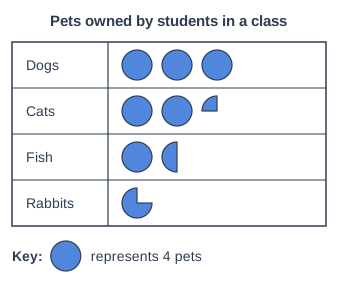
The pictogram shows the number of each type of pet owned by the students in a class.

What fraction of the pets are cats?
Give your answer in its simplest form.

Pictogram titled "Pets owned by students in a class", a table with 4 rows of circle symbols. Key: one circle represents 4 pets. Dogs: 3 circles. Cats: 2 and a quarter circles. Fish: 1 and a half circles. Rabbits: three quarters of a circle.

Model answer

Each circle represents 4 pets.
Dogs = 12, cats = 9, fish = 6, rabbits = 3
Total = 12 + 9 + 6 + 3 = 30 pets
Fraction that are cats \(= \dfrac{9}{30} = \dfrac{3}{10}\)

Explanation

Use the key to read each row: a quarter of a circle is 1 pet, so 2 and a quarter circles is 9 cats. Add all the rows to find the total, then write the number of cats over the total and simplify. A common error is to count the symbols instead of the pets they represent.

Mark scheme
  1. 1 mark

    M1 for \(\dfrac{9}{30}\) oe

    Or for 9 (cats) and 30 (total) both seen. FT their total from their readings of the pictogram, with 9 cats; correct answer with no working scores full marks

  2. 1 mark

    A1 for \(\dfrac{3}{10}\) cao

    Correct answer with no working scores 2 marks. \(\dfrac{9}{21}\) or \(\dfrac{3}{7}\) (cats as a fraction of the other pets) scores 0. Do not accept 0.3 or 30%.

Question 3

2 marks

Holly wants to write 40 minutes as a fraction of 1 hour 20 minutes.
She writes

\(\dfrac{40}{120} = \dfrac{1}{3}\)

Is Holly correct?
Show how you decide.

Model answer

1 hour 20 minutes = 60 + 20 = 80 minutes, not 120 minutes.
\(\dfrac{40}{80} = \dfrac{1}{2}\)
Holly is not correct: 40 minutes is \(\dfrac{1}{2}\) of 1 hour 20 minutes.

Explanation

Both quantities must be in the same units before writing one as a fraction of the other. There are 60 minutes in an hour, so 1 hour 20 minutes is 80 minutes. Holly has treated 1 hour 20 minutes as if it were 120 minutes.

Mark scheme
  1. 1 mark

    M1 for 1 hour 20 minutes = 80 minutes

    Or for \(\dfrac{40}{80}\) seen.

  2. 1 mark

    A1 for No, with \(\dfrac{1}{2}\) oe

    Accept 'No, 1 hour 20 minutes is 80 minutes, not 120 minutes, so the fraction is \(\dfrac{40}{80}\)'. 'No' with no supporting working scores 0.

Question 4

4 marks

A car park has 180 spaces.
At 9 am, \(\dfrac{5}{6}\) of the spaces have a car in them.

Between 9 am and 12 noon:
\(\dfrac{3}{5}\) of these cars leave the car park
25 more cars arrive.
No other cars arrive or leave.

What fraction of the spaces have a car in them at 12 noon?
Give your answer in its simplest form.

Model answer

Cars at 9 am \(= 180 \div 6 \times 5 = 150\)
Cars that leave \(= 150 \div 5 \times 3 = 90\)
Cars left \(= 150 - 90 = 60\)
Cars at 12 noon \(= 60 + 25 = 85\)
Fraction \(= \dfrac{85}{180} = \dfrac{17}{36}\)

Explanation

Work step by step: \(\dfrac{5}{6}\) of 180 spaces is 150 cars; \(\dfrac{3}{5}\) of those 150 cars leave, so 60 stay; then add the 25 that arrive. Finally write 85 over the 180 spaces and simplify by dividing by 5. A common error is to take \(\dfrac{3}{5}\) of the 180 spaces instead of \(\dfrac{3}{5}\) of the 150 cars.

Mark scheme
  1. 1 mark

    M1 for \(180 \div 6 \times 5\) or 150 seen

    Number of cars at 9 am; correct answer with no working scores full marks

  2. 1 mark

    M1 for their \(150 \times \dfrac{2}{5}\) or their \(150 - 150 \times \dfrac{3}{5}\) oe

    Implied by 60 cars left (or 90 cars leaving followed by a subtraction).

  3. 1 mark

    M1 for (their 60 + 25) written as a fraction of 180

    Implied by \(\dfrac{85}{180}\). FT their number of cars left.

  4. 1 mark

    A1 for \(\dfrac{17}{36}\) cao

    Correct answer with no working scores 4 marks. \(\dfrac{85}{180}\) not simplified scores M1 M1 M1 A0. \(\dfrac{115}{180}\) or \(\dfrac{23}{36}\) (using the 90 cars that left instead of the 60 that stayed) scores M1 M0 M1 A0.

Ready to try the rest? Every answer you write is marked against the mark scheme, so you can see exactly where the marks are.

Study Helper Hints first, answers after you try

Stuck on this one? Ask for a hint and I’ll point you in the right direction, without giving the answer away. Once you’ve checked your answer, I’ll show you how the marks are awarded.