
Level:
Correct: 0
Incorrect: 0
Marks: 0/0
Exam Practice
Course:
Topics:
OCR GCSE Maths (Foundation non-calculator) Smart practice A mixed round aimed at your weak spots
Unit 1
Number Operations and Integers
Unit 2
Fractions, Decimals and Percentages
Unit 3
Indices and Surds
Unit 4
Approximation and Estimation
Unit 5
Ratio, Proportion and Rates of Change
Unit 6
Algebra
Unit 7
Graphs of Equations and Functions
Unit 8
Basic Geometry
Unit 9
Congruence and Similarity
Unit 10
Mensuration
Unit 11
Probability
Unit 12
Statistics
Avg
score:
–
Topics
done:
0/100

Relative frequency

Practise 14 exam-style questions on Relative frequency for OCR GCSE Maths (Foundation non-calculator). Write your answer as you would in the exam and get it marked in seconds against the mark scheme, point by point, with the Study Helper on hand if you get stuck.

  • 14 questions
  • 1–4 marks each
  • Instant marking
  • No sign-up needed
14 questions, marked as you go

Sample questions with model answers

Here are 4 of the questions in this topic, each with a model answer, an explanation of why it earns the marks and the mark scheme an examiner would use.

Question 1

1 mark

Tia and Kai each drop the same paper cup to see if it lands on its side.

Tia drops the cup 20 times. It lands on its side 13 times.
Kai drops the cup 200 times. It lands on its side 118 times.

Whose results give the better estimate of the probability that the cup lands on its side?
Give a reason for your answer.

Model answer

Kai's results, because he dropped the cup many more times (200 compared with 20).
The more trials there are, the more reliable the relative frequency is as an estimate of the probability.

Explanation

Relative frequency gets closer to the true probability as the number of trials increases, so the experiment with more trials gives the better estimate. With only 20 drops, Tia's result could easily be affected by chance. The number of times the cup landed on its side is not the reason on its own.

Mark scheme
  1. 1 mark

    B1 for Kai, as he did more trials oe

    Accept 'Kai, because he dropped it 200 times, which is more than 20'. 'Kai' with no reason or with an incorrect reason (e.g. 'because 118 is more than 13') scores 0.
Question 2

2 marks

Erin drops a drawing pin 250 times.
It lands point up 90 times.
The rest of the time it lands point down.

Use Erin's results to estimate the probability that the drawing pin lands point down.
Give your answer as a fraction in its simplest form.

Model answer

Number of times point down = \(250 - 90 = 160\)
Estimated probability = \(\dfrac{160}{250} = \dfrac{16}{25}\)

Explanation

The relative frequency of point down is used as the estimate of the probability. First find how many times it landed point down, then divide by the total number of drops and simplify by dividing the top and bottom by 10. A common error is to give the relative frequency of point up instead.

Mark scheme
  1. 1 mark

    M1 for \(\dfrac{160}{250}\) oe

    Or \(1 - \dfrac{90}{250}\). Implied by 0.64.

  2. 1 mark

    A1 for \(\dfrac{16}{25}\)

    0.64 or \(\dfrac{160}{250}\) as the final answer scores M1 A0. \(\dfrac{9}{25}\) (point up) scores M0 A0.

Question 3

2 marks

A dentist recorded information about 80 patients.
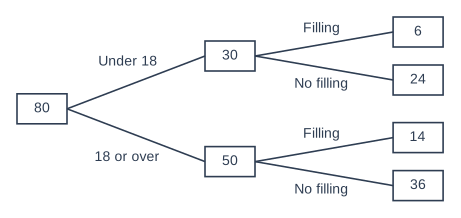
The frequency tree shows whether each patient was under 18 or 18 or over, and whether they needed a filling.

Use the frequency tree to estimate the probability that the dentist's next patient is 18 or over and needs a filling.

A frequency tree drawn from left to right with 2 stages of branches. It starts from a box containing 80 on the left. From the first box, branches labelled "Under 18" and "18 or over" lead to a box containing 30 and a box containing 50 respectively. From the "Under 18" box, branches labelled "Filling" and "No filling" lead to a box containing 6 and a box containing 24 respectively. From the "18 or over" box, branches labelled "Filling" and "No filling" lead to a box containing 14 and a box containing 36 respectively.

Model answer

Patients who are 18 or over and needed a filling = 14
Total number of patients = 80
Estimated probability = \(\dfrac{14}{80} = \dfrac{7}{40}\)

Explanation

Follow the branches '18 or over' then 'Filling' to find the 14 patients who are in both groups. The next patient could be any patient, so divide by the total, 80. A common error is to divide by the 50 patients aged 18 or over.

Mark scheme
  1. 1 mark

    M1 for 14 as the numerator or 80 as the denominator of a fraction

    \(\dfrac{14}{50}\) or \(\dfrac{20}{80}\) (all fillings) scores M1 A0.

  2. 1 mark

    A1 for \(\dfrac{14}{80}\) oe

    Accept \(\dfrac{7}{40}\), 0.175 or 17.5%.

Question 4

4 marks

120 learners took a driving test.
70 of the learners were female and the rest were male.
48 of the female learners passed.
15 of the male learners failed.

Were the female learners or the male learners more likely to pass the test?
Show how you decide.

Model answer

Male learners: \(120 - 70 = 50\)
Male learners who passed: \(50 - 15 = 35\)
Female: \(\dfrac{48}{70}\) passed
Male: \(\dfrac{35}{50} = \dfrac{49}{70}\) passed
\(\dfrac{49}{70}\) is greater than \(\dfrac{48}{70}\), so the male learners were more likely to pass.

Explanation

A frequency tree helps to organise the information: 70 female (48 pass, 22 fail) and 50 male (35 pass, 15 fail). To compare how likely each group was to pass, compare the fractions who passed, not the numbers who passed, because the groups are different sizes. More females passed (48 compared with 35), but a slightly greater proportion of males passed.

Mark scheme
  1. 1 mark

    M1 for \(120 - 70\) or 50 male learners

    May be seen in a frequency tree.

  2. 1 mark

    M1 for their \(50 - 15\) or 35 males passed

  3. 1 mark

    M1 for comparing \(\dfrac{48}{70}\) with \(\dfrac{35}{50}\) using a correct method

    For example a common denominator \(\dfrac{48}{70}\) and \(\dfrac{49}{70}\), or decimals 0.68... and 0.7, or percentages 68.6% and 70%. FT their 35 and 50.

  4. 1 mark

    A1 for male, with correct values

    Comparing 48 with 35 (numbers, not proportions) scores M1 M1 M0 A0.

Ready to try the rest? Every answer you write is marked against the mark scheme, so you can see exactly where the marks are.

Study Helper Hints first, answers after you try

Stuck on this one? Ask for a hint and I’ll point you in the right direction, without giving the answer away. Once you’ve checked your answer, I’ll show you how the marks are awarded.