
Level:
Correct: 0
Incorrect: 0
Marks: 0/0
Exam Practice
Course:
Topics:
OCR GCSE Maths (Foundation non-calculator) Smart practice A mixed round aimed at your weak spots
Unit 1
Number Operations and Integers
Unit 2
Fractions, Decimals and Percentages
Unit 3
Indices and Surds
Unit 4
Approximation and Estimation
Unit 5
Ratio, Proportion and Rates of Change
Unit 6
Algebra
Unit 7
Graphs of Equations and Functions
Unit 8
Basic Geometry
Unit 9
Congruence and Similarity
Unit 10
Mensuration
Unit 11
Probability
Unit 12
Statistics
Avg
score:
–
Topics
done:
0/100

Independent events and conditional probability

Practise 13 exam-style questions on Independent events and conditional probability for OCR GCSE Maths (Foundation non-calculator). Write your answer as you would in the exam and get it marked in seconds against the mark scheme, point by point, with the Study Helper on hand if you get stuck.

  • 13 questions
  • 1–4 marks each
  • Instant marking
  • No sign-up needed
13 questions, marked as you go

Sample questions with model answers

Here are 4 of the questions in this topic, each with a model answer, an explanation of why it earns the marks and the mark scheme an examiner would use.

Question 1

2 marks

Nadia spins a biased spinner and flips a fair coin.

The probability that the spinner lands on red is 0.3.
The spinner and the coin are independent.

Work out the probability that the spinner lands on red and the coin lands on heads.

Model answer

P(heads) = 0.5
The events are independent, so multiply:
P(red and heads) = 0.3 × 0.5 = 0.15

Explanation

When two events are independent, the probability that both happen is the product of their probabilities. Half of 0.3 is 0.15. Adding the probabilities would give an answer bigger than either one, which cannot be right for 'both'.

Mark scheme
  1. 1 mark

    M1 for 0.3 × 0.5 oe

    Or \(0.3 \times \dfrac{1}{2}\); correct answer with no working scores full marks

  2. 1 mark

    A1 for 0.15

    Accept \(\dfrac{3}{20}\) or 15%. A correct answer with no working scores 2 marks. 0.8 (from 0.3 + 0.5) scores 0.
Question 2

2 marks

The probability that it rains on Saturday is 0.3.
If it rains on Saturday, the probability that a football match is cancelled is 0.6.

Work out the probability that it rains on Saturday and the match is cancelled.

Model answer

First it must rain: probability 0.3.
Then, when it has rained, the match is cancelled with probability 0.6.
P(rains and cancelled) = 0.3 × 0.6 = 0.18

Explanation

The cancellation depends on the weather, but the probability 0.6 already tells you what happens when it has rained, so multiply along this path as on a tree diagram. 3 × 6 = 18, so 0.3 × 0.6 = 0.18.

Mark scheme
  1. 1 mark

    M1 for 0.3 × 0.6

    correct answer with no working scores full marks

  2. 1 mark

    A1 for 0.18

    Accept \(\dfrac{18}{100}\) oe. A correct answer with no working scores 2 marks. 0.9 (from 0.3 + 0.6) scores 0. 1.8 scores M1 A0.

Question 3

3 marks

On her way to work, Ali drives through three sets of traffic lights.
The lights work independently.

The probabilities that the lights are green when she reaches them are:
first set 0.5   second set 0.6   third set 0.8

Ali has to stop at a set of lights if they are not green.

Work out the probability that Ali has to stop at least once on her way to work.

Model answer

Ali does not stop at all only if all three sets are green.
P(all green) = 0.5 × 0.6 × 0.8 = 0.24
P(stops at least once) = 1 − 0.24 = 0.76

Explanation

'At least once' includes stopping once, twice or three times, which is many paths on a tree diagram. It is quicker to use the opposite event, 'never stops', which is just all three green. Multiply because the lights are independent, then subtract from 1.

Mark scheme
  1. 1 mark

    M1 for 0.5 × 0.6 × 0.8

    P(all three green); correct answer with no working scores full marks

  2. 1 mark

    M1 for 1 − their 0.24

  3. 1 mark

    A1 for 0.76

    Accept \(\dfrac{76}{100}\) oe. A correct answer with no working scores 3 marks. 0.24 as the final answer scores M1 M0 A0. 0.04 (from 0.5 × 0.4 × 0.2, stopping at all three) scores 0.

Question 4

4 marks

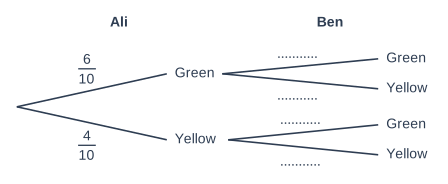
A bag contains 6 green balls and 4 yellow balls.

Ali takes a ball at random from the bag and keeps it.
Ben then takes a ball at random from the balls left in the bag.

The tree diagram shows the first set of probabilities.

Work out the probability that Ben's ball is yellow.

A probability tree diagram drawn from left to right with 2 stages of branches, headed "Ali" and "Ben". Each branch has its outcome written at its end and its probability written beside it. First stage, 2 branches: "Green" with probability 6/10, "Yellow" with probability 4/10. After "Green", the second stage branches are "Green" with probability left blank (a dotted line to fill in), "Yellow" with probability left blank (a dotted line to fill in). After "Yellow", the second stage branches are "Green" with probability left blank (a dotted line to fill in), "Yellow" with probability left blank (a dotted line to fill in).

Model answer

Ali green, then Ben yellow: \(\dfrac{6}{10} \times \dfrac{4}{9} = \dfrac{24}{90}\)
Ali yellow, then Ben yellow: \(\dfrac{4}{10} \times \dfrac{3}{9} = \dfrac{12}{90}\)
P(Ben's ball is yellow) = \(\dfrac{24}{90} + \dfrac{12}{90} = \dfrac{36}{90} = \dfrac{2}{5}\)

Explanation

Ben's probability depends on what Ali took, so there are two paths: Ali green (then 4 of the 9 balls left are yellow) and Ali yellow (then 3 of 9 are yellow). Multiply along each path and add. Interestingly, the answer, 2/5, is the same as Ali's probability of yellow, 4/10.

Mark scheme
  1. 1 mark

    M1 for \(\dfrac{6}{10} \times \dfrac{4}{9}\) or \(\dfrac{24}{90}\)

    Ali green, Ben yellow; correct answer with no working scores full marks

  2. 1 mark

    M1 for \(\dfrac{4}{10} \times \dfrac{3}{9}\) or \(\dfrac{12}{90}\)

    Ali yellow, Ben yellow.

  3. 1 mark

    M1 for their \(\dfrac{24}{90}\) + their \(\dfrac{12}{90}\)

    Both paths ending in yellow for Ben.

  4. 1 mark

    A1 for \(\dfrac{36}{90}\) oe

    Accept \(\dfrac{2}{5}\) or 0.4. A correct answer with no working scores 4 marks. \(\dfrac{4}{9}\) or \(\dfrac{3}{9}\) on its own scores 0. \(\dfrac{12}{90}\) (both yellow only) scores M0 M1 M0 A0.

Ready to try the rest? Every answer you write is marked against the mark scheme, so you can see exactly where the marks are.

Study Helper Hints first, answers after you try

Stuck on this one? Ask for a hint and I’ll point you in the right direction, without giving the answer away. Once you’ve checked your answer, I’ll show you how the marks are awarded.