
Level:
Correct: 0
Incorrect: 0
Marks: 0/0
Exam Practice
Course:
Topics:
OCR GCSE Maths (Foundation non-calculator) Smart practice A mixed round aimed at your weak spots
Unit 1
Number Operations and Integers
Unit 2
Fractions, Decimals and Percentages
Unit 3
Indices and Surds
Unit 4
Approximation and Estimation
Unit 5
Ratio, Proportion and Rates of Change
Unit 6
Algebra
Unit 7
Graphs of Equations and Functions
Unit 8
Basic Geometry
Unit 9
Congruence and Similarity
Unit 10
Mensuration
Unit 11
Probability
Unit 12
Statistics
Avg
score:
–
Topics
done:
0/100

Percentages of amounts

Practise 16 exam-style questions on Percentages of amounts for OCR GCSE Maths (Foundation non-calculator). Write your answer as you would in the exam and get it marked in seconds against the mark scheme, point by point, with the Study Helper on hand if you get stuck.

  • 16 questions
  • 1–4 marks each
  • Instant marking
  • No sign-up needed
16 questions, marked as you go

Sample questions with model answers

Here are 4 of the questions in this topic, each with a model answer, an explanation of why it earns the marks and the mark scheme an examiner would use.

Question 1

1 mark

Mia says

"Finding 20% of an amount is the same as dividing the amount by 5."

Explain why Mia is correct.

Model answer

\(20\% = \dfrac{20}{100} = \dfrac{1}{5}\)
Finding \(\dfrac{1}{5}\) of an amount means dividing it into 5 equal parts, so finding 20% is the same as dividing by 5.

Explanation

Percentages can be written as fractions: \(20\% = \dfrac{20}{100}\), which simplifies to \(\dfrac{1}{5}\). One example only shows the rule works once; an explanation must show why it always works, for example because 5 lots of 20% make 100%.

Mark scheme
  1. 1 mark

    B1 for a correct explanation

    e.g. '20% = \(\dfrac{20}{100} = \dfrac{1}{5}\), and finding \(\dfrac{1}{5}\) of an amount means dividing by 5' or '100% is 5 lots of 20%, so 20% is the whole divided by 5'. An example on its own (e.g. 20% of \(50 = 10\) and \(50 \div 5 = 10\)) does not explain why, so scores 0.
Question 2

2 marks

Ella scores 42 out of 50 in a test.

What is her score as a percentage?

Model answer

\(\dfrac{42}{50} = \dfrac{84}{100}\)
\(\dfrac{84}{100} = 84\%\)

Explanation

Write the score as a fraction of the total, \(\dfrac{42}{50}\), then make the denominator 100 by multiplying the top and bottom by 2. 84 out of 100 is 84%. A common error is to give 42%, ignoring that the test is out of 50, not 100.

Mark scheme
  1. 1 mark

    M1 for \(\dfrac{42}{50}\) oe

    Or \(\dfrac{84}{100}\) or \(42 \times 2\) or \(42 \div 50 \times 100\) or 0.84 seen; correct answer with no working scores full marks

  2. 1 mark

    A1 for 84%

    Accept 84. Correct answer with no working scores 2 marks. 42% scores 0.

Question 3

2 marks

Kim's car journey takes 2 hours of driving.
She stops for a break after 36 minutes of driving.

What percentage of the driving time had Kim completed when she stopped?

Model answer

2 hours = 120 minutes
\(\dfrac{36}{120} = \dfrac{3}{10} = \dfrac{30}{100} = 30\%\)

Explanation

Both quantities must be in the same units before you write one as a percentage of the other, so change 2 hours to 120 minutes. Then simplify \(\dfrac{36}{120}\) and change it to hundredths. A common error is to treat 2 hours as 200 minutes.

Mark scheme
  1. 1 mark

    M1 for \(\dfrac{36}{120}\) oe

    Both times in minutes. Or \(36 \div 120 \times 100\) or \(\dfrac{3}{10}\) or 0.3 seen; correct answer with no working scores full marks

  2. 1 mark

    A1 for 30%

    Accept 30. Correct answer with no working scores 2 marks. 18% (from \(\dfrac{36}{200}\)) or 1800% (from \(\dfrac{36}{2}\)) score 0.

Question 4

4 marks

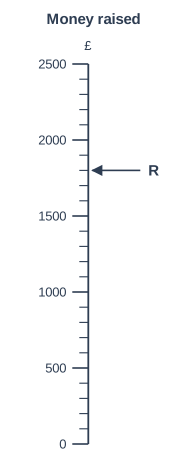
Arrow R on the diagram shows how much money a school has raised so far for a new minibus.
The target is to raise £2500.

The school wants to raise 90% of the target by the end of the month.

How much more money does the school need to raise by the end of the month?

Money raised. A vertical scale from 0 to 2500 £, divided into 5 equal parts by long marks, each split into 5 small divisions by short marks. Every long mark is numbered (0, 500, 1000, 1500, 2000 and 2500). An arrow labelled R points to a mark on the scale.

Model answer

Each small division on the scale is £100, so arrow R shows that the school has raised £1800.
10% of £2500 = £250
90% of £2500 \(= 2500 - 250 = 2250\)
Money still needed \(= 2250 - 1800 = 450\)
The school needs to raise £450 more.

Explanation

First read the scale carefully: there are 5 small divisions between £1500 and £2000, so each is £100 and the arrow is at £1800. Then find 90% of the target (100% - 10%) and subtract what has already been raised. A common error is to subtract from the whole £2500 target.

Mark scheme
  1. 1 mark

    B1 for £1800 read from the diagram

    Implied by a correct final answer; correct answer with no working scores full marks

  2. 1 mark

    M1 for 90% of 2500 attempted

    e.g. \(2500 - 250\) or \(9 \times 250\) or \(0.9 \times 2500\).

  3. 1 mark

    A1 for 2250

    90% of the target. Implied by 450 from a correct reading.

  4. 1 mark

    B1 for £450

    FT 2250 − their reading, or their 90% of the target − 1800. Correct answer with no working scores 4 marks. £700 (\(2500 - 1800\), the amount to reach the whole target) scores B1 M0 A0 B0.

Ready to try the rest? Every answer you write is marked against the mark scheme, so you can see exactly where the marks are.

Study Helper Hints first, answers after you try

Stuck on this one? Ask for a hint and I’ll point you in the right direction, without giving the answer away. Once you’ve checked your answer, I’ll show you how the marks are awarded.