Practise 15 exam-style questions on Calculating with decimals for OCR GCSE Maths (Foundation non-calculator). Write your answer as you would in the exam and get it marked in seconds against the mark scheme, point by point, with the Study Helper on hand if you get stuck.
15 questions
1–4 marks each
Instant marking
No sign-up needed
15 questions, marked as you go
Sample questions with model answers
Here are 4 of the questions in this topic, each with a model answer, an explanation of why it earns the marks and the mark scheme an examiner would use.
Question 1
1 mark
Work out \(7 - 2.36\).
Model answer
Write 7 as 7.00 \(7.00 - 2.36 = 4.64\)
Explanation
Write the whole number with the same number of decimal places, 7.00, and line up the decimal points before subtracting. You can check by adding: \(4.64 + 2.36 = 7\). A common error is to subtract the smaller digit from the bigger one in each column.
Mark scheme
1 mark
B1 for 4.64
cao. 5.36 or 5.74 (subtracting the digits the wrong way round) score 0.
Question 2
2 marks
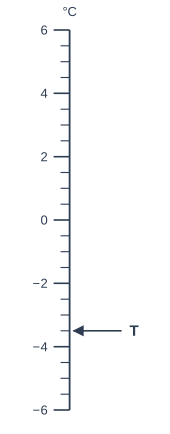
Arrow T on the thermometer shows the temperature in a garden at 6 am.
By 2 pm the temperature had gone up by 8.3 °C.
Work out the temperature at 2 pm.
Model answer
Each small division on the thermometer is 0.5 °C. At 6 am the temperature was \(-3.5\) °C. \(-3.5 + 8.3 = 4.8\) The temperature at 2 pm was 4.8 °C.
Explanation
Work out the scale first: there are 4 small divisions between −4 and −2, so each one is 0.5 °C, and the arrow is at −3.5 °C. Going up 8.3 °C means adding: 3.5 of it takes the temperature up to 0, and the other 4.8 takes it to 4.8 °C.
Mark scheme
1 mark
B1 for −3.5 read from the thermometer
Implied by a correct final answer. −2.5 or −4.5 or −3.4 score B0; correct answer with no working scores full marks
1 mark
B1 for 4.8
Accept 4.8 °C. FT their reading + 8.3, provided their reading is negative. −11.8 (subtracting) scores B0 for this mark.
Question 3
2 marks
Work out \(1.8 \div 0.06\).
Model answer
Multiply both numbers by 100: \(1.8 \div 0.06 = 180 \div 6\) \(180 \div 6 = 30\)
Explanation
To divide by a decimal, multiply both numbers by 10, 100 or 1000 until the divisor is a whole number; the answer stays the same. Here multiplying by 100 gives \(180 \div 6 = 30\). Check: \(30 \times 0.06 = 1.8\). Multiplying only one of the numbers gives an answer that is 10 or 100 times too big or too small.
Mark scheme
1 mark
M1 for \(180 \div 6\) oe
Both numbers multiplied by 100 so that the divisor is a whole number, or the fraction 180 over 6 seen; correct answer with no working scores full marks
1 mark
A1 for 30
Correct answer with no working scores 2 marks. 3 or 0.3 or 300 scores M0 A0 unless \(180 \div 6\) is seen.
Question 4
4 marks
Lucy's car travels 9.6 km on 0.8 litres of petrol. Petrol costs £1.40 per litre.
Lucy drives 150 km. Work out the cost of the petrol she uses.
Model answer
Distance per litre \(= 9.6 \div 0.8 = 96 \div 8 = 12\) km Petrol used \(= 150 \div 12 = 12.5\) litres Cost \(= 12.5 \times 1.40 = 17.50\) The petrol costs £17.50
Explanation
First find how far the car goes on 1 litre by dividing by the decimal 0.8 (multiply both numbers by 10: \(96 \div 8 = 12\) km). Then 150 km needs \(150 \div 12 = 12.5\) litres, which costs 12.5 lots of £1.40, that is £17.50. A common error is to stop after finding the number of litres.
Mark scheme
1 mark
M1 for \(9.6 \div 0.8\) oe
Or \(96 \div 8\), or \(150 \div 9.6\) (= 15.625, the number of lots of 9.6 km); correct answer with no working scores full marks
1 mark
A1 for 12 (km per litre)
Or 15.625 as the number of lots of 9.6 km.
1 mark
M1 for \(150 \div\) their 12 \(\times 1.40\) oe
Or their \(12.5 \times 1.40\), or their \(15.625 \times 0.8 \times 1.40\). Implied by 12.5 litres seen and multiplied by 1.40.
1 mark
A1 for £17.50
Accept 17.5. Correct answer with no working scores 4 marks. 12.5 (litres) as the final answer scores M1 A1 M0 A0.
Ready to try the rest? Every answer you write is marked against the mark scheme, so you can see exactly where the marks are.
Ctrl + Enter to check
Study HelperHints first, answers after you try
Stuck on this one? Ask for a hint and I’ll point you in the right direction, without giving the answer away. Once you’ve checked your answer, I’ll show you how the marks are awarded.