Practise 14 exam-style questions on Area of a triangle for OCR GCSE Maths (Foundation non-calculator). Write your answer as you would in the exam and get it marked in seconds against the mark scheme, point by point, with the Study Helper on hand if you get stuck.
14 questions
1–4 marks each
Instant marking
No sign-up needed
14 questions, marked as you go
Sample questions with model answers
Here are 4 of the questions in this topic, each with a model answer, an explanation of why it earns the marks and the mark scheme an examiner would use.
Question 1
1 mark
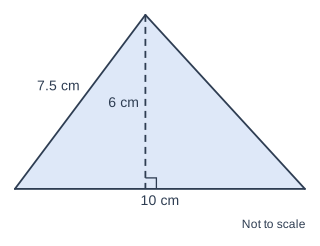
The diagram shows a triangle.
Which calculation works out the area of the triangle?
Choose your answer.
\(10 \times 6\)
\(\dfrac{1}{2} \times 10 \times 7.5\)
\(\dfrac{1}{2} \times 10 \times 6\)
\(\dfrac{1}{2} \times 7.5 \times 6\)
Model answer
The 6 cm line is perpendicular to the 10 cm base, so it is the height. Area = \(\dfrac{1}{2} \times 10 \times 6\)
Explanation
The height of a triangle must be perpendicular (at right angles) to the base. The 7.5 cm side slopes, so it is not the height; the dashed 6 cm line meets the base at a right angle. Then halve base times height. Using the sloping side is the most common error.
Mark scheme
1 mark
B1 for \(\dfrac{1}{2} \times 10 \times 6\)
Accept the answer 30 if it is clearly from this calculation. \(10 \times 6\) (not halved), \(\dfrac{1}{2} \times 10 \times 7.5\) (sloping side used as the height) and \(\dfrac{1}{2} \times 7.5 \times 6\) score 0. More than one answer chosen scores 0.
Question 2
2 marks
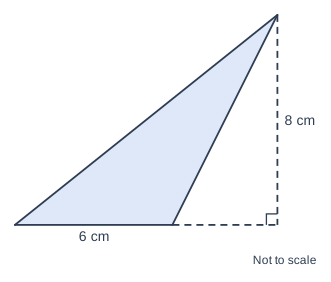
The diagram shows a shaded triangle. The base of the triangle is 6 cm. The perpendicular height of the triangle is 8 cm. The height is shown outside the triangle by the dashed lines.
Work out the area of the shaded triangle.
Model answer
Area = \(\dfrac{1}{2} \times\) base \(\times\) perpendicular height = \(\dfrac{1}{2} \times 6 \times 8\) = 24 cm²
Explanation
The perpendicular height is the distance from the top vertex straight down to the line of the base, even when that falls outside the triangle. So the area is still half of 6 times 8. Do not add any extra length to the base: only the side of the triangle itself, 6 cm, is the base.
Mark scheme
1 mark
M1 for \(\dfrac{1}{2} \times 6 \times 8\) oe
Accept \(6 \times 8 \div 2\) or \(3 \times 8\); correct answer with no working scores full marks
1 mark
A1 for 24
Accept 24 cm². 48 (not halved) scores M0 A0.
Question 3
3 marks
Ruby makes a string of bunting from 12 triangular flags. Each flag has a base of 20 cm and a perpendicular height of 25 cm.
Work out the total area of fabric in the 12 flags.
Model answer
Area of one flag = \(\dfrac{1}{2} \times 20 \times 25 = 10 \times 25 = 250\) cm² Area of 12 flags = \(12 \times 250 = 3000\) cm²
Explanation
Find the area of one triangular flag first: half of 20 is 10, and \(10 \times 25 = 250\) cm². Then multiply by the number of flags. A common mistake is to forget the half, which doubles the answer to 6000 cm².
Mark scheme
1 mark
M1 for \(\dfrac{1}{2} \times 20 \times 25\) oe or 250 seen
Area of one flag; correct answer with no working scores full marks
1 mark
M1 for their \(250 \times 12\)
FT their area of one flag, provided it comes from multiplying the base and height (with or without the half).
1 mark
A1 for 3000
Accept 3000 cm² or 0.3 m². 6000 (not halved) scores M0 M1 A0.
Question 4
4 marks
A triangle has a base of 16 cm and a perpendicular height of 8 cm. A square has the same area as the triangle.
Work out the perimeter of the square.
Model answer
Area of the triangle = \(\dfrac{1}{2} \times 16 \times 8 = 64\) cm² Area of the square = 64 cm² Side of the square = \(\sqrt{64} = 8\) cm Perimeter of the square = \(4 \times 8 = 32\) cm
Explanation
Find the area of the triangle, which is also the area of the square. The side of a square is the square root of its area, so the side is 8 cm, and the perimeter is 4 sides. A common error is to divide the area by 4, which mixes up area and perimeter.
Mark scheme
1 mark
M1 for \(\dfrac{1}{2} \times 16 \times 8\) oe
correct answer with no working scores full marks
1 mark
A1 for 64
The area of the triangle (and of the square), in cm².
1 mark
M1 for \(\sqrt{\text{their } 64}\) or 8 as the side of the square
Their area must come from an attempt at the area of the triangle. FT their area if it is a square number, e.g. 128 is not.
1 mark
A1 for 32
Accept 32 cm. 8 as the final answer scores M1 A1 M1 A0. 16 (\(64 \div 4\), area divided by 4) scores M1 A1 M0 A0.
Ready to try the rest? Every answer you write is marked against the mark scheme, so you can see exactly where the marks are.
Ctrl + Enter to check
Study HelperHints first, answers after you try
Stuck on this one? Ask for a hint and I’ll point you in the right direction, without giving the answer away. Once you’ve checked your answer, I’ll show you how the marks are awarded.