
Level:
Correct: 0
Incorrect: 0
Marks: 0/0
Exam Practice
Course:
Topics:
OCR GCSE Maths (Foundation non-calculator) Smart practice A mixed round aimed at your weak spots
Unit 1
Number Operations and Integers
Unit 2
Fractions, Decimals and Percentages
Unit 3
Indices and Surds
Unit 4
Approximation and Estimation
Unit 5
Ratio, Proportion and Rates of Change
Unit 6
Algebra
Unit 7
Graphs of Equations and Functions
Unit 8
Basic Geometry
Unit 9
Congruence and Similarity
Unit 10
Mensuration
Unit 11
Probability
Unit 12
Statistics
Avg
score:
–
Topics
done:
0/100

Properties of 3D solids

Practise 12 exam-style questions on Properties of 3D solids for OCR GCSE Maths (Foundation non-calculator). Write your answer as you would in the exam and get it marked in seconds against the mark scheme, point by point, with the Study Helper on hand if you get stuck.

  • 12 questions
  • 1–4 marks each
  • Instant marking
  • No sign-up needed
12 questions, marked as you go

Sample questions with model answers

Here are 4 of the questions in this topic, each with a model answer, an explanation of why it earns the marks and the mark scheme an examiner would use.

Question 1

2 marks

Write down the mathematical name of the 3D shape of each of these objects.

A tin of soup
A dice

Model answer

Tin of soup: cylinder
Dice: cube

Explanation

A tin has two flat circular faces joined by a curved surface, so it is a cylinder. A dice has six identical square faces, so it is a cube. Use the 3D names: circle and square are names of flat 2D shapes.

Mark scheme
  1. 1 mark

    B1 for cylinder (tin of soup)

    Do not accept circle or tube; correct answer with no working scores full marks

  2. 1 mark

    B1 for cube (dice)

    Do not accept square. Accept cuboid only if 'cube' is also given.
Question 2

2 marks

The net of a cylinder is made from three 2D shapes.

Write down the names of these three shapes.

Model answer

Two circles (the top and the bottom) and one rectangle (the curved surface, unrolled).

Explanation

The two flat ends of a cylinder are circles. The curved surface can be unrolled into a flat rectangle, whose length is the distance round the circle and whose width is the height of the cylinder. A common error is to describe the curved surface as a circle or as a curved shape.

Mark scheme
  1. 2 marks

    B2 for two circles and one rectangle

    B1 for circles and rectangle with the wrong number of one of them, or for two circles and a square/curved shape. Accept 'oblong' for rectangle.

Question 3

2 marks

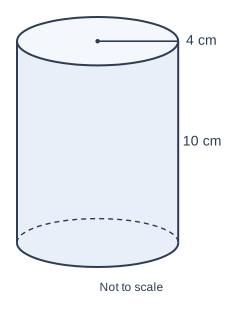
The diagram shows a cylinder.

The cylinder is cut straight across, parallel to its circular top face.
Write down the shape of the cut face.

A different cylinder of the same size is cut straight down through the centres of both circular faces.
Write down the shape of this cut face.

A cylinder drawn in 3D (hidden edges dashed). The radius is labelled 4 cm (on a line from the centre of the flat top face to its edge). The height is labelled 10 cm (beside the vertical side of the cylinder). The diagram is labelled "Not to scale".

Model answer

Cut parallel to the top: a circle (the same size as the top face).
Cut down through the centres: a rectangle, 8 cm wide (the diameter) and 10 cm tall (the height).

Explanation

A cylinder has the same circular cross-section all the way up, so any cut parallel to the ends gives a circle. A vertical cut through the middle goes across a diameter at the top and bottom and down the full height, giving a rectangle.

Mark scheme
  1. 1 mark

    B1 for circle (cut parallel to the top)

    correct answer with no working scores full marks

  2. 1 mark

    B1 for rectangle (cut down through the centres)

    Accept square only if justified by equal height and diameter; for this cylinder (radius 4 cm, height 10 cm) the answer is a rectangle.

Question 4

4 marks

An artist makes a sculpture in the shape of a pyramid with a hexagon as its base.

Each edge is a metal rod costing £3.
Each vertex is a metal joint costing £2.
Each triangular face is filled with a glass panel costing £10. The base has no glass.

Work out the total cost of the rods, joints and glass panels.

Model answer

Edges: 6 round the hexagon + 6 up to the top = 12 rods, cost \(12 \times 3 = £36\).
Vertices: 6 round the base + 1 at the top = 7 joints, cost \(7 \times 2 = £14\).
Triangular faces: one on each side of the hexagon = 6 panels, cost \(6 \times 10 = £60\).
Total \(= 36 + 14 + 60 = £110\)

Explanation

A pyramid with an n-sided base has 2n edges, n + 1 vertices and n triangular faces. Here n = 6. A common error is to include the hexagonal base as a glass panel or to forget the edges going up to the top.

Mark scheme
  1. 1 mark

    B1 for 12 edges (rods)

    6 round the base + 6 up to the top; correct answer with no working scores full marks

  2. 1 mark

    B1 for 7 vertices (joints)

  3. 1 mark

    B1 for 6 triangular faces (panels)

  4. 1 mark

    B1 for £110

    FT 3 × their edges + 2 × their vertices + 10 × their faces, provided at least one of their counts is correct. Accept 110.

Ready to try the rest? Every answer you write is marked against the mark scheme, so you can see exactly where the marks are.

Study Helper Hints first, answers after you try

Stuck on this one? Ask for a hint and I’ll point you in the right direction, without giving the answer away. Once you’ve checked your answer, I’ll show you how the marks are awarded.