
Level:
Correct: 0
Incorrect: 0
Marks: 0/0
Exam Practice
Course:
Topics:
OCR GCSE Maths (Foundation non-calculator) Smart practice A mixed round aimed at your weak spots
Unit 1
Number Operations and Integers
Unit 2
Fractions, Decimals and Percentages
Unit 3
Indices and Surds
Unit 4
Approximation and Estimation
Unit 5
Ratio, Proportion and Rates of Change
Unit 6
Algebra
Unit 7
Graphs of Equations and Functions
Unit 8
Basic Geometry
Unit 9
Congruence and Similarity
Unit 10
Mensuration
Unit 11
Probability
Unit 12
Statistics
Avg
score:
–
Topics
done:
0/100

Pythagoras' theorem

Practise 16 exam-style questions on Pythagoras' theorem for OCR GCSE Maths (Foundation non-calculator). Write your answer as you would in the exam and get it marked in seconds against the mark scheme, point by point, with the Study Helper on hand if you get stuck.

  • 16 questions
  • 1–5 marks each
  • Instant marking
  • No sign-up needed
16 questions, marked as you go

Sample questions with model answers

Here are 4 of the questions in this topic, each with a model answer, an explanation of why it earns the marks and the mark scheme an examiner would use.

Question 1

2 marks

Here is a right-angled triangle.

Work out the length of the side marked \(x\).
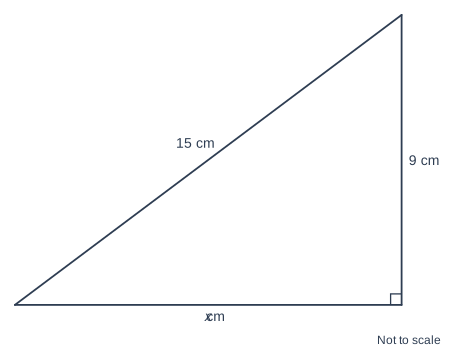
Geometry diagram, marked "Not to scale". A triangle (its vertices are not labelled). The angle at an unlabelled point is marked as a right angle (90°). The unlabelled side going upwards is labelled 9 cm. The unlabelled side going up and to the right is labelled 15 cm. The unlabelled side going to the right is labelled x cm.

Model answer

The hypotenuse is 15 cm, so
\(x^2 = 15^2 - 9^2\)
\(x^2 = 225 - 81 = 144\)
\(x = \sqrt{144} = 12\) cm

Explanation

The side marked x is one of the two shorter sides, so subtract the square of the known shorter side from the square of the hypotenuse. Check that your answer is shorter than the hypotenuse. A common error is to add the squares, which gives an answer longer than 15 cm.

Mark scheme
  1. 1 mark

    M1 for \(15^2 - 9^2\) or 225 − 81 or 144

    Also award M1 for \(x^2 + 9^2 = 15^2\) oe; correct answer with no working scores full marks

  2. 1 mark

    A1 for 12

    Accept 12 cm. A correct answer with no working scores 2 marks. 144 as the final answer scores M1 A0. \(\sqrt{306}\) or 17.5 (from \(15^2 + 9^2\)) scores 0. 6 (from 15 − 9) scores 0.
Question 2

3 marks

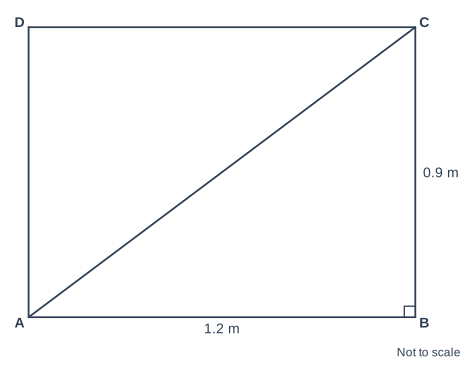
The diagram shows a rectangular gate ABCD.
The gate is 1.2 m wide and 0.9 m high.

A straight wooden brace is fixed to the gate from corner A to corner C.

Work out the length of the brace.

Geometry diagram, marked "Not to scale". Rectangle ABCD. Line segment AC is drawn. Side AB is labelled 1.2 m. Side BC is labelled 0.9 m. Angle ABC is marked as a right angle (90°).

Model answer

Triangle ABC has a right angle at B, and AC is its hypotenuse.
\(AC^2 = 1.2^2 + 0.9^2\)
\(AC^2 = 1.44 + 0.81 = 2.25\)
\(AC = \sqrt{2.25} = 1.5\) m

Explanation

The brace is the diagonal of a rectangle, so it is the hypotenuse of a right-angled triangle whose shorter sides are the width and the height. Squaring decimals by hand: 1.2 × 1.2 = 1.44 and 0.9 × 0.9 = 0.81. Working in centimetres avoids decimals: 120² + 90² = 22 500, and the square root is 150 cm.

Mark scheme
  1. 1 mark

    M1 for \(1.2^2 + 0.9^2\) or 1.44 + 0.81

    Working in centimetres: M1 for \(120^2 + 90^2\) or 14 400 + 8100; correct answer with no working scores full marks

  2. 1 mark

    M1 for \(\sqrt{2.25}\)

    The square root of their sum of squares. In centimetres, \(\sqrt{22500}\).

  3. 1 mark

    A1 for 1.5

    Accept 1.5 m or 150 cm. A correct answer with no working scores 3 marks. 2.25 as the final answer scores M1 M0 A0. 2.1 (from 1.2 + 0.9) scores 0.

Question 3

3 marks

A right-angled triangle has a hypotenuse of length 13 cm.
The lengths of the other two sides are both whole numbers of centimetres.

Work out the area of the triangle.

Model answer

Let the shorter sides be \(a\) and \(b\): \(a^2 + b^2 = 13^2 = 169\)
Square numbers less than 169: 1, 4, 9, 16, 25, 36, 49, 64, 81, 100, 121, 144
The only pair that adds up to 169 is 25 + 144.
So the sides are \(\sqrt{25} = 5\) cm and \(\sqrt{144} = 12\) cm.
The two shorter sides are perpendicular, so they are the base and the height.
Area = \(\dfrac{1}{2} \times 5 \times 12 = 30\) cm²

Explanation

Look for two square numbers that add up to 13² = 169: working systematically through the square numbers, only 25 + 144 works, so the sides are 5 cm and 12 cm. In a right-angled triangle the two shorter sides meet at the right angle, so they are the base and perpendicular height. A common error is to forget to halve 5 × 12.

Mark scheme
  1. 1 mark

    M1 for \(a^2 + b^2 = 169\) oe, or for a trial of two whole numbers whose squares are added and compared with 169

    E.g. a list of square numbers with 169 − 144 = 25 seen, or \(5^2 + 12^2 = 169\); correct answer with no working scores full marks

  2. 1 mark

    A1 for sides 5 and 12

  3. 1 mark

    A1 for 30

    Accept 30 cm². A correct answer with no working scores 3 marks. 60 (from 5 × 12, not halved) scores M1 A1 A0.

Question 4

4 marks

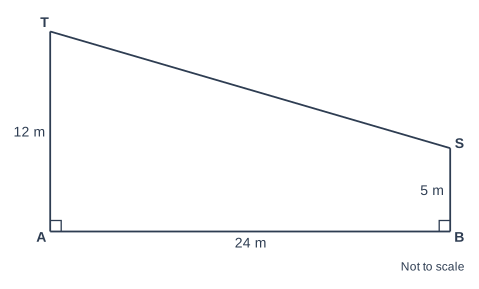
Two vertical posts, AT and BS, stand on level ground, 24 m apart.
Post AT is 12 m tall and post BS is 5 m tall.

A zip wire TS is a straight line from the top of the taller post to the top of the shorter post.

The diagram shows this information.

Work out the length of the zip wire.

Geometry diagram, marked "Not to scale". Line segments AB, AT, BS and TS are drawn. Angle TAB is marked as a right angle (90°). Angle ABS is marked as a right angle (90°). AT is labelled 12 m. BS is labelled 5 m. AB is labelled 24 m.

Model answer

Draw a horizontal line from the top of the shorter post to the taller post.
This makes a right-angled triangle with the zip wire as the hypotenuse.
Vertical side = 12 − 5 = 7 m
Horizontal side = 24 m
\(L^2 = 7^2 + 24^2 = 49 + 576 = 625\)
\(L = \sqrt{625} = 25\) m

Explanation

The wire is not the hypotenuse of a triangle with the 12 m post as a side, because its lower end is 5 m above the ground. A horizontal line at the height of the shorter post makes a right-angled triangle with sides 7 m and 24 m. 25 × 25 = 625, so the wire is 25 m long.

Mark scheme
  1. 1 mark

    B1 for 12 − 5 or 7

    The difference in heights, the vertical side of a right-angled triangle with the wire as hypotenuse; correct answer with no working scores full marks

  2. 1 mark

    M1 for their \(7^2 + 24^2\) or 49 + 576

    FT their difference in heights. Using 12 or 5 in place of 7, e.g. \(12^2 + 24^2\), scores M0.

  3. 1 mark

    M1 for \(\sqrt{625}\)

    The square root of their sum of squares.

  4. 1 mark

    A1 for 25

    Accept 25 m. A correct answer with no working scores 4 marks. 625 as the final answer scores B1 M1 M0 A0.

Ready to try the rest? Every answer you write is marked against the mark scheme, so you can see exactly where the marks are.

Study Helper Hints first, answers after you try

Stuck on this one? Ask for a hint and I’ll point you in the right direction, without giving the answer away. Once you’ve checked your answer, I’ll show you how the marks are awarded.