
Level:
Correct: 0
Incorrect: 0
Marks: 0/0
Exam Practice
Course:
Topics:
OCR GCSE Maths (Foundation non-calculator) Smart practice A mixed round aimed at your weak spots
Unit 1
Number Operations and Integers
Unit 2
Fractions, Decimals and Percentages
Unit 3
Indices and Surds
Unit 4
Approximation and Estimation
Unit 5
Ratio, Proportion and Rates of Change
Unit 6
Algebra
Unit 7
Graphs of Equations and Functions
Unit 8
Basic Geometry
Unit 9
Congruence and Similarity
Unit 10
Mensuration
Unit 11
Probability
Unit 12
Statistics
Avg
score:
–
Topics
done:
0/100

Listing outcomes and the product rule

Practise 13 exam-style questions on Listing outcomes and the product rule for OCR GCSE Maths (Foundation non-calculator). Write your answer as you would in the exam and get it marked in seconds against the mark scheme, point by point, with the Study Helper on hand if you get stuck.

  • 13 questions
  • 1–4 marks each
  • Instant marking
  • No sign-up needed
13 questions, marked as you go

Sample questions with model answers

Here are 4 of the questions in this topic, each with a model answer, an explanation of why it earns the marks and the mark scheme an examiner would use.

Question 1

2 marks

The table shows the menu at a café.

Olivia chooses one starter and one dessert.

List all the different meals she could choose.
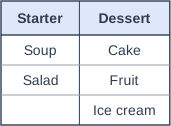
Table with columns "Starter", "Dessert". Starter: Soup; Dessert: Cake | Starter: Salad; Dessert: Fruit | Starter: (blank); Dessert: Ice cream.

Model answer

Soup and cake
Soup and fruit
Soup and ice cream
Salad and cake
Salad and fruit
Salad and ice cream
There are 6 different meals.

Explanation

Take each starter in turn and pair it with every dessert. This systematic order makes it easy to see that nothing is missed: 3 meals with soup and 3 with salad, 6 altogether.

Mark scheme
  1. 2 marks

    B2 for all six meals and no others: soup and cake, soup and fruit, soup and ice cream, salad and cake, salad and fruit, salad and ice cream

    Any clear notation, e.g. initials or a table. Ignore repeats. B1 for at least four correct meals, or all six with one extra wrong meal.

Question 2

2 marks

Ali, Bea, Cal and Dev are in a quiz team.
Two of them will be chosen to go to the final.

List all the different pairs that could be chosen.

Model answer

Pairs with Ali: AB, AC, AD
Pairs with Bea (not already listed): BC, BD
Pairs with Cal (not already listed): CD
There are 6 different pairs: AB, AC, AD, BC, BD, CD.

Explanation

The order does not matter here: Ali and Bea is the same pair as Bea and Ali. Pair the first person with everyone after them, then the second person with everyone after them, and so on. This gives 3 + 2 + 1 = 6 pairs with no repeats.

Mark scheme
  1. 2 marks

    B2 for all six pairs and no repeats: Ali and Bea, Ali and Cal, Ali and Dev, Bea and Cal, Bea and Dev, Cal and Dev

    Initials are fine (AB, AC, AD, BC, BD, CD). B1 for at least four different correct pairs, or for all six with repeats in reverse order (e.g. AB and BA both listed).

Question 3

3 marks

Kofi's locker code is a two-digit number.
The two digits are different and are chosen from 3, 4, 5 and 6.

The code is an even number.
The code is greater than 40.

How many different codes are possible?
Show how you decide.

Model answer

The code is even, so the last digit is 4 or 6.
Ending in 4: 34, 54, 64. Greater than 40: 54, 64
Ending in 6: 36, 46, 56. Greater than 40: 46, 56
The possible codes are 46, 54, 56 and 64.
There are 4 possible codes.

Explanation

Use one condition to organise the list: an even number ends in 4 or 6. List the numbers for each last digit, then cross out any that are not greater than 40 (those starting with 3). The digits must be different, so 44 and 66 are not allowed.

Mark scheme
  1. 1 mark

    M1 for identifying that the last digit is 4 or 6

    May be implied by a list of even numbers made from the digits, e.g. 34, 54, 64, 36, 46, 56.

  2. 1 mark

    M1 for a systematic list of even numbers greater than 40 with at least three correct

    The four codes are 46, 54, 56, 64.

  3. 1 mark

    A1 for 4

    Accept 4 with the list 46, 54, 56, 64. 6 (all the even numbers, including 34 and 36) scores M1 M0 A0. 5 (including 44, a repeated digit) scores M1 M1 A0.

Question 4

4 marks

Four runners, Amy, Beth, Cara and Dee, run in a relay race.
Each runner runs once, one after the other.

Amy must not run last.

Work out the number of different orders in which the four runners can run.

Model answer

The last runner must be Beth, Cara or Dee.
If Dee runs last, the other three can run in these orders:
ABC, ACB, BAC, BCA, CAB, CBA (6 orders)
In the same way there are 6 orders with Beth last and 6 with Cara last.
Number of orders = 6 + 6 + 6 = 18

Explanation

Fix the condition first: 3 runners can run last. For each choice, the other three runners can be listed in 6 orders. Another way: there are 24 orders altogether and 6 of them have Amy last, so 24 − 6 = 18.

Mark scheme
  1. 1 mark

    M1 for listing the orders of three runners, or for 6 orders with a given runner last (or first)

    E.g. with Dee last: ABC, ACB, BAC, BCA, CAB, CBA; correct answer with no working scores full marks

  2. 1 mark

    M1 for 24 orders in total, or for 3 choices of runner to run last

    Total may come from a full list or from 4 × 6 oe.

  3. 1 mark

    M1 for 24 − 6 or 3 × 6

    Removing the 6 orders with Amy last, or 6 orders for each of Beth, Cara or Dee running last.

  4. 1 mark

    A1 for 18

    A correct answer with no working scores 4 marks. 24 (ignoring the condition) scores M1 M1 M0 A0. 6 scores M1 only.

Ready to try the rest? Every answer you write is marked against the mark scheme, so you can see exactly where the marks are.

Study Helper Hints first, answers after you try

Stuck on this one? Ask for a hint and I’ll point you in the right direction, without giving the answer away. Once you’ve checked your answer, I’ll show you how the marks are awarded.