
Level:
Correct: 0
Incorrect: 0
Marks: 0/0
Exam Practice
Course:
Topics:
OCR GCSE Maths (Foundation non-calculator) Smart practice A mixed round aimed at your weak spots
Unit 1
Number Operations and Integers
Unit 2
Fractions, Decimals and Percentages
Unit 3
Indices and Surds
Unit 4
Approximation and Estimation
Unit 5
Ratio, Proportion and Rates of Change
Unit 6
Algebra
Unit 7
Graphs of Equations and Functions
Unit 8
Basic Geometry
Unit 9
Congruence and Similarity
Unit 10
Mensuration
Unit 11
Probability
Unit 12
Statistics
Avg
score:
–
Topics
done:
0/100

Simplifying ratios

Practise 14 exam-style questions on Simplifying ratios for OCR GCSE Maths (Foundation non-calculator). Write your answer as you would in the exam and get it marked in seconds against the mark scheme, point by point, with the Study Helper on hand if you get stuck.

  • 14 questions
  • 1–4 marks each
  • Instant marking
  • No sign-up needed
14 questions, marked as you go

Sample questions with model answers

Here are 4 of the questions in this topic, each with a model answer, an explanation of why it earns the marks and the mark scheme an examiner would use.

Question 1

1 mark

Write the ratio 10 : 15 : 25 in its simplest form.

Model answer

The highest common factor of 10, 15 and 25 is 5.
\(10 \div 5 = 2\), \(15 \div 5 = 3\), \(25 \div 5 = 5\)
10 : 15 : 25 = 2 : 3 : 5

Explanation

Divide every part of the ratio by the same number. The largest number that divides 10, 15 and 25 exactly is 5, so dividing by 5 gives the simplest form in one step. All three parts must be divided by the same number, and they stay in the same order.

Mark scheme
  1. 1 mark

    B1 for 2 : 3 : 5

    The parts must be in this order. Do not accept a ratio that is not fully simplified.
Question 2

2 marks

Write the ratio 45 minutes : 2 hours in its simplest form.

Model answer

2 hours = 120 minutes
45 minutes : 2 hours = 45 : 120
Divide both parts by 15.
= 3 : 8

Explanation

Both parts of a ratio must be in the same units before you simplify, so change 2 hours into 120 minutes. Then divide 45 and 120 by their highest common factor, 15. A common error is to simplify 45 : 2 without changing the units.

Mark scheme
  1. 1 mark

    M1 for 45 : 120 or 2 hours = 120 minutes seen

    Also M1 for working in hours: 0.75 : 2 or 3/4 : 2; correct answer with no working scores full marks

  2. 1 mark

    A1 for 3 : 8

    3 : 8 with no working scores 2 marks. 45 : 2 (units not the same) scores 0.

Question 3

2 marks

Ella is asked to write the ratio 36 : 60 in its simplest form.
She writes 6 : 10.

Explain why Ella's answer is not in its simplest form.
Write 36 : 60 in its simplest form.

Model answer

6 and 10 are both even, so they can both still be divided by 2. Ella has not finished simplifying.
The highest common factor of 36 and 60 is 12.
\(36 \div 12 = 3\) and \(60 \div 12 = 5\)
36 : 60 = 3 : 5

Explanation

A ratio is in its simplest form only when its parts have no common factor other than 1. Ella divided by 6, but the highest common factor of 36 and 60 is 12, so 6 : 10 can still be halved to 3 : 5. Dividing by the highest common factor gives the simplest form in one step.

Mark scheme
  1. 1 mark

    B1 for 6 and 10 still have a common factor (of 2) oe

    Accept e.g. 'both numbers can still be divided by 2' or 'she did not divide by the highest common factor (12)'. Do not accept 'she divided by the wrong number' with no further detail.

  2. 1 mark

    B1 for 3 : 5

    Independent of the explanation.

Question 4

4 marks

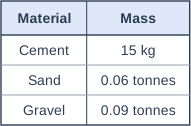
Harry mixes cement, sand and gravel to make concrete.
The table shows the mass of each material he uses.

Harry says,

"The ratio cement : sand : gravel is 1 : 4 : 5."

Is Harry correct?
Show how you decide.

Table with columns "Material", "Mass". Material: Cement; Mass: 15 kg | Material: Sand; Mass: 0.06 tonnes | Material: Gravel; Mass: 0.09 tonnes.

Model answer

1 tonne = 1000 kg
Sand: \(0.06 \times 1000 = 60\) kg
Gravel: \(0.09 \times 1000 = 90\) kg
Cement : sand : gravel = 15 : 60 : 90
Divide every part by 15.
= 1 : 4 : 6
The ratio is 1 : 4 : 6, not 1 : 4 : 5, so Harry is not correct.

Explanation

All three masses must be in the same unit before they can be compared, so change tonnes into kilograms (1 tonne = 1000 kg). Dividing 15 : 60 : 90 by 15 gives 1 : 4 : 6. A common error is to multiply 0.06 and 0.09 by 100 instead of 1000.

Mark scheme
  1. 1 mark

    B1 for sand = 60 kg

    Accept 60 000 g if working in grams.

  2. 1 mark

    B1 for gravel = 90 kg

    Accept 90 000 g if working in grams.

  3. 1 mark

    M1 for 15 : 60 : 90 or their three masses in the same units divided by 15

    Also M1 for 0.015 : 0.06 : 0.09 (working in tonnes), or for working out that a ratio of 1 : 4 : 5 would need 75 kg (or 0.075 tonnes) of gravel.

  4. 1 mark

    A1 for No, with 1 : 4 : 6 (or 2 : 8 : 12 or 5 : 20 : 30) or with gravel needing to be 75 kg but being 90 kg

    No with no valid working scores 0. The decision must be supported by correct figures.

Ready to try the rest? Every answer you write is marked against the mark scheme, so you can see exactly where the marks are.

Study Helper Hints first, answers after you try

Stuck on this one? Ask for a hint and I’ll point you in the right direction, without giving the answer away. Once you’ve checked your answer, I’ll show you how the marks are awarded.