
Level:
Correct: 0
Incorrect: 0
Marks: 0/0
Exam Practice
Course:
Topics:
AQA GCSE Design and Technology Smart practice A mixed round aimed at your weak spots
Unit 1
Core technical principles
Unit 2
Specialist technical principles
Unit 3
Designing and making principles
Investigation, primary and secondary data
Environmental, social and economic challenge
Design strategies
Design strategies
Communication of design ideas
Prototype development
Selection of materials and components
Selecting materials and components for prototypes
Specialist tools and equipment
Avg
score:
–
Topics
done:
0/40

Thermoforming and thermosetting polymers

Practise 18 exam-style questions on Thermoforming and thermosetting polymers for AQA GCSE Design and Technology. Write your answer as you would in the exam and get it marked in seconds against the mark scheme, point by point, with the Study Helper on hand if you get stuck.

  • 18 questions
  • 1–8 marks each
  • Instant marking
  • No sign-up needed
18 questions, marked as you go

Sample questions with model answers

Here are 4 of the questions in this topic, each with a model answer, an explanation of why it earns the marks and the mark scheme an examiner would use.

Question 1

1 mark

The diagram shows the structures of two polymers, P and Q.

Which one of the following statements is true?

Choose your answer.

  • P can be reheated and reshaped because its chains are not cross-linked
  • Q can be reheated and reshaped because its chains are cross-linked
  • P is thermosetting because its chains are not joined together
  • Q softens at a lower temperature than P because of its cross-links
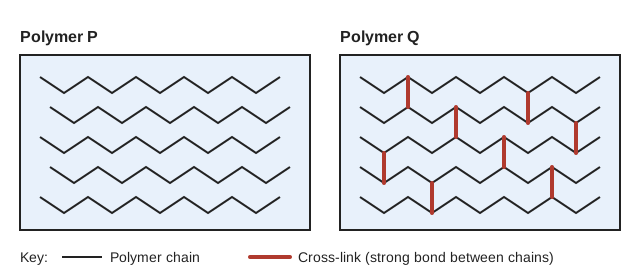
Two boxes side by side. The box labelled Polymer P contains five long zigzag chains lying side by side, not joined to each other. The box labelled Polymer Q contains five similar zigzag chains, joined to the chains next to them at eight places by short, thick lines. A key shows that a thin zigzag line is a polymer chain and a short thick line is a cross-link (strong bond between chains).

Model answer

P can be reheated and reshaped because its chains are not cross-linked

Explanation

In a thermoforming polymer (P) the long chains are held together only by weak forces, so when heated the chains can slide past each other: the polymer softens, can be reshaped and sets again as it cools, many times. In a thermosetting polymer (Q) strong cross-links form between the chains when it sets, locking them in place, so it cannot be softened or reshaped by heating.

Mark scheme
  1. 1 mark

    P can be reheated and reshaped because its chains are not cross-linked

    If more than one option is given, 0 marks. 'Q can be reheated and reshaped because its chains are cross-linked' is wrong: the cross-links stop the chains sliding past each other, so Q (a thermosetting polymer) cannot be reshaped by heat. 'P is thermosetting because its chains are not joined together' is wrong: chains that are not cross-linked are the structure of a thermoforming polymer. 'Q softens at a lower temperature than P because of its cross-links' is wrong: the cross-links make Q resist heat; it does not soften, and it chars or burns if heated too much.

Question 2

2 marks

Car body filler, used to repair small dents in steel car panels, is mostly polyester resin mixed with a fine powder. Just before use, a small amount of hardener (catalyst) is mixed in, and the paste is spread into the dent. After about 20 minutes it has set.

Give two properties of polyester resin that make it suitable for the body filler.

Model answer

Before the hardener makes it set, polyester resin is a paste, so it can be spread into the dent and shaped to match the panel.
Once it has set it is a hard, rigid thermosetting polymer, so it can be sanded smooth and painted over.

Explanation

Polyester resin is a liquid thermosetting polymer that cures into a hard, rigid, cross-linked solid when a catalyst (hardener) is added, without needing heat. This is why it is used for body filler, for casting and embedding, and, with glass fibre, as the matrix of glass reinforced plastic (GRP) for boat hulls and car body panels. On its own, set polyester resin is quite brittle.

Mark scheme
  1. 1 mark

    Before it sets it is a liquid (paste), so it can be spread into the dent and shaped to the curve of the panel

    One mark for each correct property given, max 2.

  2. 1 mark

    It sets (cures) quickly at room temperature once the hardener is added, so the repair needs no heating and can be finished the same day

    Accept 'cures without heating' or 'sets when a catalyst is added'.

  3. 1 mark

    It sets into a hard, rigid thermosetting polymer, so it can be sanded smooth and painted, and it keeps its shape

    Accept 'it is thermosetting, so it will not soften again when the car is hot in the sun'.

  4. 1 mark

    It bonds (sticks) well to the steel panel

    Accept 'good adhesion'. Do not accept 'waterproof': body filler absorbs moisture and must be painted over. Do not accept 'strong' or 'easy to use' alone. Accept all other valid responses.

Question 3

3 marks

A school buys acrylic sheets for its laser cutter. Each sheet measures 600 mm × 400 mm × 3 mm. The density of acrylic is 1190 kg/m³.

Calculate the total mass of a delivery of 25 sheets.

Give your answer in kg.

Model answer

Volume of one sheet = 0.6 m × 0.4 m × 0.003 m = 0.00072 m³
Mass of one sheet = 0.00072 × 1190 = 0.8568 kg
Total mass = 0.8568 × 25 = 21.42 kg

Explanation

Change the dimensions to metres (3 mm = 0.003 m) so the volume is in m³, then multiply by the density to get the mass in kg, and multiply by the number of sheets. The commonest slip is writing 3 mm as 0.03 m, which makes the answer ten times too big. Acrylic is about half as dense as glass, which is one reason it is chosen for glazing and displays.

Mark scheme
  1. 1 mark

    Step 1: volume of one sheet = 0.6 × 0.4 × 0.003 = 0.00072 m³

    Award full marks for a correct answer, even with no working shown. Accept the total volume 25 × 0.00072 = 0.018 m³ for this step. 720 000 mm³ earns this mark only if it is correctly converted to m³.

  2. 1 mark

    Step 2: mass of one sheet = 0.00072 × 1190 = 0.8568 kg (or total volume 0.018 × 1190)

    ft their volume in m³.

  3. 1 mark

    Step 3: total mass = 0.8568 × 25 = 21.42 kg

    Accept [21.4, 21.42]. The question gives the unit, so mark the number. ft their mass of one sheet × 25. Using 3 mm as 0.03 m (volume 0.0072 m³, giving 214.2 kg) loses step 1 but can earn steps 2 and 3 as follow-through: max 2.

Question 4

4 marks

The handle of a saucepan is made from phenol formaldehyde (PF).

Analyse and evaluate the use of phenol formaldehyde, rather than a thermoforming polymer such as polypropylene, for the handle.

Model answer

Phenol formaldehyde is a thermosetting polymer, so its chains are cross-linked and it will not soften or melt when the handle gets hot near the hob. Polypropylene is a thermoforming polymer that softens at a much lower temperature, so a polypropylene handle could deform or even melt if it was near a gas flame. Phenol formaldehyde is also a poor conductor of heat, so the handle stays cool enough to hold, and it is hard and rigid, so it gives a secure grip on a heavy pan of boiling water.

The disadvantages are that phenol formaldehyde is brittle, so the handle could crack if the pan is dropped, it only comes in dark colours, and it cannot be remelted and recycled.

Overall, phenol formaldehyde is the right choice: safety when the pan is hot matters far more than colour choice or toughness, so its heat resistance justifies its use.

Explanation

Level 2 needs the key reason - phenol formaldehyde is thermosetting, so it does not soften with heat, unlike polypropylene - plus other relevant properties (poor heat conductor, rigid), the drawbacks (brittle, dark colours only, not recyclable) and a clear conclusion. Answers that only say 'it is heat resistant' stay in Level 1.

Mark scheme
  1. 4 marks

    Levels of response (4 marks).
    Level 2 (3-4 marks): Well described and justified analysis containing full evaluation, drawing on conclusions having considered both positive and negative factors.
    Level 1 (1-2 marks): Brief points mentioned but not fully explained. Analysis present but limited evaluation/conclusions drawn. May have focused solely on either positive or negative factors.
    0 marks: No attempt or nothing worthy of credit.

    Indicative content (illustrative, not exhaustive; credit any worthy points made in support of the band descriptors): For phenol formaldehyde: it is a thermosetting polymer with cross-linked chains, so it does not soften or melt when the handle gets hot from the pan or the hob, whereas polypropylene, a thermoforming polymer, softens and melts at about 160°C and could deform or drip near a gas flame; it is a poor conductor of heat, so the handle stays cool enough to hold; it is hard and rigid, so the handle does not flex and gives a secure grip on a heavy pan; it can be moulded around the metal fixing; it resists scratches. Against: it is brittle, so it may chip or crack if the pan is dropped (polypropylene is tougher); it is only available in dark colours such as black or brown, which limits the appearance; it cannot be remelted and recycled; it can still char if left in a flame. Conclusion: e.g. phenol formaldehyde is justified because heat resistance and safety are the most important requirements for a saucepan handle, and these outweigh its brittleness and limited colours. Analysis: identification of the properties of PF (and PP) relevant to the handle. Evaluation: a judgement weighing the positive and negative factors, ending in a conclusion. An answer with only positive (or only negative) points stays in Level 1. Accept all other valid responses.

Ready to try the rest? Every answer you write is marked against the mark scheme, so you can see exactly where the marks are.

Study Helper Hints first, answers after you try

Stuck on this one? Ask for a hint and I’ll point you in the right direction, without giving the answer away. Once you’ve checked your answer, I’ll show you how the marks are awarded.