
Level:
Correct: 0
Incorrect: 0
Marks: 0/0
Exam Practice
Course:
Topics:
AQA GCSE Design and Technology Smart practice A mixed round aimed at your weak spots
Unit 1
Core technical principles
Unit 2
Specialist technical principles
Unit 3
Designing and making principles
Investigation, primary and secondary data
Environmental, social and economic challenge
Design strategies
Design strategies
Communication of design ideas
Prototype development
Selection of materials and components
Selecting materials and components for prototypes
Specialist tools and equipment
Avg
score:
–
Topics
done:
0/40

Investigation, primary and secondary data

Practise 22 exam-style questions on Investigation, primary and secondary data for AQA GCSE Design and Technology. Write your answer as you would in the exam and get it marked in seconds against the mark scheme, point by point, with the Study Helper on hand if you get stuck.

  • 22 questions
  • 1–8 marks each
  • Instant marking
  • No sign-up needed
20 questions, marked as you go

Sample questions with model answers

Here are 4 of the questions in this topic, each with a model answer, an explanation of why it earns the marks and the mark scheme an examiner would use.

Question 1

1 mark

A designer is designing a wooden bird box for a garden.

Which of these is a point from a manufacturing specification rather than a design specification?

Choose your answer.

  • The bird box must suit small birds such as blue tits
  • The bird box should blend in with the colours of a garden
  • The roof must overhang the front so that rain runs off
  • The sides are cut from 12 mm exterior plywood, 150 ± 1 mm wide

Model answer

The sides are cut from 12 mm exterior plywood, 150 ± 1 mm wide

Explanation

A design specification lists what the product must do and be (function, user, aesthetics, size limits) so ideas can be judged against it. A manufacturing specification tells the maker exactly how to make the chosen design: materials, exact sizes, tolerances, processes, sequence and quality checks. The tolerance (± 1 mm) is a clear sign of a manufacturing specification.

Mark scheme
  1. 1 mark

    The sides are cut from 12 mm exterior plywood, 150 ± 1 mm wide

    If more than one option is given, 0 marks. 'Must suit small birds' states the user/function, a design specification point. 'Should blend in' is an aesthetic requirement, a design specification point. 'The roof must overhang' is a functional requirement of the design, not an instruction for making it. Only the last option gives the exact material, size and tolerance needed to make the part, which belongs in a manufacturing specification.
Question 2

3 marks

Amara owns a small campsite. The path from the camping field to the toilet block is 120 m long, uneven and has no lighting. There is no mains electricity along the path. Campers, including young children, often get lost or trip on the path at night. Amara does not want bright lights that would keep people in their tents awake.

Write a design brief for a product to solve Amara's problem.

Model answer

Amara, the owner of a small campsite, needs a product that will help campers, including young children, find their way safely along the 120 m unlit, uneven path from the camping field to the toilet block at night. The product must work without mains electricity, survive being outdoors in all weathers, and show the route with low-level light that does not disturb people sleeping in their tents.

Explanation

A design brief is a short statement that sets out who the product is for, the problem or need, and what the product must do, including the main constraints. It should not name a finished solution, because that limits ideas; detailed measurable points belong in the design specification that follows. The best briefs use the details given, here the lack of mains power and the need not to disturb sleeping campers.

Mark scheme
  1. 1 mark

    Identifies the client and users: Amara (the campsite owner) and the campers, including young children, who use the path at night

    Accept 'campers' and 'Amara' named anywhere in the brief.

  2. 1 mark

    States the problem / need: campers cannot see or find the way along the unlit, uneven 120 m path to the toilet block at night, so they get lost or trip

    Must be linked to the path at night, not a general statement such as 'the campsite needs improving'.

  3. 1 mark

    States what the product must do and at least one main constraint from the scenario: e.g. guide campers safely along the path at night, working without mains electricity (e.g. solar or battery powered), outdoors in all weathers, with low-level light that does not disturb sleeping campers

    Needs both the aim of the product and at least one constraint taken from the scenario. A design brief is a short statement of the problem, who it is for and what the product should do; it does not need measurable specification points. Do not credit a list of specification points with no statement of the problem, or a solution alone (e.g. 'Make some solar lights'). Do not credit constraints not linked to the scenario (e.g. 'it must be cheap').

Question 3

3 marks

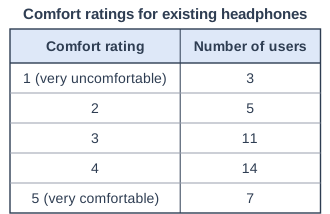
As part of product analysis, a designer asked 40 users to rate the comfort of an existing pair of wireless headphones from 1 (very uncomfortable) to 5 (very comfortable). The frequency table shows the results.

Calculate the mean comfort rating. Give your answer to one decimal place.

Comfort ratings for existing headphones. Table with columns "Comfort rating", "Number of users". Comfort rating: 1 (very uncomfortable); Number of users: 3 | Comfort rating: 2; Number of users: 5 | Comfort rating: 3; Number of users: 11 | Comfort rating: 4; Number of users: 14 | Comfort rating: 5 (very comfortable); Number of users: 7.

Model answer

Total = (1 × 3) + (2 × 5) + (3 × 11) + (4 × 14) + (5 × 7) = 3 + 10 + 33 + 56 + 35 = 137
Mean = 137 ÷ 40 = 3.425
Mean comfort rating = 3.4

Explanation

To find a mean from a frequency table, multiply each rating by how many users gave it, add these products, then divide by the total number of users (40), not by the number of rating values (5). A mean of 3.4 suggests the headphones are only fairly comfortable, so comfort is a feature the designer could improve on.

Mark scheme
  1. 1 mark

    Step 1: total of (rating × number of users) = (1 × 3) + (2 × 5) + (3 × 11) + (4 × 14) + (5 × 7) = 137

    Award full marks for a correct answer, even with no working shown.

  2. 1 mark

    Step 2: 137 ÷ 40

    ft their total ÷ 40. Dividing by 5 (the number of ratings), giving 27.4, gains step 1 only.

  3. 1 mark

    Step 3: mean = 3.4

    Accept 3.4 only for this mark (correctly rounded to one decimal place). 3.425 (or 3.43) seen but not rounded to one decimal place gains steps 1 and 2 only. ft their step 2, correctly rounded to one decimal place. Common errors that gain 0: (1 + 2 + 3 + 4 + 5) ÷ 5 = 3; 40 ÷ 5 = 8.

Question 4

6 marks

Two computer mice are described below.

Mouse A: a symmetrical mouse 115 mm long, 60 mm wide and 38 mm high. The user's palm rests on top of it, facing down. It has two buttons and a scroll wheel on top, a smooth glossy polymer case and a 1.8 m cable.

Mouse B: a vertical wireless mouse about 80 mm tall. The user holds it with the palm facing sideways, as if shaking hands. It has a textured rubber grip, a thumb rest and buttons on its side, and a rechargeable battery. It is made in one size only and is shaped for right-handed users.

Analyse and evaluate both mice in terms of ergonomics.

Model answer

Mouse A is held palm down, which twists the forearm. For short periods this is fine, but someone using it all day may get aches or strain in the wrist and forearm. Its symmetrical shape is a strength: it suits both left- and right-handed users, so it is a good choice for shared computers such as those in a school. Its size of 115 × 60 × 38 mm suits small and average hands but may cramp the fingers of users with large hands. The buttons and scroll wheel on top are easy to reach and familiar, so nobody needs to learn how to use it. However, the smooth glossy case could become slippery with sweaty hands, making the user grip harder, and the 1.8 m cable can drag and snag, although it never needs charging.

Mouse B is held in a handshake position, which keeps the forearm untwisted and is designed to reduce strain, so it is better for someone who works at a computer for many hours. The textured rubber grip and thumb rest support the hand, so less grip force is needed. The side buttons take some getting used to, and pointing may feel less precise at first. Because it is made in one size and only for right-handed users, it will not suit everyone: a left-handed user cannot use it comfortably, and people with very small or very large hands may find it the wrong size. Being wireless removes cable drag, but the battery could run out mid-task.

Overall, Mouse B is ergonomically better for a right-handed person who uses a computer all day, because of its natural wrist position and supportive grip. Mouse A is the better choice for shared use or for left-handed users.

Explanation

Top-level answers analyse features of both mice (grip position, size, shape, buttons, surface, cable or battery) and evaluate each one: who it suits, why, and any drawback, ending with a clear judgement about which mouse suits which user. Listing features without saying how they affect comfort or ease of use keeps an answer in Level 1 or 2. Anthropometric points, such as hand size and the one-size limitation, can be credited when linked to ergonomics.

Mark scheme
  1. 6 marks

    Levels of response (6 marks).
    Level 3 (5-6 marks): Thorough analysis and evaluation of both mice considering ergonomics (comfort, posture, ease of use and safety in use).
    Level 2 (3-4 marks): Good analysis and simple evaluative points of one or more mice considering ergonomics.
    Level 1 (1-2 marks): Basic analysis of one or two simple ergonomic points for either mouse.
    0 marks: No response or nothing worthy of credit.

    Analysis: identification of the features of each mouse that affect how the user interacts with it. Evaluation: a judgement of how well each feature suits users, for whom, and which mouse is better ergonomically in which situation. Indicative content (illustrative, not exhaustive; credit any worthy points made in support of the band descriptors): Mouse A - the palm-down grip twists the forearm, which over long periods of use can cause strain or discomfort in the wrist and forearm (repetitive strain); its symmetrical shape suits left- and right-handed users, so it is good for shared computers such as in a school; it is familiar, so there is no time needed to learn to use it, and pointing is precise; at 115 × 60 × 38 mm it may feel too small for large hands (fingers cramped) but suits smaller hands; buttons on top are easy to reach with the index and middle fingers; the smooth glossy case may become slippery if hands are sweaty, so the user grips harder; the cable can drag or snag and limits where the mouse can be used, but it never needs charging. Mouse B - the handshake grip keeps the forearm in a more natural, untwisted position, designed to reduce strain for people who use a computer for many hours (e.g. office workers); the textured rubber grip and thumb rest support the hand so less squeezing is needed; side buttons are pressed in a different direction and can take time to get used to, and some users find pointing less precise at first; one size only means it may be too big for users with small hands (e.g. 5th percentile) or too small for large hands; right-handed only excludes left-handed users; wireless gives freedom to move and no cable drag, but the battery may run out during use. Judgements, e.g.: Mouse B is likely to be more comfortable for a right-handed person using a computer all day, while Mouse A is better for shared use, for left-handed users or for short periods. Accept all other valid responses.

Ready to try the rest? Every answer you write is marked against the mark scheme, so you can see exactly where the marks are.

Study Helper Hints first, answers after you try

Stuck on this one? Ask for a hint and I’ll point you in the right direction, without giving the answer away. Once you’ve checked your answer, I’ll show you how the marks are awarded.