Level:
Correct: 0
Incorrect: 0
Marks: 0/0
Exam Practice
Course:
Topics:
AQA GCSE Design and Technology Smart practice A mixed round aimed at your weak spots
Unit 1
Core technical principles
Unit 2
Specialist technical principles
Unit 3
Designing and making principles
Investigation, primary and secondary data
Environmental, social and economic challenge
Design strategies
Design strategies
Communication of design ideas
Prototype development
Selection of materials and components
Selecting materials and components for prototypes
Specialist tools and equipment
Avg
score:
–
Topics
done:
0/40

Prototype development

Practise 18 exam-style questions on Prototype development for AQA GCSE Design and Technology. Write your answer as you would in the exam and get it marked in seconds against the mark scheme, point by point, with the Study Helper on hand if you get stuck.

  • 18 questions
  • 1–8 marks each
  • Instant marking
  • No sign-up needed
18 questions, marked as you go

Sample questions with model answers

Here are 4 of the questions in this topic, each with a model answer, an explanation of why it earns the marks and the mark scheme an examiner would use.

Question 1

1 mark

State what is meant by a prototype being 'fit for purpose'.

Model answer

It does the job it was designed to do and meets the needs of its users and the requirements of the design specification.

Explanation

Fitness for purpose is judged against the purpose set out in the brief and specification: does the prototype work, safely and reliably, for the people who will use it, in the place it will be used? A product can be well made or attractive and still not be fit for purpose if it does not do its job.

Mark scheme
  1. 1 mark

    It does the job it was designed to do / it meets the needs of its users and the requirements of the brief and specification (safely and reliably)

    Accept 'it works as intended for its users'. Do not accept 'it is good' or 'it looks nice' alone, or 'it has been made well' with no reference to its purpose or users.

Question 2

3 marks

A designer has made a prototype of a phone holder that clamps onto a bicycle's handlebars.

Describe how the designer could test whether the prototype is functional.

Model answer

The designer should fit the holder to handlebars of different diameters and check that it clamps tightly without slipping round. Phones of different sizes should then be put in it to check they are held securely and that the screen can still be seen and used. Finally, a cyclist should ride over bumpy ground with a phone in place to check that it does not come loose, and the results should be recorded against the specification.

Explanation

A functional prototype does what it was designed to do. Testing should copy real use: different handlebars, different phones and the vibration of riding, with results compared against the specification. Vague answers such as 'test whether it works' gain no credit.

Mark scheme
  1. 1 mark

    Fit it to handlebars of different diameters (or different bikes) and check that it clamps tightly without slipping or rotating

    Award 1 mark for each test described, max 3. Each test must be linked to a function of the phone holder. Do not credit 'see if it works' or 'test it' with no description.

  2. 1 mark

    Put phones of different sizes in it and check they are held securely and that the screen and buttons can still be seen and used

  3. 1 mark

    Ride over bumpy ground (or shake/vibrate it) and check that the phone stays in place

  4. 1 mark

    Time how long it takes to fit and remove the phone or holder / spray it with water to check that it still works when wet / ask cyclists to use it and record results against the specification

Question 3

3 marks

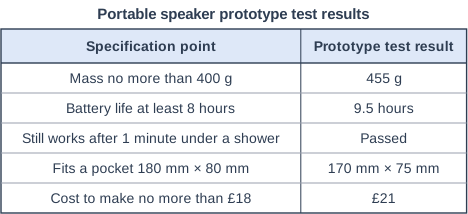
The table shows five points from the design specification for a portable speaker, and the results of testing the prototype against each one.

Identify the two specification points that the prototype does not meet, and give a modification to the prototype that would help it meet one of them.

Portable speaker prototype test results. Table with columns "Specification point", "Prototype test result". Specification point: Mass no more than 400 g; Prototype test result: 455 g | Specification point: Battery life at least 8 hours; Prototype test result: 9.5 hours | Specification point: Still works after 1 minute under a shower; Prototype test result: Passed | Specification point: Fits a pocket 180 mm × 80 mm; Prototype test result: 170 mm × 75 mm | Specification point: Cost to make no more than £18; Prototype test result: £21.

Model answer

The prototype does not meet the mass point (455 g is more than 400 g) or the cost point (£21 is more than £18).

Modification: use a slightly smaller battery. The battery lasts 9.5 hours, more than the 8 hours needed, so a smaller battery would still meet that point while reducing both the mass and the cost.

Explanation

Checking a prototype against each specification point shows whether it satisfies the requirements of the brief. Good modifications target the failed points without causing new failures, so using the spare battery life to save mass and cost is a strong suggestion.

Mark scheme
  1. 1 mark

    Mass: the prototype is 455 g, more than the maximum of 400 g

    Accept 'mass' or 'too heavy'.

  2. 1 mark

    Cost to make: £21, more than the maximum of £18

    Accept 'cost' or 'too expensive to make'. Do not credit battery life, waterproofing or size: these are met.

  3. 1 mark

    A suitable modification for mass or cost: e.g. mass - use a lighter material or thinner walls for the case, fewer or smaller internal parts, or a smaller battery (battery life of 9.5 h is above the 8 h needed); cost - fewer parts, cheaper standard components, a cheaper process or material, or a smaller battery

    The modification must be specific and linked to mass or cost. Do not credit 'make it lighter' or 'make it cheaper' with no method.

Question 4

6 marks

The owner of a café wants a charging station that customers can use to charge their phones at the tables. She wants it to charge several phones at once, to be safe, to have no trailing cables, to be easy to wipe clean and to suit the café's natural wood interior. Two prototypes have been made.

Prototype A: a bright orange 3D-printed PLA case with four built-in charging cables of different types. It plugs into a mains socket using a 2 m cable.

Prototype B: a walnut-veneered MDF case with a wireless charging pad on top, powered by a rechargeable battery that lasts about one day. It charges one phone at a time.

Analyse and evaluate both prototypes in terms of how well they respond to the client's wants and needs.

Model answer

Prototype A meets the client's most important functional need: it can charge four phones at once, and having different types of cable means it suits most customers' phones. However, it fails several other needs. The 2 m mains cable trails across the floor, which is a trip hazard in a busy café and goes against her wish for no trailing cables, and it can only be used at tables near a socket. The built-in cables could be pulled, damaged or even taken, and would be awkward to wipe around. Its bright orange 3D-printed case clashes with the natural wood interior, and the layer lines of printed PLA are hard to clean. PLA is also only a prototyping material: a mains-powered product would need a durable, flame-retardant case.

Prototype B responds much better to safety and appearance. With no cables at all, it is safe and tidy and can be put on any table. The flat top is easy to wipe clean, and the walnut veneer suits the café's natural wood style. Its weakness is serious, though: it charges only one phone at a time, so it fails the need to charge several phones. Some customers' phones may not support wireless charging, staff would have to recharge it every night, and the MDF would need sealing in case drinks are spilt.

Overall, Prototype B is closer to what the client wants, because safety, cleanliness and appearance matter in a café, but neither prototype fully meets the brief. The best development would keep B's veneered case and rechargeable battery but fit several wireless charging pads so that more customers can charge at once.

Explanation

Level 3 answers go through the client's requirements (several phones, safety, no cables, cleaning, appearance) for both prototypes, say clearly which are met and which are not, and reach a justified conclusion, ideally suggesting how to develop the better prototype. Describing the prototypes without linking features to the client's wants and needs stays in Level 1.

Mark scheme
  1. 6 marks

    Levels of response (6 marks).
    Level 3 (5-6 marks): Thorough analysis and evaluation of both prototypes considering how well they respond to the client's wants and needs.
    Level 2 (3-4 marks): Good analysis and simple evaluative points of one or more prototypes considering the client's wants and needs.
    Level 1 (1-2 marks): Basic analysis of one or two simple points about the client's wants and needs for either prototype.
    0 marks: No response or nothing worthy of credit.

    Analysis: identification of how each prototype's features relate to the client's requirements. Evaluation: a judgement on how well each meets them, and which prototype is better or how it should be developed. Indicative content (illustrative, not exhaustive; credit any worthy points made in support of the band descriptors): Prototype A - charges four phones at once (meets a need); built-in cables of different types suit most phones; but the 2 m mains cable trails across the floor or table, a trip hazard that fails the 'no trailing cables' and safety needs; must be near a socket, limiting which tables can use it; built-in cables may be pulled, damaged or tangled and are hard to wipe around; bright orange 3D-printed PLA does not suit the natural wood interior (fails a want); PLA is a prototyping material - layer lines are hard to clean, and the final enclosure would need a suitable flame-retardant, durable material for a mains product; cables could be stolen. Prototype B - no cables, so it is safe, tidy and portable to any table (meets needs); the flat top is easy to wipe clean; the walnut veneer suits the natural wood interior (meets a want); but it charges only one phone at a time (fails a key need); battery lasts about a day, so staff must recharge it every night; not all phones support wireless charging; MDF may swell if drinks are spilt unless sealed; may be stolen because it is portable. Judgements, e.g.: B responds better to safety, cleaning and aesthetics; A responds better to charging several phones; neither fully meets the brief - the best development would combine B's case and battery with several wireless pads. Accept all other valid responses.

Ready to try the rest? Every answer you write is marked against the mark scheme, so you can see exactly where the marks are.

Study Helper Hints first, answers after you try

Stuck on this one? Ask for a hint and I’ll point you in the right direction, without giving the answer away. Once you’ve checked your answer, I’ll show you how the marks are awarded.