Level:
Correct: 0
Incorrect: 0
Marks: 0/0
Exam Practice
Course:
Topics:
AQA GCSE Design and Technology Smart practice A mixed round aimed at your weak spots
Unit 1
Core technical principles
Unit 2
Specialist technical principles
Unit 3
Designing and making principles
Investigation, primary and secondary data
Environmental, social and economic challenge
Design strategies
Design strategies
Communication of design ideas
Prototype development
Selection of materials and components
Selecting materials and components for prototypes
Specialist tools and equipment
Avg
score:
–
Topics
done:
0/40

Energy generation and storage

Practise 22 exam-style questions on Energy generation and storage for AQA GCSE Design and Technology. Write your answer as you would in the exam and get it marked in seconds against the mark scheme, point by point, with the Study Helper on hand if you get stuck.

  • 22 questions
  • 1–8 marks each
  • Instant marking
  • No sign-up needed
20 questions, marked as you go

Sample questions with model answers

Here are 4 of the questions in this topic, each with a model answer, an explanation of why it earns the marks and the mark scheme an examiner would use.

Question 1

1 mark

A designer is choosing rechargeable nickel-metal hydride (NiMH) AA cells to power a product.

What is the voltage of one of these cells?

Choose your answer.

  • 1.2 V
  • 1.5 V
  • 3.7 V
  • 9 V

Model answer

1.2 V

Explanation

A NiMH cell has a nominal voltage of 1.2 V, a little lower than the 1.5 V of an alkaline cell of the same size. Designers must allow for this: a product that needs four alkaline cells (6 V) gets only 4.8 V from four NiMH cells. A common error is to assume every AA cell gives 1.5 V.

Mark scheme
  1. 1 mark

    1.2 V

    If more than one option is given, 0 marks. 1.5 V is wrong: this is the voltage of a single-use alkaline AA cell. 3.7 V is wrong: this is the typical voltage of a single lithium-ion cell, as used in mobile phones. 9 V is wrong: this is a PP3-style battery, which is made of several cells joined in series inside one case.

Question 2

2 marks

During one night a pumped storage power station uses 9600 MWh of electricity to pump water up to its upper reservoir.

The next day all of this water flows back down through the turbines and generates 7200 MWh of electricity.

Calculate the efficiency of the pumped storage system. Give your answer as a percentage.

Model answer

Efficiency = 7200 ÷ 9600 = 0.75
0.75 × 100 = 75%
Answer: 75%

Explanation

Efficiency is the useful energy out divided by the energy put in: here the electricity generated divided by the electricity used for pumping. Pumped storage gives back about 70-80% of the energy used, because some is wasted in the pumps, turbines and pipes. It is still worth doing because it moves electricity from times of low demand to times of high demand.

Mark scheme
  1. 1 mark

    Step 1: 7200 ÷ 9600 (= 0.75)

    Award full marks for a correct answer, even with no working shown.

  2. 1 mark

    Step 2: 75%

    ft their Step 1 × 100. 0.75 with no conversion to a percentage scores 1 mark. 9600 ÷ 7200 = 133% scores 0 (an efficiency cannot be more than 100%). 2400 MWh (the energy wasted) seen alone scores 0; 2400 ÷ 9600 = 25% scores 0, but 100 - 25 = 75% scores full marks.

Question 3

3 marks

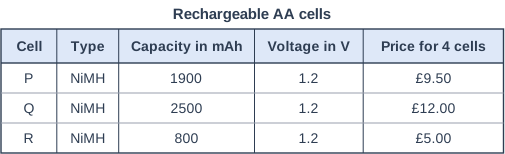
The table shows information about three rechargeable AA cells.

Kai is choosing cells for an LED torch that draws a current of 200 mA. The running time in hours is the capacity in mAh ÷ the current in mA.

Calculate how many hours longer the torch would run on one charge of cell Q than on one charge of cell P.

Rechargeable AA cells. Table with columns "Cell", "Type", "Capacity in mAh", "Voltage in V", "Price for 4 cells". Cell: P; Type: NiMH; Capacity in mAh: 1900; Voltage in V: 1.2; Price for 4 cells: £9.50 | Cell: Q; Type: NiMH; Capacity in mAh: 2500; Voltage in V: 1.2; Price for 4 cells: £12.00 | Cell: R; Type: NiMH; Capacity in mAh: 800; Voltage in V: 1.2; Price for 4 cells: £5.00.

Model answer

Cell P: 1900 ÷ 200 = 9.5 hours
Cell Q: 2500 ÷ 200 = 12.5 hours
12.5 - 9.5 = 3
Answer: 3 hours longer

Explanation

Capacity in mAh tells you how long a cell can supply a current: dividing by the current in mA gives the time in hours. Cell Q has the larger capacity, so it runs the torch for longer at the same voltage. Read the right rows from the table: the voltage is the same for all three cells, so it does not affect this answer.

Mark scheme
  1. 1 mark

    Step 1: cell P: 1900 ÷ 200 = 9.5 (hours)

    Award full marks for a correct answer, even with no working shown.

  2. 1 mark

    Step 2: cell Q: 2500 ÷ 200 = 12.5 (hours)

  3. 1 mark

    Step 3: 12.5 - 9.5 = 3 (hours longer)

    ft their Step 2 - their Step 1. Alternative method: (2500 - 1900) ÷ 200 = 600 ÷ 200 = 3 hours scores full marks; 600 (mAh) seen alone scores 1 mark. Cell R (800 mAh) used instead of P or Q: no marks for that step, but ft the subtraction.

Question 4

6 marks

A designer has produced two LED desk lamps for students to use in their bedrooms.

Lamp A is powered from the mains. It has a 1.8 m cable and a plug-in adaptor that changes 230 V mains electricity into 5 V for the lamp.

Lamp B has a built-in rechargeable lithium-ion battery that cannot be removed. It runs for 5 hours at full brightness and takes 3 hours to recharge from a USB charger.

Analyse and evaluate both lamps in terms of their power systems.

Model answer

Lamp A runs from the mains, so it never runs out. A student could study for hours and the lamp would stay at full brightness. With no battery to wear out it should last for many years, and it is cheaper to make and better for the environment because no lithium battery has to be mined, made or disposed of. The adaptor also means only a safe 5 V reaches the lamp. Its weakness is the 1.8 m cable. The lamp can only be used near a socket, so it cannot be moved to a bed or a desk on the other side of the room, and the trailing cable is untidy and could be tripped over.

Lamp B is cordless, so it can be used anywhere: on the desk, in bed or taken to another room, and it still works in a power cut. Five hours is enough for an evening's homework. However, the student has to remember to charge it, and if it goes flat it is unusable for up to 3 hours. Lithium-ion batteries lose capacity after a few hundred charges, and because this battery cannot be removed the whole lamp may be thrown away when it wears out, which adds to e-waste and makes it poorer value.

Overall, I think Lamp A is the better choice for a student with a fixed desk near a socket, because it is reliable, cheaper and longer lasting. Lamp B is better for a small bedroom with no socket by the desk, but it would be improved by a replaceable battery and by letting it be used while charging.

Explanation

Level 3 answers analyse both lamps, linking each feature of the power system to its effect on the student (reliability, portability, safety, product life and the environment), and then make a reasoned judgement. A common pitfall is to describe the lamps without evaluating, or to write only about one lamp. Points such as the non-removable battery shortening the product's life, and the trailing cable, show real analysis.

Mark scheme
  1. 6 marks

    Levels of response (6 marks).
    Level 3 (5-6 marks): Thorough analysis and evaluation of both desk lamps considering their power systems.
    Level 2 (3-4 marks): Good analysis and simple evaluative points of one or more desk lamps considering their power systems.
    Level 1 (1-2 marks): Basic analysis of one or two simple power system points for either desk lamp.
    0 marks: No response or nothing worthy of credit.

    Indicative content (illustrative, not exhaustive; credit any worthy points made in support of the band descriptors): Lamp A (mains): a continuous supply, so it never runs out or dims during a long study session; no battery to wear out, so the lamp should last longer; cheaper to make with no battery or charging circuit; less environmental impact (no lithium or cobalt to mine, less e-waste, no battery disposal problem); the adaptor gives a safe low voltage (5 V) at the lamp; but it must be used within 1.8 m of a socket, so it cannot be moved around the room or used on a bed or a desk with no socket nearby; the trailing cable can be untidy, can be a trip hazard or get caught; it does not work in a power cut. Lamp B (battery): cordless and portable, so it can be used anywhere - at a desk, in bed, on the floor, or taken to another room; tidy desk with no trailing cable; works in a power cut; 5 hours is enough for an evening of homework; but it must be remembered and recharged, and it cannot be used for a long session if it is flat (3 hours to recharge); the battery's capacity falls after a few hundred charges, so the running time gets shorter; because the battery cannot be removed, the whole lamp may be thrown away when the battery wears out (shorter product life, e-waste); lithium-ion batteries must be disposed of at a recycling point because they can catch fire if damaged; usually costs more; it still uses mains electricity to recharge. Analysis: identification of the features of each power system and how each affects the student using the lamp (convenience, cost, safety, product life, environment). Evaluation: a judgement on which lamp suits students better and why, e.g. Lamp A for a fixed study desk used for long periods; Lamp B for a small room, a bedside or where there is no nearby socket; or that the best choice depends on the user's needs. Answers that only describe one lamp cannot reach Level 3. Accept all other valid responses.

Ready to try the rest? Every answer you write is marked against the mark scheme, so you can see exactly where the marks are.

Study Helper Hints first, answers after you try

Stuck on this one? Ask for a hint and I’ll point you in the right direction, without giving the answer away. Once you’ve checked your answer, I’ll show you how the marks are awarded.