
Level:
Correct: 0
Incorrect: 0
Marks: 0/0
Exam Practice
Course:
Topics:
AQA GCSE Design and Technology Smart practice A mixed round aimed at your weak spots
Unit 1
Core technical principles
Unit 2
Specialist technical principles
Unit 3
Designing and making principles
Investigation, primary and secondary data
Environmental, social and economic challenge
Design strategies
Design strategies
Communication of design ideas
Prototype development
Selection of materials and components
Selecting materials and components for prototypes
Specialist tools and equipment
Avg
score:
–
Topics
done:
0/40

Textile fibres and fabrics

Practise 18 exam-style questions on Textile fibres and fabrics for AQA GCSE Design and Technology. Write your answer as you would in the exam and get it marked in seconds against the mark scheme, point by point, with the Study Helper on hand if you get stuck.

  • 18 questions
  • 1–8 marks each
  • Instant marking
  • No sign-up needed
18 questions, marked as you go

Sample questions with model answers

Here are 4 of the questions in this topic, each with a model answer, an explanation of why it earns the marks and the mark scheme an examiner would use.

Question 1

1 mark

Which one of the following statements about a plain weave fabric is true?

Choose your answer.

  • It is made from loops of yarn that interlock with each other
  • Each weft yarn passes alternately over and under one warp yarn at a time
  • It is made from a web of fibres held together with adhesive or heat
  • It is made by matting wool fibres together using heat, moisture and pressure

Model answer

Each weft yarn passes alternately over and under one warp yarn at a time

Explanation

A plain weave is the simplest woven structure: the weft yarn passes over one warp yarn and under the next, and each row is the reverse of the one before. This gives a firm, strong, hard-wearing fabric that looks the same on both sides and has a flat surface that prints well. The other statements describe knitted, bonded and felted fabrics.

Mark scheme
  1. 1 mark

    Each weft yarn passes alternately over and under one warp yarn at a time

    If more than one option is given, 0 marks. 'Loops of yarn that interlock' describes a knitted fabric. 'A web of fibres held together with adhesive or heat' describes a bonded (non-woven) fabric. 'Matting wool fibres together using heat, moisture and pressure' describes felted fabric. None of these is woven.
Question 2

2 marks

Ropes for rock climbing are made from polyamide (nylon) fibres.

Give two properties of polyamide that make it suitable for a climbing rope.

Model answer

Polyamide has a high tensile strength, so the rope will not snap when it holds a climber who falls.
It is elastic, so the rope stretches to absorb the shock of a fall and then returns to its length.

Explanation

Polyamide is a synthetic fibre made from oil. It is very strong in tension, elastic and abrasion resistant, which together explain its use for climbing ropes, tights and carpets. The stretch matters: a rope that did not stretch would stop a falling climber too suddenly. 'Strong' must be qualified, for example 'strong in tension'.

Mark scheme
  1. 1 mark

    High tensile strength / very strong in tension, so it does not snap when it holds a falling climber

    One mark for each correct property given, max 2. Do not accept 'strong' with no qualification; accept 'high tensile strength' or 'strong when pulled'.

  2. 1 mark

    Elastic / stretches and then recovers its length, so it absorbs the shock (energy) of a fall

    Accept 'has some stretch'.

  3. 1 mark

    Abrasion resistant / hard-wearing when rubbed over rock edges

    Accept 'durable' if linked to rubbing or wear.

  4. 1 mark

    Lightweight (low density), so long lengths are easy to carry

  5. 1 mark

    Does not rot or go mouldy if it gets damp

    Accept 'resists rot and mildew'. Do not accept 'absorbent', 'cheap' or 'waterproof'. Accept 'flexible' only if linked to coiling or tying knots. Accept all other valid responses.

Question 3

4 marks

Tea towels are often made from 100% cotton.

Explain two reasons why cotton is a suitable fibre for tea towels.

Model answer

Cotton is very absorbent. Its cellulose fibres soak up water, so the tea towel dries plates and glasses quickly instead of just spreading the water around.
Cotton can be washed at high temperatures and ironed with a hot iron without melting or being damaged, so bacteria from the kitchen can be killed and the tea towel stays hygienic.

Explanation

Good answers name a property of cotton and then link it to what a tea towel has to do: dry wet dishes and stay clean in a kitchen. Cotton is absorbent, can be washed hot, is stronger wet than dry and does not melt, so it suits tea towels, bath towels and dishcloths. 'It is natural' or 'it is cheap' on their own do not explain why it is suitable.

Mark scheme
  1. 1 mark

    Reason 1: a valid reason, e.g. cotton is absorbent / can be washed at high temperatures / is stronger when wet / does not melt / is soft

    Maximum of two marks for each reason. The second mark for a reason is given only when that same reason is developed. Reason 2 must be different from reason 1.

  2. 1 mark

    Reason 1 developed: explains how this suits a tea towel, e.g. its cellulose fibres soak up a lot of water, so it dries plates and glasses instead of spreading the water around / hot washing kills bacteria so it stays hygienic, without damaging the fibres / it does not tear when rubbed while damp and survives frequent washing / it scorches rather than melting if it touches a hot pan / it does not scratch glasses

  3. 1 mark

    Reason 2: a second, different valid reason (as listed for reason 1)

  4. 1 mark

    Reason 2 developed: explains how this second reason suits a tea towel (as in the examples for reason 1)

    Do not accept 'it is natural', 'it is cheap' or 'it is strong' with no link to the use. Do not accept 'cotton is waterproof' or 'cotton does not absorb water'. Accept 'renewable and biodegradable' as a reason only if developed (e.g. it comes from a plant that can be regrown and breaks down at the end of its life). Accept all other valid responses.

Question 4

6 marks

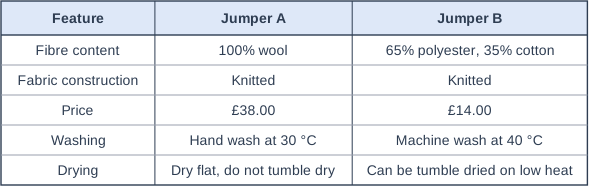
A school is choosing a jumper for its uniform. The table shows information about two jumpers.

Analyse and evaluate the suitability of each jumper for the school uniform. In your answer you should consider:
- comfort and warmth
- care and durability
- cost.

Table with columns "Feature", "Jumper A", "Jumper B". Feature: Fibre content; Jumper A: 100% wool; Jumper B: 65% polyester, 35% cotton | Feature: Fabric construction; Jumper A: Knitted; Jumper B: Knitted | Feature: Price; Jumper A: £38.00; Jumper B: £14.00 | Feature: Washing; Jumper A: Hand wash at 30 °C; Jumper B: Machine wash at 40 °C | Feature: Drying; Jumper A: Dry flat, do not tumble dry; Jumper B: Can be tumble dried on low heat.

Model answer

Jumper A is 100% wool. Wool fibres have a natural crimp that traps air, so this jumper is very warm, which suits cold winter mornings and draughty classrooms. Wool can absorb a lot of moisture vapour without feeling damp, so it stays comfortable if a student gets warm, and it is elastic, so it keeps its shape and does not crease. However, some students find wool itchy. The care label is a real drawback for a school uniform: wool felts and shrinks if it is washed too hot or tumble dried, so parents must hand wash it at 30 °C and dry it flat, which is slow. At £38.00 it is also expensive, more than two and a half times the price of Jumper B, and children outgrow jumpers quickly.

Jumper B is 65% polyester and 35% cotton. The polyester makes it strong and hard-wearing, so the elbows and cuffs will survive a year of school, and it does not shrink, so it can be machine washed at 40 °C and tumble dried overnight. The cotton makes it softer and more absorbent than pure polyester, so it is less itchy than wool. It is not as warm as wool, because the fibres do not trap as much air, and polyester can pill and feel clammy if the wearer is hot. Polyester is also made from crude oil, which is a finite resource.

Overall, I think Jumper B is more suitable for a school uniform. It is £24 cheaper, so families can afford a spare, it is durable and it is far easier to wash and dry. Jumper A is warmer and more comfortable, so it might suit a school in a very cold area if families can afford it and are willing to hand wash it.

Explanation

Top-level answers analyse both jumpers against all three areas, using the information in the table (fibre content, care instructions and prices), and finish with a reasoned judgement about which is more suitable for a school. Simply listing properties of wool and polyester without linking them to school use, or describing only one jumper, keeps an answer in Level 1 or 2. Using the prices and care labels as evidence strengthens the evaluation.

Mark scheme
  1. 6 marks

    Levels of response (6 marks).
    Level 3 (5-6 marks): Thorough analysis and evaluation of both jumpers considering comfort and warmth, care and durability, and cost for a school uniform.
    Level 2 (3-4 marks): Good analysis and simple evaluative points of one or more jumpers considering comfort and warmth, care and durability, or cost.
    Level 1 (1-2 marks): Basic analysis of one or two simple points about comfort and warmth, care and durability, or cost for either jumper.
    0 marks: No response or nothing worthy of credit.

    Indicative content (illustrative, not exhaustive; credit any worthy points made in support of the band descriptors): Jumper A (100% wool): the crimp in wool fibres traps air, so it is very warm, good for cold classrooms and walking to school; wool absorbs a lot of moisture vapour (up to about 30% of its own weight) without feeling damp, so it stays comfortable; wool is elastic and resilient, so it recovers its shape and resists creasing; wool is naturally flame resistant (it tends to self-extinguish); natural, renewable and biodegradable; but some students find wool itchy or scratchy, especially with sensitive skin; it felts and shrinks if washed too hot, agitated or tumble dried, so it must be hand washed or washed on a wool cycle and dried flat, which takes longer and is less convenient for busy families; wool is weaker when wet and can be damaged by moths; at £38.00 it costs about 2.7 times as much as Jumper B (£24 more per jumper), which is a lot for families buying several jumpers as children grow. Jumper B (65% polyester, 35% cotton): polyester is strong and abrasion resistant, so elbows and cuffs wear well; it keeps its shape, does not shrink and dries quickly, so it can be machine washed at 40 °C and tumble dried, which is easy care for families; cotton gives softness and some absorbency, so it is less itchy than wool; colourfast and cheaper at £14.00, so families can afford spares; but it is less warm than wool because the fibres have no natural crimp; the low absorbency of polyester can make it feel clammy if the wearer is hot; polyester can pill and build up static; it melts when heated; polyester comes from crude oil, a finite resource. Both are knitted, so both stretch, trap some air and allow movement. Analysis: identification of how the properties of wool and of polyester/cotton affect comfort, warmth, care, durability and cost. Evaluation: judgements on which jumper is more suitable for the school and its families, with reasons, e.g. Jumper B is the more suitable choice for most families because it is cheaper, durable and easy to wash and dry, even though Jumper A is warmer and more comfortable in cold weather. Accept all other valid responses.

Ready to try the rest? Every answer you write is marked against the mark scheme, so you can see exactly where the marks are.

Study Helper Hints first, answers after you try

Stuck on this one? Ask for a hint and I’ll point you in the right direction, without giving the answer away. Once you’ve checked your answer, I’ll show you how the marks are awarded.