A designer is developing an electric potter's wheel for a school art room. The motor runs at 1400 rpm and the wheel head must turn at up to about 240 rpm. Two drive designs are being considered.
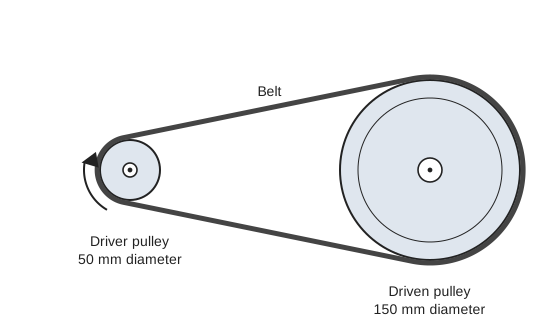
Design 1: a vee belt and pulleys from the motor to the wheel head
Design 2: a compound gear train from the motor to the wheel head
Analyse and evaluate both designs for this product.
Model answer
Both designs need to reduce the speed by about 1400 ÷ 240 = 5.8 times.
Design 1 would need a driven pulley about six times the diameter of the motor pulley, for example 50 mm and 300 mm, which would fit under the wheel head. A belt drive is quiet, which matters in a classroom where a teacher is talking, and it absorbs vibration so the wheel turns smoothly. Its biggest advantage in a school is that the belt can slip: if a student's clay jams the wheel or something gets caught, the belt slips instead of the motor stalling, which protects the motor and the student. It is also cheap, needs no oil and the belt is easy to replace. However, slip means the wheel may slow down when a heavy lump of clay is being centred, and water and clay slip splashing onto the belt would make it slip more, so the drive must be covered. The belt will also stretch and wear, so it needs a tensioner and occasional maintenance.
Design 2 gives a positive drive with no slip, so the wheel keeps a steady speed and full turning force even with a heavy load, and a two-stage compound train, such as 2.4:1 × 2.4:1, would be compact and long-lasting. However, gears are noisier, more expensive to make accurately, and need lubrication. Grease could contaminate the clay, and water and clay could get into the gears, so a sealed gearbox would be needed. Because gears cannot slip, a jam could stall and damage the motor or injure a student unless an overload cut-out or clutch is added.
Overall, I think Design 1 is the better choice for a school art room: it is quieter, cheaper, simpler to maintain and safer because of its ability to slip, as long as the belt is fully guarded and kept at the correct tension. Design 2 would suit a professional potter who needs constant speed and turning force with large amounts of clay.
Explanation
Top-level answers analyse both drives against the real context - a school, with students, water and clay, noise and safety - rather than listing generic features, and finish with a justified choice. Using the speed reduction needed (about 5.8:1) to discuss pulley sizes or gear stages strengthens the analysis. Answers covering only one design stay in Level 2 or below.