Practise 20 exam-style questions on New technologies in industry and enterprise for AQA GCSE Design and Technology. Write your answer as you would in the exam and get it marked in seconds against the mark scheme, point by point, with the Study Helper on hand if you get stuck.
20 questions
1–8 marks each
Instant marking
No sign-up needed
20 questions, marked as you go
Sample questions with model answers
Here are 4 of the questions in this topic, each with a model answer, an explanation of why it earns the marks and the mark scheme an examiner would use.
Question 1
1 mark
A car manufacturer uses robots, rather than people, to spray paint car bodies.
Which one of the following is the main reason for this?
Choose your answer.
Robots give an even coat and keep workers away from harmful paint fumes
Robots cost less to buy and install than paying one painter for a year
Robots can paint a new car design without any reprogramming
Robots never need maintenance or servicing
Model answer
Robots give an even coat and keep workers away from harmful paint fumes
Explanation
A robot follows exactly the same programmed path every time, so every car body gets the same thickness of paint with less overspray and waste. Spray painting produces mist and solvent fumes that are harmful to breathe, so automating it removes people from a hazardous task. The high cost of robots and their need for programming and maintenance are disadvantages, not reasons for using them.
Mark scheme
1 mark
Robots give an even coat and keep workers away from harmful paint fumes
If more than one option is given, 0 marks. Industrial painting robots are expensive to buy, install and program, costing far more than one painter's yearly wage; the saving comes over several years. A robot must be reprogrammed (given a new path) for a new body shape. Robots need regular maintenance, such as cleaning spray nozzles and servicing joints, and breakdowns stop the line.
Question 2
2 marks
Give two ways technology in a modern 'smart' office building can reduce the amount of energy the building uses.
Model answer
1. Motion sensors switch the lights off in rooms that are empty. 2. A building management system turns the heating down in areas that are not being used and outside working hours.
Explanation
Smart buildings use sensors and automatic controls so that lighting, heating and cooling are only used where and when they are needed. Each mark needs a specific technology or control, not just the result, so 'it saves energy' on its own scores nothing.
Mark scheme
1 mark
Motion (PIR) sensors switch lights off in empty rooms / daylight sensors dim the lights when there is enough natural light
One mark for each correct way given. max 2. The two ways must be different (two kinds of light sensor count once). 'Saves electricity' or 'uses less energy' without saying how gains nothing. Accept solar panels or heat pumps as reducing the energy bought from the grid or from fossil fuels. Accept all other valid responses.
1 mark
A building management system controls the heating, cooling and ventilation by time of day and by which rooms are in use / smart thermostats
1 mark
Low-energy LED lighting
1 mark
Automatic blinds or smart glass that reduce heat from the sun, so less air conditioning is needed
1 mark
Smart meters / energy monitoring that show where energy is being wasted
1 mark
Equipment that switches off automatically instead of being left on standby
1 mark
Solar panels on the roof / heat pumps, which reduce the energy bought from the grid or made from fossil fuels
Question 3
3 marks
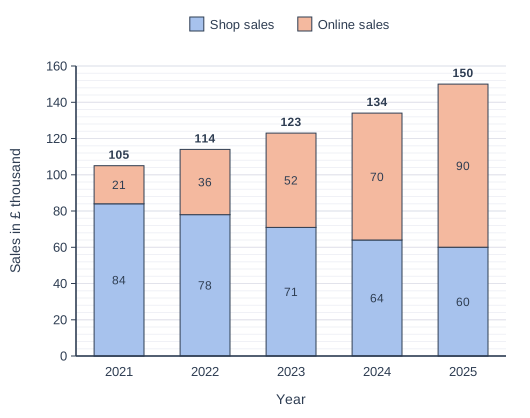
Sam runs a company that makes bicycle accessories. The chart shows the value of the company's sales in its shops and online in each of five years.
Use the chart to: - identify the first year in which online sales were greater than shop sales - calculate the percentage of the company's total sales in 2025 that were made online.
Model answer
Online sales were first greater than shop sales in 2024 (£70,000 online, £64,000 in shops).
Compare the two parts of each bar to find the first year the online part is larger. For a percentage of the total, divide the online value by the whole bar (shop plus online), not by the shop value. The chart shows a steady move from shop to online sales, which is typical of the growth of virtual retail.
Mark scheme
1 mark
2024
In 2024 online sales were £70,000 and shop sales £64,000. 2025 is not the first such year.
1 mark
90 ÷ (60 + 90) × 100 / 90 ÷ 150 × 100
Award full marks for the second part for a correct answer, even with no working shown. Accept working in pounds (90,000 ÷ 150,000 × 100). 60 ÷ 150 × 100 = 40% (the shop share: divided by the correct total but used the wrong part) scores this method mark but not the answer mark. 90 ÷ 60 × 100 = 150% (online sales as a percentage of shop sales) scores 0 for this part.
1 mark
60%
Accept 60.
Question 4
4 marks
A kitchen design company has an office in a city centre where its six designers work. The company plans to close the office. The designers would work from home, using cloud-based CAD software and video calls to meet each other and their clients.
Analyse and evaluate the company's plan in terms of how it changes the designers' place of work.
Model answer
Working from home would save the company the rent, business rates and energy bills of a city-centre office, and the designers would save commuting time and fares, which also cuts traffic and emissions. Cloud-based CAD means all six designers can work on the latest version of a kitchen layout from anywhere, and video calls with screen sharing let clients see a 3D walkthrough of their new kitchen without travelling.
However, the designers would lose the quick, informal sharing of ideas that happens in an office, and training a new designer would be much harder. Each home would need a proper desk, an adjustable chair, a large screen, a computer powerful enough for rendering and fast broadband, which costs money. Kitchen clients also usually want to see and touch real worktop and door samples before they commit, which a video call cannot replace.
Overall, I think the plan is good for saving money but goes too far. A better solution would be to replace the large office with a small showroom and meeting space with hot desks, used two days a week, so the company keeps most of the savings while clients can still handle samples and the designers can work together.
Explanation
Level 2 needs both positive and negative effects explained and linked to this company (CAD, clients, samples), followed by a justified conclusion, such as a hybrid office. Answers that only list advantages, or that give no overall judgement, stay in Level 1.
Mark scheme
4 marks
Levels of response (4 marks). Level 2 (3-4 marks): Well described and justified analysis containing full evaluation, drawing on conclusions having considered both positive and negative factors. Level 1 (1-2 marks): Brief points mentioned but not fully explained. Analysis present but limited evaluation/conclusions drawn. May have focused solely on either positive or negative factors. 0 marks: No attempt or nothing worthy of credit.
Analysis: identification of the effects of moving the place of work from the office to the designers' homes. Evaluation: judgement on whether the benefits outweigh the drawbacks, with a conclusion. Indicative content (illustrative, not exhaustive; credit any worthy points made in support of the band descriptors): Positive: the company saves office rent, business rates, energy and cleaning costs; designers save commuting time and fares, with less traffic and fewer carbon dioxide emissions; flexible hours and a better work-life balance; the company can recruit designers who live anywhere; cloud-based CAD means everyone works on the latest version of each design from anywhere, and files are backed up; video calls with screen sharing let clients see 3D renders or virtual walkthroughs of their kitchen without travelling. Negative: designers lose face-to-face sharing of ideas and quick informal feedback; training junior designers is harder; isolation can affect wellbeing; work and home life may blur; each home needs a suitable workstation (desk, adjustable chair, large screens), a powerful computer for rendering and fast, reliable broadband, which costs money, and the employer must still check home workstations are safe and comfortable; client data must be kept secure; clients often want to see and touch real samples of worktops, doors and handles, which needs a showroom or meeting space. Evaluation: e.g. a hybrid arrangement - a small shared office or showroom with hot desks used on some days - keeps most of the savings while allowing meetings, training and samples; the plan suits experienced designers more than new staff. Accept all other valid responses.
Ready to try the rest? Every answer you write is marked against the mark scheme, so you can see exactly where the marks are.
Ctrl + Enter to check
Study HelperHints first, answers after you try
Stuck on this one? Ask for a hint and I’ll point you in the right direction, without giving the answer away. Once you’ve checked your answer, I’ll show you how the marks are awarded.