Practise 20 exam-style questions on Sustainability, people, culture and society for AQA GCSE Design and Technology. Write your answer as you would in the exam and get it marked in seconds against the mark scheme, point by point, with the Study Helper on hand if you get stuck.
20 questions
1–8 marks each
Instant marking
No sign-up needed
20 questions, marked as you go
Sample questions with model answers
Here are 4 of the questions in this topic, each with a model answer, an explanation of why it earns the marks and the mark scheme an examiner would use.
Question 1
1 mark
An elderly person has arthritis in their hands, which makes gripping small objects painful.
Which feature of a vegetable peeler would help them most?
Choose your answer.
A thin, smooth metal handle
A heavy, solid steel handle
A very sharp blade with no guard
A large, cushioned, non-slip handle
Model answer
A large, cushioned, non-slip handle
Explanation
A large-diameter handle can be held with a loose grip rather than a tight pinch, the cushioned surface reduces pressure on painful joints and a non-slip material stops it turning in the hand. Designing for elderly users means allowing for reduced grip strength, dexterity and eyesight.
Mark scheme
1 mark
A large, cushioned, non-slip handle
If more than one option is given, 0 marks. A thin handle needs a tight pinch grip, which is painful with arthritis, and smooth metal is slippery. A heavy handle tires the hand quickly and is harder to control. A sharp, unguarded blade does not help the user's grip and increases the risk of cuts.
Question 2
2 marks
A company is designing a range of sportswear for women who choose to dress modestly because of their religious beliefs.
Give two features the designer could include in the sportswear.
Model answer
1. Long sleeves and full-length leggings, so the arms and legs are covered. 2. A built-in sports head covering that stays in place during exercise without pins.
Explanation
Designing for different religious groups means understanding their needs and respecting their beliefs. Modest sportswear covers more of the body, so it must also use technical fabrics that are breathable and wick sweat away, or the wearer would overheat.
Mark scheme
1 mark
Long sleeves and full-length leggings or trousers, so the arms and legs are covered
One mark for each correct feature given. max 2. The two features must be different. Do not credit features unrelated to modesty or to comfort while covered, e.g. 'bright colours' or 'a logo'. Accept all other valid responses.
1 mark
A loose-fitting cut / a longer tunic top that covers the hips, so the body shape is not revealed
1 mark
A built-in sports head covering (sports hijab) that stays in place during exercise without pins
1 mark
Opaque fabric that is not see-through, even when wet or stretched
1 mark
Lightweight, breathable, moisture-wicking fabric, so the wearer stays cool and dry even though more of the body is covered
Question 3
3 marks
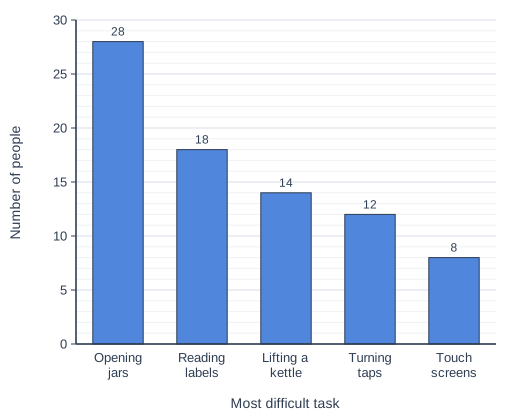
A designer surveyed 80 people aged over 70. She asked each person which task they found most difficult when using products in their kitchen. The bar chart shows the results.
Calculate the percentage of the people surveyed who chose opening jars.
Then give one design feature that would help with the task chosen by the second-largest number of people.
The second-largest number of people (18) chose reading labels. A product could have large, high-contrast text on its labels and controls, for example white numbers on a black background.
Explanation
Divide the number who chose the task by the total surveyed and multiply by 100. The second part tests reading the chart: the second-tallest bar is reading labels, not lifting a kettle. Good design features for elderly users with poor eyesight make information larger, clearer or available by touch or sound.
Mark scheme
1 mark
Step 1: 28 ÷ 80 × 100
Award full marks for the percentage for a correct answer, even with no working shown.
1 mark
Step 2: 35%
Accept 35.
1 mark
A feature that helps with reading labels (small print on products and packaging, chosen by 18 people), e.g. large, clear, high-contrast text on labels and controls / a backlit display / raised tactile symbols or markings / spoken (audio) instructions or readouts / a built-in magnifier / colour-coded controls
The task must be reading labels. A feature for opening jars (the most popular answer) or for another task scores 0 for this mark. 'Make it bigger' alone is too vague: the text or symbols must be larger or clearer.
Question 4
6 marks
Explain how new and emerging technologies have led to changes in fashion and trends.
Give examples in your answer.
Model answer
Social media has changed how trends start and spread. A style worn by an influencer can be seen by millions of people within hours, so trends now appear and disappear in weeks rather than following two fashion seasons a year. Fast-fashion companies use online sales data and CAD to design copies of these styles and get them on sale within a few weeks, which encourages people to buy more often but creates much more textile waste.
Digital manufacturing has made personalised fashion a trend. Digital textile printing can print a single T-shirt with a customer's own design as cheaply as a large batch, and some companies let customers choose the colours and materials of their trainers online before they are made to order. 3D printing makes jewellery and shoe soles with complex lattice shapes that could not be cast or moulded before.
New materials and smart textiles have created new trends too. Fitness trackers and smart watches have become fashion accessories, with interchangeable straps to match outfits, and breathable waterproof fabrics developed for sport are now everyday wear. Recycled polyester made from drinks bottles and leather alternatives made from plant fibres have helped create a trend for sustainable fashion, along with apps for reselling and renting clothes.
Finally, trends affect products as well as clothes: phones are released in new fashionable colours each year, and as a reaction to digital technology, film cameras and vinyl records have become fashionable again.
Explanation
Top-level answers explain how specific technologies create or speed up trends (social media, digital printing, 3D printing, smart textiles, new materials) and give real examples for each. Simply listing technologies stays in Level 1, and answers without examples cannot go above four marks.
Mark scheme
6 marks
Levels of response (6 marks). Level 3 (5-6 marks): A thorough and detailed explanation with clear, relevant discussion of new and emerging technologies and changes in fashion and trends. Excellent understanding of how these technologies create, spread or change trends. Clear example(s) given to support the response. Level 2 (3-4 marks): A good explanation with relevant supporting discussion of new technologies and fashion and trends. Some understanding of how these technologies create, spread or change trends. There may be example(s) given to support the response. Level 1 (1-2 marks): Basic discussion with general points made around new technologies and fashion and what they are. Little or no consideration of examples to support the response. 0 marks: No response or nothing worthy of credit.
Maximum of four marks for detailed points but no examples given. Indicative content (illustrative, not exhaustive; credit any worthy points made in support of the band descriptors): social media and influencers spread new styles instantly around the world, creating short-lived micro-trends; online shopping and sales data let fast-fashion companies design, make and sell copies of new trends within weeks; CAD/CAM and digital textile printing allow short runs, fast changes of design and personalised products (names, own photos, made-to-order trainers); body scanning and online size tools for custom fit; augmented reality virtual try-on of clothes, glasses and make-up; 3D printing of jewellery, shoe soles and accessories with complex lattice shapes not possible before; smart and technical textiles - wearable technology such as fitness trackers and smart watches becoming fashion items, garments with LEDs or conductive threads, thermochromic colour-changing prints, breathable waterproof fabrics making outdoor and sports clothing everyday wear; new materials such as recycled polyester from drinks bottles and leather alternatives made from plant or fungus fibres, linked to a trend for sustainable fashion; resale and rental apps; trends in products as well as clothing - phone colours and finishes, folding phones, smart home devices as lifestyle items; a reaction to digital technology making retro products such as vinyl records and film cameras fashionable again; digital-only clothing for avatars in games and virtual worlds; drawbacks - more frequent buying, more textile waste, pressure to keep up. Accept all other valid responses.
Ready to try the rest? Every answer you write is marked against the mark scheme, so you can see exactly where the marks are.
Ctrl + Enter to check
Study HelperHints first, answers after you try
Stuck on this one? Ask for a hint and I’ll point you in the right direction, without giving the answer away. Once you’ve checked your answer, I’ll show you how the marks are awarded.