Environment, production systems and critical evaluation
Practise 22 exam-style questions on Environment, production systems and critical evaluation for AQA GCSE Design and Technology. Write your answer as you would in the exam and get it marked in seconds against the mark scheme, point by point, with the Study Helper on hand if you get stuck.
22 questions
1–8 marks each
Instant marking
No sign-up needed
20 questions, marked as you go
Sample questions with model answers
Here are 4 of the questions in this topic, each with a model answer, an explanation of why it earns the marks and the mark scheme an examiner would use.
Question 1
1 mark
Which one of the following design features makes a product easier to maintain?
Choose your answer.
Casing parts joined by ultrasonic welding
A battery sealed permanently inside the casing
Parts held together with standard screws
Components fixed with permanent adhesive
Model answer
Parts held together with standard screws
Explanation
Design for maintenance means making a product easy to clean, service, repair and upgrade, so it lasts longer. Standard screws let the product be opened with ordinary tools, and a removable filter can be cleaned or replaced by the user. Permanent joining methods make repair difficult and are often linked to planned obsolescence.
Mark scheme
1 mark
Parts held together with standard screws
If more than one option is given, 0 marks. Ultrasonic welding and permanent adhesive join parts permanently, so the product cannot be opened without damage. A battery sealed inside the casing cannot be replaced when it wears out, so the whole product may be thrown away.
Question 2
2 marks
Explain how continuous improvement of a product, such as a family car or a washing machine, can have a positive impact on the environment.
Model answer
Continuous improvement means each new model is developed from the last one and made better. For example, each new model of washing machine is designed to use less water and electricity per wash, so over its life it uses fewer resources and less of the electricity that power stations make by burning fossil fuels.
Explanation
Continuous improvement is the identification of improvements and the evolution of products over time. Many improvements make products more efficient, lighter or longer lasting, which reduces their impact. It can also have a negative side if people throw away products that still work to buy the newest version.
Mark scheme
1 mark
Each new version of the product is developed to be more efficient / to use less energy, fuel, water or material than the one before
One mark for a simple correct point; a second mark for developing that same point with its effect or a specific example. Do not credit negative impacts (e.g. people replacing products that still work).
1 mark
Developed: e.g. each new car model is lighter and has a more efficient engine or is hybrid/electric, so it burns less fuel and releases less carbon dioxide and pollution per kilometre / each new washing machine model uses less water and electricity per wash
Question 3
3 marks
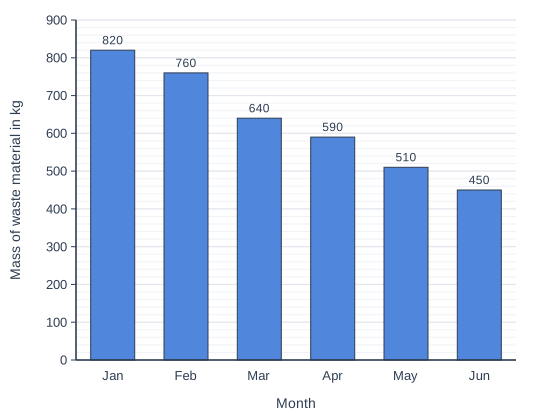
A factory introduced lean manufacturing methods at the start of January. The bar chart shows the mass of waste material it produced each month from January to June.
Calculate the percentage reduction in the mass of waste material from January to June. Give your answer to the nearest whole number.
Percentage reduction = reduction ÷ original value × 100, and the original value is January's 820 kg, not June's. The chart shows that lean methods such as quality checks at each stage, better layouts and nesting reduce material waste month by month, which is how continuous improvement works in practice.
Mark scheme
1 mark
Step 1: reduction = 820 - 450 = 370 kg
Award full marks for a correct answer, even with no working shown.
1 mark
Step 2: 370 ÷ 820 × 100
ft their reduction ÷ 820 × 100. Dividing by the June value (370 ÷ 450 × 100 = 82%) scores Step 1 only. 450 ÷ 820 × 100 = 55% (June as a percentage of January) scores 0 unless followed by 100 - 55 = 45%.
1 mark
Step 3: 45%
Accept 45 only for this mark (mark the number). An answer not rounded to the nearest whole number (e.g. 45.1 or 45.12): award Steps 1 and 2 only.
Question 4
4 marks
A delivery company plans to replace its diesel vans in a city centre with electric cargo bikes. Each bike has a battery-assisted motor and a large box for parcels.
Analyse and evaluate this new product in terms of its impact on the environment.
Model answer
The cargo bikes would produce no exhaust fumes, so the city centre would have less air pollution such as nitrogen dioxide and particulates, which harm people's health. They also release far less carbon dioxide than diesel vans, especially if the batteries are charged with renewable electricity, so the company would contribute much less to global warming. A bike also needs far less material and energy to make than a van, and it is quieter.
However, the batteries contain finite metals such as lithium and cobalt, and mining them damages the environment, and the batteries must be recycled carefully when they wear out. Each bike carries far fewer parcels than a van, so more bikes and journeys are needed, and vans would still be needed for heavy items and to bring parcels into the city.
Overall, I think the cargo bikes are much better for the environment for short city-centre deliveries, as long as they are charged from renewable sources and the batteries are recycled. The best solution is to use larger vehicles to bring parcels to a city-centre depot and the bikes for the final part of each journey.
Explanation
Level 2 needs both positive and negative environmental impacts explained, not just listed, and a justified conclusion. Strong answers recognise that 'zero emissions' applies only at the point of use, because battery manufacture and electricity generation also have impacts. Answers that only praise the bikes stay in Level 1.
Mark scheme
4 marks
Levels of response (4 marks). Level 2 (3-4 marks): Well described and justified analysis containing full evaluation, drawing on conclusions having considered both positive and negative factors. Level 1 (1-2 marks): Brief points mentioned but not fully explained. Analysis present but limited evaluation/conclusions drawn. May have focused solely on either positive or negative factors. 0 marks: No attempt or nothing worthy of credit.
Analysis: identification of the positive and negative environmental impacts of the cargo bikes. Evaluation: judgement on whether the overall impact is better than the diesel vans, with a conclusion. Indicative content (illustrative, not exhaustive; credit any worthy points made in support of the band descriptors): Positive: no exhaust emissions in the city, so less air pollution (nitrogen dioxide, particulates) where people live and work; far less carbon dioxide, especially if charged from renewable electricity, reducing the contribution to global warming; a bike needs far fewer materials and much less energy to make than a van; small battery uses much less electricity than an electric van; quieter, so less noise pollution; less congestion, so other traffic idles less. Negative: batteries need finite metals such as lithium and cobalt, whose mining damages habitats; batteries wear out and must be recycled carefully; electricity may still be generated partly from fossil fuels; carries fewer parcels than a van, so more bikes and trips are needed; tyres and brakes still produce some particles; vans may still be needed for heavy items or longer distances, and to bring parcels to the city-centre depot. Evaluation: e.g. for short city-centre trips the overall impact is much better, especially with renewable charging; the best system combines larger vehicles to a depot with cargo bikes for the last part of the journey. Accept all other valid responses.
Ready to try the rest? Every answer you write is marked against the mark scheme, so you can see exactly where the marks are.
Ctrl + Enter to check
Study HelperHints first, answers after you try
Stuck on this one? Ask for a hint and I’ll point you in the right direction, without giving the answer away. Once you’ve checked your answer, I’ll show you how the marks are awarded.