
Level:
Correct: 0
Incorrect: 0
Marks: 0/0
Exam Practice
Course:
Topics:
AQA GCSE Design and Technology Smart practice A mixed round aimed at your weak spots
Unit 1
Core technical principles
Unit 2
Specialist technical principles
Unit 3
Designing and making principles
Investigation, primary and secondary data
Environmental, social and economic challenge
Design strategies
Design strategies
Communication of design ideas
Prototype development
Selection of materials and components
Selecting materials and components for prototypes
Specialist tools and equipment
Avg
score:
–
Topics
done:
0/40

Modern and smart materials

Practise 20 exam-style questions on Modern and smart materials for AQA GCSE Design and Technology. Write your answer as you would in the exam and get it marked in seconds against the mark scheme, point by point, with the Study Helper on hand if you get stuck.

  • 20 questions
  • 1–8 marks each
  • Instant marking
  • No sign-up needed
20 questions, marked as you go

Sample questions with model answers

Here are 4 of the questions in this topic, each with a model answer, an explanation of why it earns the marks and the mark scheme an examiner would use.

Question 1

1 mark

Why are liquid crystal displays (LCDs) often used in battery-powered products such as calculators and digital watches?

Choose your answer.

  • They use very little electrical power
  • They give out their own bright light
  • They change shape when heated
  • They cannot be damaged by pressure

Model answer

They use very little electrical power

Explanation

An LCD only needs a tiny current to change the alignment of its liquid crystals, so a simple display without a backlight can run for years on a small cell. That is why calculators and watches use them. A common misconception is that LCDs give out light: they work by blocking or letting through light.

Mark scheme
  1. 1 mark

    They use very little electrical power

    If more than one option is given, 0 marks. 'They give out their own bright light' is wrong: liquid crystals do not produce light; they control light from the surroundings or from a backlight. 'They change shape when heated' is wrong: that describes a shape memory alloy. 'They cannot be damaged by pressure' is wrong: pressing hard on an LCD can distort or crack it.
Question 2

2 marks

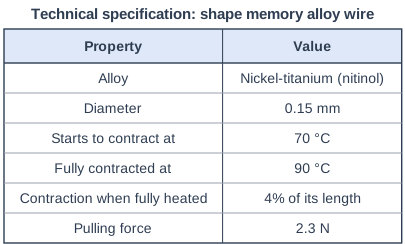
The table shows part of the technical specification for a shape memory alloy wire.

A designer uses a 150 mm length of this wire to pull open the latch on an automatic pet feeder. An electric current heats the wire so that it fully contracts.

Calculate how far the wire pulls the latch. Give your answer in mm.

Technical specification: shape memory alloy wire. Table with columns "Property", "Value". Property: Alloy; Value: Nickel-titanium (nitinol) | Property: Diameter; Value: 0.15 mm | Property: Starts to contract at; Value: 70 °C | Property: Fully contracted at; Value: 90 °C | Property: Contraction when fully heated; Value: 4% of its length | Property: Pulling force; Value: 2.3 N.

Model answer

4% of 150 mm = 0.04 × 150 = 6
Answer: 6 mm

Explanation

The specification says the wire contracts by up to 4% of its length when fully heated, so the movement is 4% of 150 mm. A common error is to give the new length (144 mm) rather than the distance moved. Small movements like this are why shape memory alloy wires are often used with levers to increase the movement.

Mark scheme
  1. 1 mark

    Step 1: 4% of 150 = 0.04 × 150 / 4 ÷ 100 × 150

    Award full marks for a correct answer, even with no working shown.

  2. 1 mark

    Step 2: 6 (mm)

    The unit is given in the question, so mark the number. 144 (the new length of the wire) scores 1 mark. 600 (150 × 4) scores 0.

Question 3

3 marks

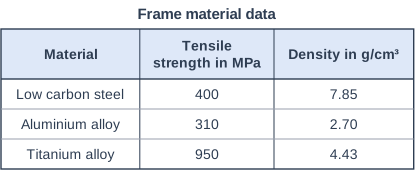
A designer is choosing a material for the frame of a sports wheelchair. The table shows data for three materials.

Strength-to-weight ratio = tensile strength ÷ density

Calculate the strength-to-weight ratio of each material, and state which material would give the lightest frame for a given strength.

Frame material data. Table with columns "Material", "Tensile strength in MPa", "Density in g/cm³". Material: Low carbon steel; Tensile strength in MPa: 400; Density in g/cm³: 7.85 | Material: Aluminium alloy; Tensile strength in MPa: 310; Density in g/cm³: 2.70 | Material: Titanium alloy; Tensile strength in MPa: 950; Density in g/cm³: 4.43.

Model answer

Low carbon steel: 400 ÷ 7.85 = 51
Aluminium alloy: 310 ÷ 2.70 = 115
Titanium alloy: 950 ÷ 4.43 = 214
Titanium alloy has the highest strength-to-weight ratio, so it would give the lightest frame for a given strength.

Explanation

Strength-to-weight ratio compares how strong a material is for its mass, so the highest ratio gives the lightest frame for the strength needed. Titanium alloy's ratio is about four times that of steel, which is why it is used in high-performance products despite its cost. A common error is to choose the material with the highest strength or the lowest density alone.

Mark scheme
  1. 1 mark

    Any one ratio correct: steel 400 ÷ 7.85 = 51 / aluminium alloy 310 ÷ 2.70 = 115 / titanium alloy 950 ÷ 4.43 = 214

    Award full marks for a correct answer, even with no working shown. Accept steel [50.9, 51], aluminium alloy [114.8, 115], titanium alloy [214, 214.5]. Units are not required.

  2. 1 mark

    All three ratios correct

    Density ÷ strength used for all three (0.0196, 0.0087, 0.0047) scores 0 for these two marks; ft to the third mark only if the material with the lowest of these values (titanium alloy) is chosen.

  3. 1 mark

    Titanium alloy (it has the highest strength-to-weight ratio)

    ft the material with the highest of their ratios. Titanium alloy identified with no ratios given scores this mark only (1 mark).

Question 4

6 marks

Explain how smart materials respond to changes in their surroundings, such as temperature, light, stress, moisture or pH, to improve the function of products.

Give examples in your answer.

Model answer

A smart material has a property that changes significantly when something in its surroundings changes, and usually changes back when that stimulus is removed. This lets products react automatically, often without any electronics or power.

Thermochromic pigments respond to temperature by changing colour at a set temperature. A baby's feeding spoon coated with a thermochromic pigment turns pale when food is hotter than about 40 °C, warning the parent not to feed the baby, which makes the product safer. Shape memory alloys such as nitinol also respond to temperature: when heated above their transformation temperature they return to a remembered shape. An anti-scald valve in a shower uses an SMA spring that closes off the hot water if it gets too hot, so the user is protected automatically.

Photochromic pigments respond to ultraviolet light. Spectacle lenses containing them darken outdoors in sunlight and clear again indoors, so the wearer does not need separate sunglasses.

Some smart materials respond to stress. Nitinol glasses frames are superelastic, so if a child sits on them they spring back into shape instead of breaking. Quantum tunnelling composite becomes a conductor when it is squeezed, so it can be used as a flexible pressure switch in clothing.

Others respond to moisture or pH. Hydrochromic inks change colour when wet, for example a pattern that appears on an umbrella in the rain, and pH-sensitive inks on food packaging can change colour to show that food is going off. All of these make products safer, more convenient or more informative.

Explanation

Level 3 answers explain the stimulus and the response for several smart materials and link each to a specific product and the improvement in function. Without examples the maximum is four marks. A common pitfall is to define smart materials and list names without explaining how they respond or why that helps the user.

Mark scheme
  1. 6 marks

    Levels of response (6 marks).
    Level 3 (5-6 marks): A thorough and detailed explanation with clear, relevant discussion of how smart materials respond to stimuli. Excellent understanding of how smart materials improve the function of products. Clear example(s) given to support the response.
    Level 2 (3-4 marks): A good explanation with relevant supporting discussion of how smart materials respond to stimuli. Some understanding of how smart materials improve the function of products. There may be example(s) given to support the response.
    Level 1 (1-2 marks): Basic discussion with general points made around smart materials and what they are. Little or no consideration of examples to support the response.
    0 marks: No response or nothing worthy of credit.

    Maximum of four marks for detailed points but no examples given. Indicative content (illustrative, not exhaustive; credit any worthy points made in support of the band descriptors): A smart material has one or more properties that change significantly, in a controlled and usually reversible way, in response to an external stimulus. Temperature: thermochromic pigments change colour at a set temperature - e.g. a baby's spoon or bath toy warning that food or water is too hot; mugs and kettles showing they are hot; forehead thermometer strips; battery testers; packaging that shows when a drink is cold enough; shape memory alloys (e.g. nitinol, nickel-titanium) return to a 'remembered' shape when heated above their transformation temperature - e.g. anti-scald shower valves, greenhouse vent openers, 'muscle wire' actuators in robots and models, medical stents that expand at body temperature. Light: photochromic pigments change colour or darken in ultraviolet light - e.g. sunglasses and lenses that darken outdoors, T-shirts, nail varnish, UV warning indicators. Stress: superelastic nitinol spectacle frames and dental brace wires that can be bent and spring back; quantum tunnelling composite (QTC) changes from insulator to conductor when squeezed - e.g. pressure-sensitive switches; piezoelectric materials produce a voltage when stressed (e.g. gas lighters). Moisture: hydrochromic inks change colour when wet (e.g. wetness indicator lines, umbrellas with patterns that appear in the rain); hydrogels absorb water and swell (e.g. nappies, water crystals for plants). pH: pH-sensitive inks change colour (e.g. food packaging freshness indicators, litmus paper). How function is improved: products give information or warnings without electronics or power (safety); they adapt automatically to conditions (comfort, e.g. lenses); fewer parts and moving components; new features add value. Accept all other valid responses.

Ready to try the rest? Every answer you write is marked against the mark scheme, so you can see exactly where the marks are.

Study Helper Hints first, answers after you try

Stuck on this one? Ask for a hint and I’ll point you in the right direction, without giving the answer away. Once you’ve checked your answer, I’ll show you how the marks are awarded.