
Level:
Correct: 0
Incorrect: 0
Marks: 0/0
Exam Practice
Course:
Topics:
AQA GCSE Design and Technology Smart practice A mixed round aimed at your weak spots
Unit 1
Core technical principles
Unit 2
Specialist technical principles
Unit 3
Designing and making principles
Investigation, primary and secondary data
Environmental, social and economic challenge
Design strategies
Design strategies
Communication of design ideas
Prototype development
Selection of materials and components
Selecting materials and components for prototypes
Specialist tools and equipment
Avg
score:
–
Topics
done:
0/40

Stock forms, types and sizes

Practise 22 exam-style questions on Stock forms, types and sizes for AQA GCSE Design and Technology. Write your answer as you would in the exam and get it marked in seconds against the mark scheme, point by point, with the Study Helper on hand if you get stuck.

  • 22 questions
  • 1–8 marks each
  • Instant marking
  • No sign-up needed
20 questions, marked as you go

Sample questions with model answers

Here are 4 of the questions in this topic, each with a model answer, an explanation of why it earns the marks and the mark scheme an examiner would use.

Question 1

1 mark

Knitting and sewing yarns are sold by weight, length and ply.

What does the ply of a yarn tell you?

Choose your answer.

  • the number of strands twisted together in the yarn
  • the mass of one metre of the yarn
  • the length of yarn on one ball or cone
  • the number of different fibres blended in the yarn

Model answer

the number of strands twisted together in the yarn

Explanation

Fibres are spun into a single yarn, and two or more singles twisted together make a plied yarn, so a 2-ply yarn has two strands. Plying makes a yarn thicker, stronger, more even and less likely to untwist. In the UK '4-ply' is also used as the name of a thickness of knitting yarn, whatever the actual number of strands, so check the yarn's weight and length as well.

Mark scheme
  1. 1 mark

    the number of strands twisted together in the yarn

    If more than one option is given, 0 marks. The mass of one metre is the yarn's weight or count, not its ply. The length on one ball or cone is how much yarn is sold in a unit, not its ply. Blending different fibres (e.g. polyester and cotton) is not plying: a plied yarn can be made from a single type of fibre.
Question 2

3 marks

Cartridge paper is sold in packs of 250 sheets of A3 paper. The paper weighs 120 gsm.

An A4 sheet measures 210 mm × 297 mm.

Calculate the mass of one pack of this paper in kg.

Give your answer to two decimal places.

Model answer

A3 is twice A4, so an A3 sheet is 297 mm × 420 mm.
Area of one A3 sheet = 0.297 m × 0.420 m = 0.12474 m²
Mass of one sheet = 0.12474 × 120 = 14.9688 g
Mass of pack = 14.9688 × 250 = 3742.2 g
3742.2 g ÷ 1000 = 3.74 kg

Explanation

gsm means grams per square metre, so the mass of one sheet is its area in m² multiplied by 120. A3 is twice the size of A4 (each A size is half the next larger one), so A3 is 297 mm × 420 mm. Common mistakes are using the A4 size, forgetting to convert mm² to m² (divide by 1 000 000) and leaving the answer in grams.

Mark scheme
  1. 1 mark

    Step 1: area of one A3 sheet = 297 mm × 420 mm = 124 740 mm² = 0.12474 m² (or A3 = 2 × A4 = 2 × 0.06237 m²)

    Award full marks for a correct answer, even with no working shown. Mark the number, not the units. Alternative order: total area of the pack = 0.12474 × 250 = 31.185 m² (Step 1), then 31.185 × 120 = 3742.2 g (Step 2).

  2. 1 mark

    Step 2: mass of the pack = 0.12474 × 120 × 250 = 3742.2 g (one sheet = 14.97 g)

    ft their A3 area. Using the A4 area by mistake loses Step 1, but Steps 2 and 3 can be gained by ft: 1871.1 g and 1.87 kg scores 2 marks. Area left in mm² (e.g. 124 740 × 120 × 250) cannot gain Step 2.

  3. 1 mark

    Step 3: 3742.2 ÷ 1000 = 3.74 (kg)

    Accept 3.74 only: the question asks for two decimal places, so an unrounded 3.742 or 3.7422 kg does not gain Step 3, and 3.75 (from rounding the sheet area to 0.125 m² too early) does not gain Step 3. ft their mass in grams ÷ 1000, correctly rounded to two decimal places. An answer left in grams (3742.2) does not gain Step 3.

Question 3

3 marks

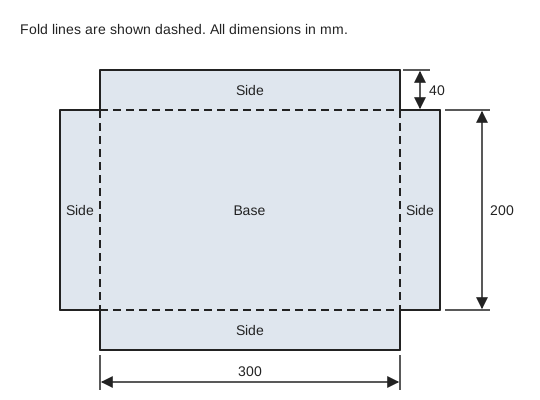
The diagram shows the net of an open-topped tray. The tray is made by bending up the four sides of a single piece of 1.2 mm aluminium sheet along the dashed fold lines.

Calculate the area of aluminium in the net. Give your answer in m².

Net of an open-topped tray: a central rectangle labelled Base, with a flap labelled Side on each of its four edges and the four corner squares cut away. The fold lines between the base and the sides are dashed. Dimensions: base length 300, base width 200, side height 40. All dimensions in mm.

Model answer

Base = 300 × 200 = 60 000 mm²
Long sides = 2 × 300 × 40 = 24 000 mm²
Short sides = 2 × 200 × 40 = 16 000 mm²
Total = 60 000 + 24 000 + 16 000 = 100 000 mm²
100 000 ÷ 1 000 000 = 0.1 m²

Explanation

The area of the net is the surface area of the tray: one base and four sides, with no lid. Sheet materials are ordered and priced in m², and 1 m² = 1000 mm × 1000 mm = 1 000 000 mm², so divide by 1 000 000, not by 1000. The 1.2 mm thickness is not needed to find the area.

Mark scheme
  1. 1 mark

    Step 1: area of base = 300 × 200 = 60 000 mm²

    Award full marks for a correct answer, even with no working shown. Mark the number, not the units. Alternative method: 380 × 280 = 106 400 mm² minus the four corners (4 × 40 × 40 = 6400 mm²) = 100 000 mm² (Steps 1 and 2).

  2. 1 mark

    Step 2: area of the four sides = 2 × (300 × 40) + 2 × (200 × 40) = 24 000 + 16 000 = 40 000 mm²

  3. 1 mark

    Step 3: total = 100 000 mm² = 0.1 m²

    ft their total ÷ 1 000 000. 0.1064 m² (corners not removed) scores 2 marks. A correct 100 000 mm² with a wrong conversion (e.g. 100 m²) scores 2 marks.

Question 4

4 marks

A furniture company sells a flat-pack bedside cabinet made from 15 mm melamine-faced chipboard. The customer assembles it at home using knock-down (KD) fittings: wooden dowels and cam lock fittings, tightened with a screwdriver.

Analyse and evaluate the use of KD fittings in this cabinet in terms of assembly by the customer.

Model answer

KD fittings make home assembly practical. All the holes for the dowels and cam locks are drilled by machine in the factory, so the panels line up accurately and the customer needs only a screwdriver, with no glue, clamps or woodworking skills. The dowels locate each panel in the right place and the cam locks pull the joints tight, so even a first-time customer can build a rigid cabinet quickly. Because the joints can be undone, the cabinet can be taken apart again to move house.
However, the customer has to follow the instructions exactly: it is easy to fit a panel the wrong way round, and then the joints must be undone. Cam locks can be overtightened, which strips the thread in the chipboard or splits the edge of the panel, and repeated dismantling wears the chipboard so the joints work loose. The small fittings are also easily lost.
Overall, KD fittings are the best choice for this cabinet, because they let a cheap, compact flat pack be built by almost anyone. The drawbacks are minor if the company supplies clear instructions and a few spare fittings.

Explanation

Level 2 needs both positive and negative points about assembly, each explained (why it helps or hinders the customer), and a reasoned conclusion. Common pitfalls are writing about the factory or the cost of the materials instead of assembly by the customer, and listing advantages with no evaluation.

Mark scheme
  1. 4 marks

    Levels of response (4 marks).
    Level 2 (3-4 marks): Well described and justified analysis of the use of KD fittings for assembly by the customer, containing full evaluation, drawing on conclusions having considered both positive and negative factors.
    Level 1 (1-2 marks): Brief points mentioned but not fully explained. Analysis present but limited evaluation/conclusions drawn. May have focused solely on either positive or negative factors.
    0 marks: No attempt or nothing worthy of credit.

    Indicative content (illustrative, not exhaustive; credit any worthy points made in support of the band descriptors): Positive: holes for dowels and cams are pre-drilled accurately (e.g. by CNC) in the factory, so panels line up and the customer needs no measuring or woodworking skill; only simple tools are needed (screwdriver, sometimes an Allen key) and no glue or clamps; dowels locate the panels in the right position and cam locks pull the joint tight, giving a rigid cabinet; quick to assemble; the cabinet can be dismantled and rebuilt, e.g. when moving house; fittings are standard components, so spares are easy to buy and instructions are familiar; flat packing makes the product cheaper and easier for the customer to carry home. Negative: the instructions must be followed exactly - panels or cams fitted the wrong way round have to be undone; overtightening can strip the thread in the chipboard or split the panel edge; repeated dismantling wears the chipboard, so joints work loose; small fittings are easily lost; joints are weaker than glued joints; large panels may need two people; visible cam heads may need cover caps. Evaluation: a judgement on how suitable KD fittings are for home assembly of this cabinet, e.g. very suitable for a cheap flat-pack product if clear instructions and spare fittings are supplied, less suitable if it will be dismantled often. Analysis: identification of how KD fittings affect each stage of home assembly. Evaluation: a judgement weighing the positive and negative factors, with a conclusion. A response giving only advantages (or only disadvantages) cannot go above Level 1. Accept all other valid responses.

Ready to try the rest? Every answer you write is marked against the mark scheme, so you can see exactly where the marks are.

Study Helper Hints first, answers after you try

Stuck on this one? Ask for a hint and I’ll point you in the right direction, without giving the answer away. Once you’ve checked your answer, I’ll show you how the marks are awarded.