
Level:
Correct: 0
Incorrect: 0
Marks: 0/0
Exam Practice
Course:
Topics:
AQA GCSE Design and Technology Smart practice A mixed round aimed at your weak spots
Unit 1
Core technical principles
Unit 2
Specialist technical principles
Unit 3
Designing and making principles
Investigation, primary and secondary data
Environmental, social and economic challenge
Design strategies
Design strategies
Communication of design ideas
Prototype development
Selection of materials and components
Selecting materials and components for prototypes
Specialist tools and equipment
Avg
score:
–
Topics
done:
0/40

Design strategies

Practise 18 exam-style questions on Design strategies for AQA GCSE Design and Technology. Write your answer as you would in the exam and get it marked in seconds against the mark scheme, point by point, with the Study Helper on hand if you get stuck.

  • 18 questions
  • 1–8 marks each
  • Instant marking
  • No sign-up needed
18 questions, marked as you go

Sample questions with model answers

Here are 4 of the questions in this topic, each with a model answer, an explanation of why it earns the marks and the mark scheme an examiner would use.

Question 1

1 mark

A designer makes a model of an idea, tests it, evaluates the results and changes the design. She then makes a new model and repeats the cycle until the design works well.

Name this design strategy.

Model answer

Iterative design

Explanation

Iterative design is a cyclical process of analysing, prototyping (modelling) and testing to refine a product; each iteration and its results start the process again. Naming only one stage, such as 'testing', does not name the strategy.

Mark scheme
  1. 1 mark

    Iterative design

    Accept 'iteration', 'an iterative process' or 'iterative designing'. Do not accept 'modelling', 'testing', 'prototyping' or 'evaluation' alone: these are stages within the cycle, not the strategy.
Question 2

2 marks

A designer makes a 1:5 scale card model of a bedside cabinet. The real cabinet is 450 mm wide, 600 mm high and 400 mm deep.

Work out the width, height and depth of the model in mm.

Model answer

Width = 450 ÷ 5 = 90 mm
Height = 600 ÷ 5 = 120 mm
Depth = 400 ÷ 5 = 80 mm

Explanation

A scale of 1:5 means 1 mm on the model represents 5 mm on the real product, so each real dimension is divided by 5. Scale models let designers check proportions and get feedback quickly, using less material than a full-size model. A common error is to multiply by 5, which gives a model five times bigger than the real cabinet.

Mark scheme
  1. 1 mark

    Step 1: dividing by 5 seen, or one or two of the model dimensions correct

    Award full marks for correct answers, even with no working shown. The units are given in the question, so mark the numbers. Multiplying by 5 (2250, 3000, 2000) gains 0.

  2. 1 mark

    Step 2: all three correct: width 90 (mm), height 120 (mm), depth 80 (mm)

    All three values needed, correctly matched to width, height and depth.

Question 3

3 marks

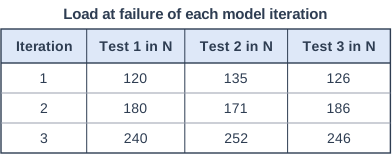
A designer is developing a bracket to hold up a wall shelf. She made three iterations of the bracket as 3D-printed models and tested each iteration three times by increasing the load on it until it failed. The table shows the results.

The specification says the bracket must hold a load of at least 220 N.

Calculate the mean failure load for iteration 2 and for iteration 3, and state which of these iterations meets the specification.

Load at failure of each model iteration. Table with columns "Iteration", "Test 1 in N", "Test 2 in N", "Test 3 in N". Iteration: 1; Test 1 in N: 120; Test 2 in N: 135; Test 3 in N: 126 | Iteration: 2; Test 1 in N: 180; Test 2 in N: 171; Test 3 in N: 186 | Iteration: 3; Test 1 in N: 240; Test 2 in N: 252; Test 3 in N: 246.

Model answer

Iteration 2 mean = (180 + 171 + 186) ÷ 3 = 537 ÷ 3 = 179 N
Iteration 3 mean = (240 + 252 + 246) ÷ 3 = 738 ÷ 3 = 246 N
Iteration 3 meets the specification because 246 N is more than 220 N; iteration 2 does not, because 179 N is less than 220 N.

Explanation

Testing each iteration more than once and taking the mean gives a more reliable result than a single test. Comparing the mean with the specification shows whether the design changes have worked: here each iteration is stronger than the last, and only iteration 3 meets the 220 N target. Its lowest single result (240 N) is also above the target.

Mark scheme
  1. 1 mark

    Step 1: iteration 2 mean = (180 + 171 + 186) ÷ 3 = 537 ÷ 3 = 179 (N)

    Award full marks for correct answers, even with no working shown.

  2. 1 mark

    Step 2: iteration 3 mean = (240 + 252 + 246) ÷ 3 = 738 ÷ 3 = 246 (N)

  3. 1 mark

    Step 3: iteration 3 meets the specification (246 N is at least 220 N) and iteration 2 does not (179 N is below 220 N)

    ft their means compared with 220 N. Both parts of the judgement are needed: iteration 3 meets it and iteration 2 does not.

Question 4

4 marks

Ben was asked to design a desk tidy. He found one existing desk tidy that he liked, sketched one idea that looked very similar to it, and spent the rest of his time developing only that idea.

Analyse and evaluate Ben's approach to generating and developing ideas.

Model answer

Ben's approach was quick, and because the existing desk tidy already works, his design is likely to work too, leaving him plenty of time to refine one idea.

However, this is design fixation. By basing his only idea on one product he liked, he never considered alternatives, so he may have missed a far better or more innovative solution. His design is so close to the existing product that it could copy it and infringe the original designer's rights. He also did not find out his user's needs or compare ideas against a specification, so his desk tidy may not suit the person it is for, and if the idea failed testing he would have no other idea to fall back on.

Overall, Ben's approach was poor. The small saving in time is outweighed by the lack of creativity and the risk of copying. He should have looked at a wide range of products, generated several different ideas and evaluated them before choosing one to develop.

Explanation

A Level 2 answer weighs up positives (speed, low risk) and negatives (fixation, no alternatives, copying, not user-focused) and reaches a justified conclusion. Answers that only criticise Ben, or only describe what he did, stay in Level 1. Naming design fixation and explaining its effects is the key analytical point.

Mark scheme
  1. 4 marks

    Levels of response (4 marks).
    Level 2 (3-4 marks): Well described and justified analysis containing full evaluation, drawing on conclusions having considered both positive and negative factors.
    Level 1 (1-2 marks): Brief points mentioned but not fully explained. Analysis present but limited evaluation/conclusions drawn. May have focused solely on either positive or negative factors.
    0 marks: No attempt or nothing worthy of credit.

    Analysis: identification of what Ben did and its effects. Evaluation: a judgement on whether this was a good approach, with a conclusion. Indicative content (illustrative, not exhaustive; credit any worthy points made in support of the band descriptors): positives - quick to start; the existing product is known to work, so there is less risk; more time to refine and make one idea well. Negatives - this is design fixation: he considered no alternatives, so he may have missed better solutions; the result is unlikely to be innovative or to stand out; it is so close to an existing product that it may copy it and infringe the original designer's rights (design right, copyright); it may not meet the specific needs of his user, as he did not research them or compare ideas against a specification; with only one idea he has nothing to fall back on if it fails testing; he did not use strategies such as collaboration, user feedback or iterative testing of alternatives. Conclusion, e.g.: overall a weak approach - he should have looked at a wide range of products, generated several different ideas and evaluated them against the specification before developing one. Accept all other valid responses.

Ready to try the rest? Every answer you write is marked against the mark scheme, so you can see exactly where the marks are.

Study Helper Hints first, answers after you try

Stuck on this one? Ask for a hint and I’ll point you in the right direction, without giving the answer away. Once you’ve checked your answer, I’ll show you how the marks are awarded.