
Level:
Correct: 0
Incorrect: 0
Marks: 0/0
Exam Practice
Course:
Topics:
AQA GCSE Design and Technology Smart practice A mixed round aimed at your weak spots
Unit 1
Core technical principles
Unit 2
Specialist technical principles
Unit 3
Designing and making principles
Investigation, primary and secondary data
Environmental, social and economic challenge
Design strategies
Design strategies
Communication of design ideas
Prototype development
Selection of materials and components
Selecting materials and components for prototypes
Specialist tools and equipment
Avg
score:
–
Topics
done:
0/40

Properties of materials in commercial products

Practise 20 exam-style questions on Properties of materials in commercial products for AQA GCSE Design and Technology. Write your answer as you would in the exam and get it marked in seconds against the mark scheme, point by point, with the Study Helper on hand if you get stuck.

  • 20 questions
  • 1–8 marks each
  • Instant marking
  • No sign-up needed
20 questions, marked as you go

Sample questions with model answers

Here are 4 of the questions in this topic, each with a model answer, an explanation of why it earns the marks and the mark scheme an examiner would use.

Question 1

2 marks

State two reasons why timber is seasoned to reduce its moisture content before it is made into indoor furniture.

Model answer

Seasoned timber is more stable, so the furniture will not shrink, warp or split once it is in a warm, dry room.
Glue and finishes such as varnish bond better to dry timber.

Explanation

Freshly felled timber contains a lot of water. Seasoning (air or kiln drying) reduces the moisture content to suit where the product will be used, so the timber does not keep drying out and moving after it has been made into furniture. Dry timber is also stronger, lighter, less prone to rot and easier to glue and finish.

Mark scheme
  1. 1 mark

    So it is more stable: it is less likely to shrink, warp, twist or split after the furniture is made

    One mark for each correct reason given, max 2. Accept 'so joints do not open up / doors and drawers do not stick'.

  2. 1 mark

    It becomes stronger and stiffer

  3. 1 mark

    It is less likely to rot (fungal decay) or be attacked by insects

  4. 1 mark

    It is lighter, so it is easier to handle and cheaper to transport

  5. 1 mark

    It is easier to machine, glue and finish: glues bond and paints, stains and varnishes take better on dry timber

    Do not accept 'to make it waterproof' or 'to kill the tree'. Do not credit descriptions of how seasoning is done (air or kiln drying) as reasons. Accept all other valid responses.
Question 2

3 marks

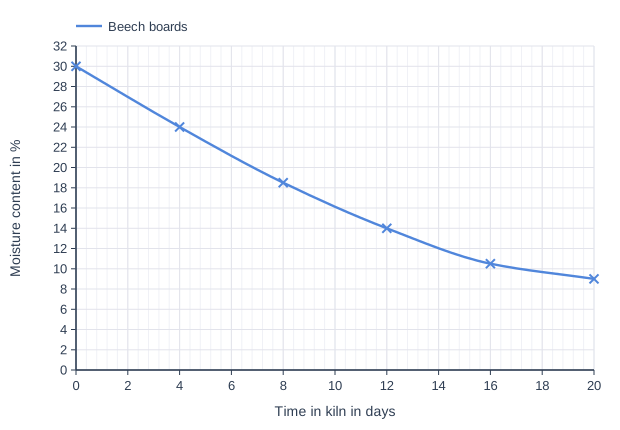
A batch of partly air-dried beech boards was seasoned in a kiln. Their moisture content was measured every 4 days. The graph shows the results, with a smooth curve drawn through them.

The boards will be made into toys for use indoors, which need a moisture content of 12% or less.

Use the graph to find how many days it took for the boards to reach a moisture content of 12%. Then use the graph to calculate the mean fall in moisture content per day over the first 10 days.

Line graph of moisture content in % (y-axis, 0 to 32) against time in kiln in days (x-axis, 0 to 20). "Beech boards" is a smooth curve through (0, 30), (4, 24), (8, 18.5), (12, 14), (16, 10.5), (20, 9).

Model answer

Reading across from 12% to the curve and down to the time axis, the moisture content reached 12% after 14 days.
At 10 days the moisture content was 16.1%.
Fall over the first 10 days = 30% − 16.1% = 13.9 percentage points
Mean fall = 13.9 ÷ 10 = 1.39% per day (about 1.4% per day)

Explanation

Read across from 12% on the moisture content axis to the curve, then down to the time axis; for the 10-day value, read up from 10 days to the curve and across. For the mean rate, find the fall over the period (start value minus value at 10 days) and divide by the number of days. The moisture content of timber is the mass of water it contains as a percentage of its oven-dry mass; seasoning in a kiln reduces it under controlled heat and humidity, so the boards are stable before they are made into toys and will not shrink, warp or split later.

Mark scheme
  1. 1 mark

    14 (days)

    Accept readings in the range [13.6, 14.4] days. The curve crosses 12% at 14.0 days, between the measurements at 12 days (14%) and 16 days (10.5%). Award full marks for 14 days and 1.4 per day, even with no working shown. Do not accept 12 or 16 (the measured days either side).

  2. 1 mark

    Step 1: fall over the first 10 days = 30 − 16.1 = 13.9 (percentage points)

    The curve gives 16.1% at 10 days (between the measurements of 18.5% at 8 days and 14% at 12 days). Accept a reading at 10 days in the range [15.8, 16.4], so a fall in the range [13.6, 14.2], with ft.

  3. 1 mark

    Step 2: mean fall = 13.9 ÷ 10 = 1.39 (% per day) (their fall ÷ 10)

    Accept answers in the range [1.36, 1.42], including 1.4, as % per day or percentage points per day. ft their fall ÷ 10. 16 ÷ 10 = 1.6 (using the reading at 10 days instead of the fall) scores 0 for both steps.

Question 3

4 marks

A set of traditional children's stacking blocks is made from beech and finished with a non-toxic paint.

Explain two properties of beech that make it suitable for the toy.

Model answer

Beech has a close grain and a fine, even texture, so it can be sanded very smooth and is unlikely to splinter. This makes the blocks safe for young children to hold and put in their mouths.
Beech is a hard and tough hardwood, so the blocks will not dent, crack or break into small pieces when they are dropped or thrown, which would be a choking hazard. This also means they last for years.

Explanation

Beech is the classic timber for wooden toys because its close grain sands smooth without splintering, it is hard and tough, it is dense enough for blocks to feel solid and stable, and it takes a smooth painted finish. Each property must be linked to a child using the toy, especially safety and durability, to gain the second mark. 'Strong' and 'cheap' alone are too vague.

Mark scheme
  1. 1 mark

    Property 1: a valid property of beech, e.g. close (fine) grain and even texture / does not splinter easily / hard and hard-wearing / tough / dense (heavy for its size) / takes paint and finishes well / non-toxic

    Maximum of two marks for each property. The second mark for a property is given only when that same property is developed. Property 2 must be different from property 1.

  2. 1 mark

    Property 1 developed: explains how it suits the toy, e.g. it can be sanded very smooth with no rough edges / it is unlikely to splinter, so it is safe for small hands and mouths / it resists dents and scratches when blocks are dropped, thrown or chewed / it does not crack or break into small pieces that could be a choking hazard / the heavy blocks sit firmly and do not topple easily when stacked / the smooth surface gives an even painted finish

  3. 1 mark

    Property 2: a second, different valid property (as listed for property 1)

  4. 1 mark

    Property 2 developed: explains how this second property suits the toy (as in the examples for property 1)

    Do not accept 'lightweight' (beech is quite dense), 'strong' or 'cheap' with no qualification, or 'waterproof'. Accept 'readily available from sustainably managed (FSC) forests' only if developed. Accept all other valid responses.

Question 4

6 marks

A shop sells two claw hammers of the same weight.

Hammer A: a forged high carbon steel head with a hardened striking face, fitted to an ash handle.
Hammer B: a one-piece forged high carbon steel head and shaft, with a rubber grip.

Analyse and evaluate the suitability of each hammer, in terms of how the properties of its materials affect its performance.

Model answer

Both hammers have a forged high carbon steel head with a hardened striking face. The hardness stops the face denting or wearing when it hits nails, and because the steel has been tempered it is also tough, so the head will not chip or crack. The claws are strong enough to lever out nails.

The main difference is the handle. Hammer A has an ash handle. Ash is tough and elastic, so it absorbs the shock of each blow and much of the vibration, which makes the hammer comfortable to use for a long time and reduces strain on the wrist and elbow. Timber is also a poor thermal conductor, so it feels warm to hold. However, timber is absorbent: it shrinks as it dries out and swells when damp, so the head can work loose and might even fly off, so the wedges need checking. The handle can also crack if the hammer is used to lever out a large nail or if a blow misses and hits the handle.

Hammer B is forged in one piece from high carbon steel. Steel is much stronger and tougher than ash, so the shaft will not break when levering, and the head can never come loose, which makes it safer and longer lasting. The rubber grip is elastic and non-slip, so it is comfortable and absorbs some vibration. However, steel is stiff, so more shock passes to the hand, which can be tiring over a long period, and the rubber grip can wear and split.

Overall, I think Hammer B is more suitable for a builder who uses a hammer every day for heavy work, because its one-piece steel construction is stronger and safer. Hammer A is better for someone doing long periods of lighter work who values comfort, as long as they check that the head stays tight.

Explanation

Top-level answers analyse both hammers using specific properties (hardness and toughness of the head, elasticity and absorbency of the ash, strength and stiffness of the steel shaft, elasticity of the rubber grip) and explain how each affects performance and safety, then reach a reasoned judgement about which suits which user. The key contrast is that ash absorbs shock but can shrink and loosen, while steel is stronger but passes more vibration to the hand. Vague points such as 'steel is better' stay in Level 1.

Mark scheme
  1. 6 marks

    Levels of response (6 marks).
    Level 3 (5-6 marks): Thorough analysis and evaluation of both hammers considering how the properties of their materials (steel head, ash handle, steel shaft and rubber grip) affect their performance.
    Level 2 (3-4 marks): Good analysis and simple evaluative points of one or more hammers considering how the properties of the materials affect performance.
    Level 1 (1-2 marks): Basic analysis of one or two simple property points for either hammer.
    0 marks: No response or nothing worthy of credit.

    Indicative content (illustrative, not exhaustive; credit any worthy points made in support of the band descriptors): Both heads: the hardened striking face resists denting and wear when hitting nails; tempering makes the head tough, so it does not chip or crack; the claw needs strength and toughness to lever out nails. Hammer A (ash handle): ash is tough and elastic (springy), so it absorbs shock and vibration, making the hammer comfortable and reducing strain on the wrist and elbow; straight grained and strong for its weight; a poor thermal conductor, so it feels warm to hold; a broken handle can be replaced cheaply; usually cheaper; but timber can dry out and shrink, so the head may loosen and could fly off (it needs wedges and checking); it is absorbent, so it can swell or rot if left damp; the handle can crack or break if the hammer is used as a heavy lever or if a blow misses and hits the handle; a varnished handle can become slippery. Hammer B (one-piece steel with rubber grip): the steel shaft is very strong and tough, so it will not break when levering out large nails, and the head can never come loose, which is safer and lasts longer; the rubber grip is elastic and non-slip, absorbs some vibration and is comfortable; but steel is stiff and passes more shock and vibration to the hand, so it can be more tiring over long periods; the rubber grip can wear or split; usually more expensive. Analysis: identification of how hardness, toughness, elasticity, strength, absorbency and thermal conductivity affect use. Evaluation: judgements, e.g. Hammer B is more suitable for heavy, frequent use and pulling large nails because its one-piece steel construction is stronger and the head cannot loosen, while Hammer A is more comfortable for long periods of lighter work if the handle is looked after. Accept all other valid responses.

Ready to try the rest? Every answer you write is marked against the mark scheme, so you can see exactly where the marks are.

Study Helper Hints first, answers after you try

Stuck on this one? Ask for a hint and I’ll point you in the right direction, without giving the answer away. Once you’ve checked your answer, I’ll show you how the marks are awarded.