
Level:
Correct: 0
Incorrect: 0
Marks: 0/0
Exam Practice
Course:
Topics:
AQA GCSE Design and Technology Smart practice A mixed round aimed at your weak spots
Unit 1
Core technical principles
Unit 2
Specialist technical principles
Unit 3
Designing and making principles
Investigation, primary and secondary data
Environmental, social and economic challenge
Design strategies
Design strategies
Communication of design ideas
Prototype development
Selection of materials and components
Selecting materials and components for prototypes
Specialist tools and equipment
Avg
score:
–
Topics
done:
0/40

Composite materials and technical textiles

Practise 18 exam-style questions on Composite materials and technical textiles for AQA GCSE Design and Technology. Write your answer as you would in the exam and get it marked in seconds against the mark scheme, point by point, with the Study Helper on hand if you get stuck.

  • 18 questions
  • 1–8 marks each
  • Instant marking
  • No sign-up needed
18 questions, marked as you go

Sample questions with model answers

Here are 4 of the questions in this topic, each with a model answer, an explanation of why it earns the marks and the mark scheme an examiner would use.

Question 1

1 mark

Why are microfibres used to make cleaning cloths?

Choose your answer.

  • Their fine fibres trap tiny particles of dirt
  • They do not burn or melt
  • They conduct electricity
  • They release a fragrance when rubbed

Model answer

Their fine fibres trap tiny particles of dirt

Explanation

Microfibres are synthetic fibres finer than 1 decitex, thinner than silk. A cloth made from them has a huge surface area and tiny spaces between the fibres, so it traps dust, dirt and grease, often without needing cleaning chemicals. The same fineness makes microfibre fabrics soft, light and good at wicking moisture in sportswear.

Mark scheme
  1. 1 mark

    Their fine fibres trap tiny particles of dirt

    If more than one option is given, 0 marks. 'They do not burn or melt' is wrong: most microfibres are polyester or polyamide, which melt and burn; that describes fire resistant fabrics. 'They conduct electricity' is wrong: that describes conductive fabrics. 'They release a fragrance when rubbed' is wrong: that describes micro-encapsulation, which can be added to fabrics but is not why microfibres clean well.
Question 2

2 marks

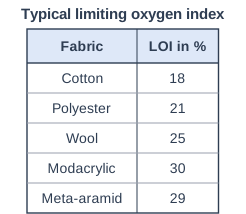
The limiting oxygen index (LOI) of a fabric is the lowest percentage of oxygen in the surrounding gas that will let the fabric keep burning. Normal air contains about 21% oxygen.

A company that makes protective clothing has its own rule: it only uses fabrics with an LOI of 26% or more. The table shows typical LOI values for five fabrics (published values vary a little with the test method and the fabric's construction).

Use the table to name the fabrics the company could use, and explain why cotton would keep burning in normal air.

Typical limiting oxygen index. Table with columns "Fabric", "LOI in %". Fabric: Cotton; LOI in %: 18 | Fabric: Polyester; LOI in %: 21 | Fabric: Wool; LOI in %: 25 | Fabric: Modacrylic; LOI in %: 30 | Fabric: Meta-aramid; LOI in %: 29.

Model answer

The company could use modacrylic (30%) and meta-aramid (29%), because both have an LOI of 26% or more.
Cotton has an LOI of 18%, which is lower than the 21% of oxygen in normal air, so there is more than enough oxygen for it to keep burning once it is alight.

Explanation

A fabric whose LOI is well above the oxygen level of the air tends to stop burning when the flame is taken away, so a higher LOI means better fire resistance. Wool is naturally quite flame resistant but just misses the company's own limit of 26%. Read every row carefully and compare each value with the limit given in the question.

Mark scheme
  1. 1 mark

    Modacrylic and meta-aramid

    Both fabrics are needed, and no others. Do not accept wool (25% is below 26%).

  2. 1 mark

    Cotton's LOI (18%) is lower than the 21% of oxygen in normal air, so there is more than enough oxygen for it to keep burning

    A comparison of 18% with 21% (or 'its LOI is below the oxygen level in air') is needed. Do not credit 'cotton is a natural fibre' or 'it is not fire resistant' alone.

Question 3

3 marks

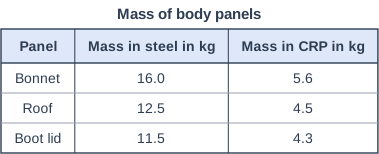
A car maker is replacing three steel body panels on a sports car with carbon fibre reinforced plastic (CRP) panels. The table shows the mass of each panel.

Calculate the percentage mass saving for the three panels together. Show your working.

Mass of body panels. Table with columns "Panel", "Mass in steel in kg", "Mass in CRP in kg". Panel: Bonnet; Mass in steel in kg: 16.0; Mass in CRP in kg: 5.6 | Panel: Roof; Mass in steel in kg: 12.5; Mass in CRP in kg: 4.5 | Panel: Boot lid; Mass in steel in kg: 11.5; Mass in CRP in kg: 4.3.

Model answer

Steel: 16.0 + 12.5 + 11.5 = 40.0 kg
CRP: 5.6 + 4.5 + 4.3 = 14.4 kg
Mass saved = 40.0 - 14.4 = 25.6 kg
25.6 ÷ 40.0 × 100 = 64%
Answer: 64%

Explanation

A percentage saving is always worked out as a percentage of the original value, so divide the mass saved by the original steel mass. Find the totals first, rather than averaging three separate percentages. Saving 25.6 kg helps the car accelerate faster and use less fuel, which is why CRP is used despite its cost.

Mark scheme
  1. 1 mark

    Step 1: total steel mass = 16.0 + 12.5 + 11.5 = 40.0 kg and total CRP mass = 5.6 + 4.5 + 4.3 = 14.4 kg

    Award full marks for a correct answer, even with no working shown.

  2. 1 mark

    Step 2: mass saved = 40.0 - 14.4 = 25.6 kg

    ft their totals. Alternative: 14.4 ÷ 40.0 × 100 = 36% seen scores Steps 1 and 2.

  3. 1 mark

    Step 3: 25.6 ÷ 40.0 × 100 = 64%

    ft their saving ÷ their steel total × 100; alternative 100 - 36 = 64%. 25.6 ÷ 14.4 × 100 = 177.8% (divided by the CRP mass) scores Steps 1 and 2 only. Averaging the three separate percentages (65%, 64% and 62.6%, mean 63.9%) is not a correct method: score 1 mark.

Question 4

4 marks

Some motorcycle jeans look like ordinary denim jeans but have Kevlar panels sewn inside at the knees, hips and seat.

Analyse and evaluate the use of Kevlar in these jeans in terms of the protection it gives the rider.

Model answer

Kevlar has a very high tensile strength for its weight and is very resistant to abrasion and tearing. If the rider falls and slides along the road, the Kevlar panels are much less likely to wear through than denim alone, so the rider's skin is protected from serious grazes. Kevlar also does not melt, so the heat from the friction will not melt fabric onto the skin. Because it is light and flexible, the jeans look and feel like ordinary jeans, so riders are more likely to wear them even on short trips.

However, the Kevlar only protects where the panels are, and it does not absorb impact, so the rider's knees and hips could still be bruised or broken in a crash unless armour is fitted as well. The outer denim and the seams could also split, letting the panels move out of place.

Overall, Kevlar gives the jeans good protection against grazes and is a big improvement on ordinary jeans, but for full protection they should be worn with impact armour at the knees and hips.

Explanation

Level 2 answers analyse how Kevlar's properties (abrasion resistance, strength for its weight, heat resistance) protect the rider, weigh these against the limitations, and reach a conclusion. A common pitfall is to give only positive points, or to say Kevlar is 'bulletproof' rather than explaining what protection a rider needs.

Mark scheme
  1. 4 marks

    Levels of response (4 marks).
    Level 2 (3-4 marks): Well described and justified analysis containing full evaluation, drawing on conclusions having considered both positive and negative factors.
    Level 1 (1-2 marks): Brief points mentioned but not fully explained. Analysis present but limited evaluation/conclusions drawn. May have focused solely on either positive or negative factors.
    0 marks: No attempt or nothing worthy of credit.

    Indicative content (illustrative, not exhaustive; credit any worthy points made in support of the band descriptors): Positive: Kevlar has a very high tensile strength for its weight and resists abrasion and tearing, so if the rider slides along the road the panels are much less likely to wear through than denim alone, protecting the skin; it does not melt and resists heat, so friction heat in a slide will not melt it onto the skin (unlike nylon or polyester); it is light and flexible, so the jeans are comfortable and look like ordinary jeans, so riders are more likely to wear protection on short trips; panels are placed where the body usually hits the road first. Negative: it only protects where the panels are, so other areas (e.g. lower legs, lower back) rely on denim alone; Kevlar resists abrasion but does not absorb impact, so knees and hips can still be injured unless impact armour is added in pockets; the outer denim can still wear through and the seams may split, letting the panels move; Kevlar is weakened by UV light (protected here by the denim) and by repeated wear, so protection may reduce over time; overall abrasion protection is usually less than thick leather. Analysis: identification of Kevlar's properties and how each one protects, or fails to protect, the rider. Evaluation: a conclusion weighing the positive and negative factors, e.g. they give good abrasion protection for everyday riding and are better than ordinary jeans, but should be combined with armour, or leathers chosen for high-speed riding. Level 2 needs both positive and negative points and a conclusion. Accept all other valid responses.

Ready to try the rest? Every answer you write is marked against the mark scheme, so you can see exactly where the marks are.

Study Helper Hints first, answers after you try

Stuck on this one? Ask for a hint and I’ll point you in the right direction, without giving the answer away. Once you’ve checked your answer, I’ll show you how the marks are awarded.