
Level:
Correct: 0
Incorrect: 0
Marks: 0/0
Exam Practice
Course:
Topics:
Edexcel GCSE Statistics (Higher Paper 2) Smart practice A mixed round aimed at your weak spots
Unit 1
The statistical enquiry cycle
Statistical enquiry cycle stages 1 and 2; (a) Planning: 1a.01, 1a.02, 1a.03
Statistical enquiry cycle: planning and collecting
Statistical enquiry cycle stages 3, 4 and 5
Statistical enquiry cycle: interpreting and evaluating
Unit 2
The collection of data
(b) Types of data: 1b.01, 1b.02, 1b.03
Types of data and variables
(b) Types of data: 1b.04; (d) Collecting data: 1d.01, 1d.02
Primary and secondary data, reliability and validity
(c) Population and sampling: 1c.01, 1c.02, 1c.03
Populations, sampling frames and non-random sampling
(c) Population and sampling: 1c.04, 1c.05
Random and systematic sampling
(c) Population and sampling: 1c.06
Stratified sampling
(d) Collecting data: 1d.05, 1d.06
Problems with collected data and cleaning data
Unit 3
Processing, representing and analysing data
(a) Tabulation, diagrams and representation: 2a.01
Tabulation, tallies, pictograms and two-way tables
(a) Tabulation, diagrams and representation: 2a.01, 2a.02
Pie charts and comparative pie charts
(a) Tabulation, diagrams and representation: 2a.01
Stem and leaf diagrams
(a) Tabulation, diagrams and representation: 2a.02
Population pyramids, choropleth maps and 2D and 3D diagrams
(a) Tabulation, diagrams and representation: 2a.04
Histograms and frequency density
(a) Tabulation, diagrams and representation: 2a.05, 2a.06, 2a.07, 2a.08
Choosing representations and misleading diagrams
(a) Tabulation, diagrams and representation: 2a.09, 2a.10
Skewness
(b) Measures of central tendency: 2b.01, 2b.02, 2b.03
Mode, median and mean
(b) Measures of central tendency: 2b.01
Weighted mean and geometric mean
(c) Measures of dispersion: 2c.01, 2c.06
Standard deviation and standardised scores
(a) Tabulation, diagrams and representation: 2a.03; (c) Measures of dispersion: 2c.02, 2c.03
Box plots and outliers
(b) Measures of central tendency: 2b.03; (c) Measures of dispersion: 2c.04, 2c.05
Comparing distributions
(d) Further summary statistics: 2d.01
Index numbers
(d) Further summary statistics: 2d.02
Rates of change
(e) Scatter diagrams and correlation: 2e.01, 2e.02, 2e.03
Scatter diagrams, correlation and causation
(e) Scatter diagrams and correlation: 2e.04
Lines of best fit and regression lines
(e) Scatter diagrams and correlation: 2e.05, 2e.06, 2e.07, 2e.08
Spearman's rank and product moment correlation coefficients
(f) Time series: 2f.01, 2f.02; (b) 2b.01 mean seasonal variation
Time series, moving averages and seasonal variation
(g) Quality assurance: 2g.01, 2g.02
Quality assurance and control charts
(h) Estimation: 2h.01, 2h.02, 2h.03
Estimation, sample size and capture-recapture
Unit 4
Probability
3. Probability: 3p.01, 3p.02, 3p.03, 3p.04
Probability, expected frequency and risk
3. Probability: 3p.05, 3p.06, 3p.10
Experimental and theoretical probability and bias
3. Probability: 3p.11
Binomial distribution
3. Probability: 3p.12, 3p.13
Normal distribution
Avg
score:
–
Topics
done:
0/40

Two-way tables, sample spaces, tree and Venn diagrams

Practise 17 exam-style questions on Two-way tables, sample spaces, tree and Venn diagrams for Edexcel GCSE Statistics (Higher Paper 2). Write your answer as you would in the exam and get it marked in seconds against the mark scheme, point by point, with the Study Helper on hand if you get stuck.

  • 17 questions
  • 1–5 marks each
  • Instant marking
  • No sign-up needed
17 questions, marked as you go

Sample questions with model answers

Here are 4 of the questions in this topic, each with a model answer, an explanation of why it earns the marks and the mark scheme an examiner would use.

Question 1

1 mark

At a cafe, for a customer chosen at random,
the probability that the customer pays by card is 0.6
the probability that the customer pays by phone is 0.3

Jo says,
"The probability that the customer pays by card or by phone is 0.6 + 0.3 = 0.9"

What must be true about the events 'the customer pays by card' and 'the customer pays by phone' for Jo's method to be correct?

Model answer

The events must be mutually exclusive: a customer cannot pay by both card and phone. Then P(card or phone) = P(card) + P(phone).

Explanation

The addition law P(A or B) = P(A) + P(B) works only for mutually exclusive events. If some customers paid partly by card and partly by phone, the general addition law would be needed: P(card or phone) = 0.6 + 0.3 − P(card and phone). Independence is about multiplying probabilities, not adding them.

Mark scheme
  1. 1 mark

    B1 for they must be mutually exclusive (oe, e.g. 'a customer cannot pay by both card and phone')

    Accept 'P(card and phone) = 0' or 'the events cannot both happen'. B0 for 'independent', 'exhaustive', 'equally likely' or 'the probabilities must add up to less than 1'. A correct and an incorrect answer (e.g. 'mutually exclusive and independent') scores B0.
Question 2

2 marks

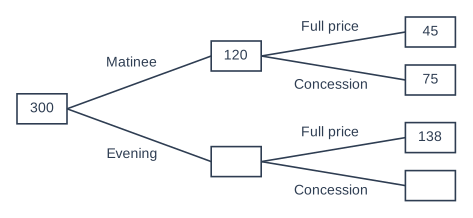
A theatre sold 300 tickets for one day.
Each ticket was for the matinee (afternoon) show or the evening show, and each ticket was full price or a concession.

The frequency tree shows information about the 300 tickets.

One of the 300 tickets is chosen at random.

Work out the probability that the ticket is for the matinee show or is a concession (or both).

A frequency tree drawn from left to right with 2 stages of branches. It starts from a box containing 300 on the left. From the first box, branches labelled "Matinee" and "Evening" lead to a box containing 120 and an empty box respectively. From the "Matinee" box, branches labelled "Full price" and "Concession" lead to a box containing 45 and a box containing 75 respectively. From the "Evening" box, branches labelled "Full price" and "Concession" lead to a box containing 138 and an empty box respectively.

Model answer

Evening tickets \(= 300 - 120 = 180\), so evening concessions \(= 180 - 138 = 42\)

Tickets that are matinee or concession (or both): all 120 matinee tickets and the 42 evening concessions.
\(120 + 42 = 162\)

Probability \(= \dfrac{162}{300} = 0.54\)

Explanation

'Matinee or concession' includes every matinee ticket and every concession ticket, but the matinee concessions must be counted only once. Either count the tickets directly from the tree (120 matinee and 42 evening concessions) or use the general addition law, P(M or C) = P(M) + P(C) − P(M and C). Adding the matinee and concession totals counts the 75 matinee concessions twice.

Mark scheme
  1. 1 mark

    M1 for \(\dfrac{120 + 42}{300}\) oe

    e.g. \(\dfrac{45 + 75 + 42}{300}\), or the general addition law \(\dfrac{120}{300} + \dfrac{117}{300} - \dfrac{75}{300}\). The number of evening tickets is \(300 - 120 = 180\), so evening concessions are 42 and evening full price is 138. \(\dfrac{120 + 117}{300}\) (= \(\dfrac{237}{300}\), counting the 75 matinee concessions twice) or \(\dfrac{75}{300}\) (matinee and concession) scores M0. Answer-only rule for this question: A correct answer with no working scores M1A1.

  2. 1 mark

    A1 for \(\dfrac{162}{300}\) oe

    e.g. \(\dfrac{27}{50}\), 0.54 or 54%. A correct answer with no working scores M1A1.

Question 3

3 marks

A company sends each of its parcels by standard delivery, next-day delivery or courier.
50% of its parcels are sent by standard delivery and 30% by next-day delivery. The rest are sent by courier.

The probability that a parcel arrives late is
0.12 for standard delivery
0.05 for next-day delivery
0.02 for courier.

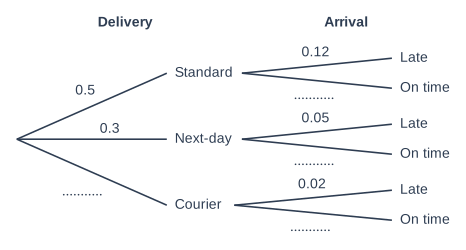
The tree diagram shows some of this information.

A parcel sent by the company is chosen at random.

Work out the probability that the parcel arrives late.

A probability tree diagram drawn from left to right with 2 stages of branches, headed "Delivery" and "Arrival". Each branch has its outcome written at its end and its probability written beside it. First stage, 3 branches: "Standard" with probability 0.5, "Next-day" with probability 0.3, "Courier" with probability left blank (a dotted line to fill in). After "Standard", the second stage branches are "Late" with probability 0.12, "On time" with probability left blank (a dotted line to fill in). After "Next-day", the second stage branches are "Late" with probability 0.05, "On time" with probability left blank (a dotted line to fill in). After "Courier", the second stage branches are "Late" with probability 0.02, "On time" with probability left blank (a dotted line to fill in).

Model answer

P(courier) \(= 1 - 0.5 - 0.3 = 0.2\)
P(late) \(= 0.5 \times 0.12 + 0.3 \times 0.05 + 0.2 \times 0.02\)
\(= 0.06 + 0.015 + 0.004\)
\(= 0.079\)

Explanation

There are three paths that end in 'Late', one for each type of delivery. Multiply along each path, then add the three products because the paths are mutually exclusive. The missing first-stage probability (courier) is 1 minus the other two. Adding the three late probabilities ignores how many parcels go by each method.

Mark scheme
  1. 1 mark

    M1 for at least one correct product, e.g. \(0.5 \times 0.12\) (= 0.06) or \(0.3 \times 0.05\) (= 0.015) or \(0.2 \times 0.02\) (= 0.004)

    The probability for courier is \(1 - 0.5 - 0.3 = 0.2\). Answer-only rule for this question: A correct answer with no working scores M1M1A1.

  2. 1 mark

    M1 for \(0.5 \times 0.12 + 0.3 \times 0.05 + 0.2 \times 0.02\)

    oe, e.g. 0.06 + 0.015 + 0.004. Two products only (e.g. 0.075, leaving out courier) scores M1M0A0. Adding 0.12 + 0.05 + 0.02 (= 0.19) scores M0M0A0.

  3. 1 mark

    A1 for 0.079 oe

    Accept 7.9%. A correct answer with no working scores M1M1A1. Probabilities must be fractions, decimals or percentages: ratio notation (e.g. 7 : 24) or 'out of' wording (e.g. '7 out of 24') scores A0/B0 for this mark (Pearson's general marking guidance).

Question 4

4 marks

A gardening club asked its 90 members which of three vegetables they grow: tomatoes, potatoes and beans.

6 members grow all three vegetables.
15 members grow tomatoes and potatoes (this includes the 6 who grow all three).
11 members grow potatoes and beans (this includes the 6 who grow all three).
13 members grow tomatoes and beans (this includes the 6 who grow all three).
44 members grow tomatoes.
38 members grow potatoes.
30 members grow beans.

One of the 90 members is chosen at random.

Work out the probability that this member grows none of the three vegetables.

Model answer

Exactly two vegetables:
tomatoes and potatoes only: 15 − 6 = 9
potatoes and beans only: 11 − 6 = 5
tomatoes and beans only: 13 − 6 = 7

Exactly one vegetable:
tomatoes only: 44 − 6 − 9 − 7 = 22
potatoes only: 38 − 6 − 9 − 5 = 18
beans only: 30 − 6 − 5 − 7 = 12

At least one: 6 + 9 + 5 + 7 + 22 + 18 + 12 = 79
None: 90 − 79 = 11

P(grows none) \(= \dfrac{11}{90}\)

Explanation

Fill a three-circle Venn diagram from the centre outwards: first the 6 who grow all three, then the 'two only' regions (subtract the 6), then the 'one only' regions. The members who grow none go outside the circles, so that all the regions add up to 90. The commonest errors are to forget to subtract the centre from the pairs, and to forget the region outside the circles.

Mark scheme
  1. 1 mark

    B1 for the numbers who grow exactly two of the vegetables: 9 (tomatoes and potatoes only), 5 (potatoes and beans only) and 7 (tomatoes and beans only)

    May be seen on a Venn diagram. Alternative (inclusion-exclusion): B1 for \(44 + 38 + 30 - 15 - 11 - 13\) (= 73). Answer-only rule for this question: A correct answer with no working scores full marks.

  2. 1 mark

    B1ft for the numbers who grow exactly one: 22 (tomatoes only), 18 (potatoes only) and 12 (beans only)

    ft their 'exactly two' numbers. Alternative: B1 for adding back the 6 to get 79 members who grow at least one vegetable.

  3. 1 mark

    M1 for 90 − (sum of their seven regions), e.g. \(90 - 79\) (= 11)

    Their seven regions must include the 6 in the centre. ft their regions.

  4. 1 mark

    A1 for \(\dfrac{11}{90}\) oe

    Accept 0.122 (awrt 0.12) or 12.2%. A correct answer with no working scores full marks. A common error is to use 15, 11 and 13 as the 'two only' regions, giving 29 members with none and \(\dfrac{29}{90}\): B0B1M1A0 (the B1ft for their 10, 6 and 0).

Ready to try the rest? Every answer you write is marked against the mark scheme, so you can see exactly where the marks are.

Study Helper Hints first, answers after you try

Stuck on this one? Ask for a hint and I’ll point you in the right direction, without giving the answer away. Once you’ve checked your answer, I’ll show you how the marks are awarded.