
Level:
Correct: 0
Incorrect: 0
Marks: 0/0
Exam Practice
Course:
Topics:
Edexcel GCSE Statistics (Higher Paper 2) Smart practice A mixed round aimed at your weak spots
Unit 1
The statistical enquiry cycle
Statistical enquiry cycle stages 1 and 2; (a) Planning: 1a.01, 1a.02, 1a.03
Statistical enquiry cycle: planning and collecting
Statistical enquiry cycle stages 3, 4 and 5
Statistical enquiry cycle: interpreting and evaluating
Unit 2
The collection of data
(b) Types of data: 1b.01, 1b.02, 1b.03
Types of data and variables
(b) Types of data: 1b.04; (d) Collecting data: 1d.01, 1d.02
Primary and secondary data, reliability and validity
(c) Population and sampling: 1c.01, 1c.02, 1c.03
Populations, sampling frames and non-random sampling
(c) Population and sampling: 1c.04, 1c.05
Random and systematic sampling
(c) Population and sampling: 1c.06
Stratified sampling
(d) Collecting data: 1d.05, 1d.06
Problems with collected data and cleaning data
Unit 3
Processing, representing and analysing data
(a) Tabulation, diagrams and representation: 2a.01
Tabulation, tallies, pictograms and two-way tables
(a) Tabulation, diagrams and representation: 2a.01, 2a.02
Pie charts and comparative pie charts
(a) Tabulation, diagrams and representation: 2a.01
Stem and leaf diagrams
(a) Tabulation, diagrams and representation: 2a.02
Population pyramids, choropleth maps and 2D and 3D diagrams
(a) Tabulation, diagrams and representation: 2a.04
Histograms and frequency density
(a) Tabulation, diagrams and representation: 2a.05, 2a.06, 2a.07, 2a.08
Choosing representations and misleading diagrams
(a) Tabulation, diagrams and representation: 2a.09, 2a.10
Skewness
(b) Measures of central tendency: 2b.01, 2b.02, 2b.03
Mode, median and mean
(b) Measures of central tendency: 2b.01
Weighted mean and geometric mean
(c) Measures of dispersion: 2c.01, 2c.06
Standard deviation and standardised scores
(a) Tabulation, diagrams and representation: 2a.03; (c) Measures of dispersion: 2c.02, 2c.03
Box plots and outliers
(b) Measures of central tendency: 2b.03; (c) Measures of dispersion: 2c.04, 2c.05
Comparing distributions
(d) Further summary statistics: 2d.01
Index numbers
(d) Further summary statistics: 2d.02
Rates of change
(e) Scatter diagrams and correlation: 2e.01, 2e.02, 2e.03
Scatter diagrams, correlation and causation
(e) Scatter diagrams and correlation: 2e.04
Lines of best fit and regression lines
(e) Scatter diagrams and correlation: 2e.05, 2e.06, 2e.07, 2e.08
Spearman's rank and product moment correlation coefficients
(f) Time series: 2f.01, 2f.02; (b) 2b.01 mean seasonal variation
Time series, moving averages and seasonal variation
(g) Quality assurance: 2g.01, 2g.02
Quality assurance and control charts
(h) Estimation: 2h.01, 2h.02, 2h.03
Estimation, sample size and capture-recapture
Unit 4
Probability
3. Probability: 3p.01, 3p.02, 3p.03, 3p.04
Probability, expected frequency and risk
3. Probability: 3p.05, 3p.06, 3p.10
Experimental and theoretical probability and bias
3. Probability: 3p.11
Binomial distribution
3. Probability: 3p.12, 3p.13
Normal distribution
Avg
score:
–
Topics
done:
0/40

Mode, median and mean

Practise 15 exam-style questions on Mode, median and mean for Edexcel GCSE Statistics (Higher Paper 2). Write your answer as you would in the exam and get it marked in seconds against the mark scheme, point by point, with the Study Helper on hand if you get stuck.

  • 15 questions
  • 1–5 marks each
  • Instant marking
  • No sign-up needed
15 questions, marked as you go

Sample questions with model answers

Here are 4 of the questions in this topic, each with a model answer, an explanation of why it earns the marks and the mark scheme an examiner would use.

Question 1

1 mark

A cinema increased the price of every ticket by 8%.

Which of these statements is true for the ticket prices after the increase?

Choose your answer.

  • The mean price increases by 8%, but the median and modal prices do not change
  • The mean, median and modal prices all increase by 8%
  • The mean, median and modal prices all increase by 8p

Model answer

The mean, median and modal prices all increase by 8%

Every price is multiplied by 1.08. The prices stay in the same order, so the middle price is the old median \(\times 1.08\), the most common price is the old mode \(\times 1.08\), and the total, and so the mean, is also multiplied by 1.08

Explanation

Multiplying every value by the same number (a scaling) multiplies the mean, the median and the mode by that number; adding the same amount to every value (a translation) adds that amount to all three. The median and the mode do change here, because the values themselves change, even though their order does not.

Mark scheme
  1. 1 mark

    B1 for The mean, median and modal prices all increase by 8%

    Every price is multiplied by 1.08, so the mean, the median and the mode are all multiplied by 1.08. 'The median and modal prices do not change' comes from thinking that only the mean uses the values themselves: the order of the prices and which price is most common do not change, but every price is 8% higher. '8p' confuses a percentage increase with an increase of a fixed amount. Any other answer, or more than one answer, scores B0.
Question 2

2 marks

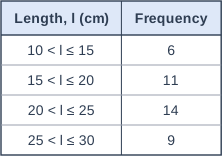
The table gives information about the lengths, l cm, of 40 runner beans grown in a school garden.

Ruby worked out an estimate of the mean length. Here is her working.

\(\dfrac{15 \times 6 + 20 \times 11 + 25 \times 14 + 30 \times 9}{4} = \dfrac{930}{4} = 232.5\) cm

Ruby has made two mistakes.

Write down the two mistakes.

Table with columns "Length, l (cm)", "Frequency". Length, l (cm): 10 < l ≤ 15; Frequency: 6 | Length, l (cm): 15 < l ≤ 20; Frequency: 11 | Length, l (cm): 20 < l ≤ 25; Frequency: 14 | Length, l (cm): 25 < l ≤ 30; Frequency: 9.

Model answer

Mistake 1: Ruby used the upper class boundaries (15, 20, 25 and 30) instead of the midpoints of the classes (12.5, 17.5, 22.5 and 27.5).
Mistake 2: Ruby divided by 4, the number of classes, instead of 40, the total frequency (the number of beans).
(A correct estimate is \(\dfrac{12.5 \times 6 + 17.5 \times 11 + 22.5 \times 14 + 27.5 \times 9}{40} = \dfrac{830}{40} = 20.75\) cm.)

Explanation

An estimate of the mean from grouped data uses the midpoint of each class as the typical value, and divides the total of the midpoint × frequency products by the total frequency. Ruby's answer, 232.5 cm, is longer than every bean in the table, which should have warned her that something was wrong. Dividing by the number of classes and using a class boundary instead of the midpoint are both common errors.

Mark scheme
  1. 1 mark

    B1 for she used the upper class boundaries (15, 20, 25, 30) instead of the midpoints of the classes (12.5, 17.5, 22.5, 27.5)

    Accept 'she should have used the midpoints / mid-interval values' or 'she used the end of each class'. B0 for 'she used the wrong numbers' with no indication of which, or for 'the multiplications are wrong' (they are correct for the values she used).

  2. 1 mark

    B1 for she divided by 4 (the number of classes) instead of 40 (the total frequency, the number of beans)

    Accept 'she should have divided by 40' or 'she divided by the number of groups'. The two mistakes may be given in either order. Ignore any attempt at a corrected value (a correct estimate is 830 ÷ 40 = 20.75 cm).

Question 3

3 marks

A running club timed 20 of its members over a 5 km course. Their times had a mean of 27.9 minutes and a median of 26.5 minutes.

Two other members ran the same course the next day. Their times were
19.4 minutes, which was faster than all of the 20 times, and
41.0 minutes, which was slower than all of the 20 times.

Kofi says, "Including these two times will change both the mean and the median of the times."

Is Kofi correct? Give reasons for your answer.

Model answer

Mean: the total of the 20 times is \(20 \times 27.9 = 558\) minutes.
With the two new times the total is \(558 + 19.4 + 41.0 = 618.4\) minutes, so the new mean is \(618.4 \div 22 = 28.1\) minutes (1 dp). The mean changes: it increases.

Median: with 20 times, the median is halfway between the 10th and 11th times. One new time is below all of them and one is above all of them, so in the list of 22 times the middle two (the 11th and 12th) are the same two times as before. The median is still 26.5 minutes.

Kofi is not correct: the mean changes but the median does not.

Explanation

The mean uses every value, so it changes unless the new values average exactly the old mean (here they average 30.2 minutes, not 27.9). The median depends only on position: adding one value at each end moves every position up by one but keeps the same two values in the middle. Saying the mean changes 'because there are more values' is not a reason.

Mark scheme
  1. 1 mark

    B1 for the mean changes (increases), with a reason or calculation, eg the new mean is \(\dfrac{20 \times 27.9 + 19.4 + 41.0}{22} = \dfrac{618.4}{22} = 28.1\) minutes / the mean of the two new times (30.2 minutes) is greater than 27.9 minutes

    Accept 28.1 or 28.109... seen. Accept 'the total goes up by 60.4 minutes, which is more than \(2 \times 27.9 = 55.8\)'. B0 for 'the mean changes because there are more values' (two new times that averaged 27.9 minutes would not change it).

  2. 1 mark

    B1 for the median does not change, with a reason, eg one new time is below all the others and one is above all the others, so the middle two times (the 11th and 12th of 22) are the same two times as before (the 10th and 11th of 20) / the median stays at 26.5 minutes

    The reason must show that one value is added on each side of the median. B0 for 'the median stays the same' with no reason, or for 'the median is not affected by extreme values' on its own (two extreme values on the same side would change it).

  3. 1 mark

    B1 for Kofi is not correct (the mean changes but the median does not)

    Dependent on the B1 for the median. B0 for 'no' with no reasons.

Question 4

4 marks

Mr Hughes converts each raw mark, x, in a test to a scaled mark, y, using the formula

\(y = ax + b\)

where \(a\) and \(b\) are positive numbers.

For the raw marks, the mean is 40, the median is 44 and the mode is 46.
For the scaled marks, the mean is 68 and the median is 74.

Work out the modal scaled mark.

Model answer

The mean and the median are transformed in the same way as every mark:
\(40a + b = 68\)
\(44a + b = 74\)
Subtracting: \(4a = 6\), so \(a = 1.5\)
\(b = 68 - 40 \times 1.5 = 8\)
The mode is transformed in the same way: modal scaled mark = \(1.5 \times 46 + 8 = 77\)

Explanation

A transformation y = ax + b applied to every value applies to the mean, the median and the mode in exactly the same way, so each pair of averages gives an equation in a and b. Solving them gives a = 1.5 and b = 8, and the formula then converts the raw mode. Adding the change in the mean, or multiplying by 68 ÷ 40, does not work, because the transformation is a scaling and a translation together.

Mark scheme
  1. 1 mark

    M1 for a correct method to find a, eg the two equations \(40a + b = 68\) and \(44a + b = 74\), or \(\dfrac{74 - 68}{44 - 40}\)

    Implied by a = 1.5 Answer-only rule for this question: A correct answer with no working scores 4 marks.

  2. 1 mark

    A1 for a = 1.5

    Accept \(\dfrac{3}{2}\).

  3. 1 mark

    M1 for a correct method to find the modal scaled mark using their a, eg b = 68 - 40 × 1.5 (= 8) and then \(1.5 \times 46 + 8\), or \(74 + 1.5 \times (46 - 44)\), or \(68 + 1.5 \times (46 - 40)\)

    Needs a value of a from a correct method (the first M1; not adjacent, so not marked dependent). ft their a.

  4. 1 mark

    A1 for 77

    cao. A correct answer with no working scores 4 marks. 74 (adding 28, the change in the mean, to the raw mode), 76 (adding 30, the change in the median) or 78.2 (multiplying by 68 ÷ 40 = 1.7) scores M0A0M0A0.

Ready to try the rest? Every answer you write is marked against the mark scheme, so you can see exactly where the marks are.

Study Helper Hints first, answers after you try

Stuck on this one? Ask for a hint and I’ll point you in the right direction, without giving the answer away. Once you’ve checked your answer, I’ll show you how the marks are awarded.