The big idea
When numbers are too big to add or subtract in your head, write them in columns. This is called the column method. It works for numbers of any size, because you only ever deal with one column at a time.
Column addition
- Write the numbers with the digits lined up from the right: ones under ones, tens under tens, and so on.
- Add the ones first, then the tens, then the hundreds, moving left.
- When a column's total is 10 or more, put down the last digit of the total. The ten moves to the column on the left: this is called carrying. Write the carried 1 small, under the answer line in that column.
A website had 274,586 visitors in May and 158,937 visitors in June. How many visitors did it have altogether?
\[ \begin{array}{ccccccc} & 2 & 7 & 4 & 5 & 8 & 6 \\ + & 1 & 5 & 8 & 9 & 3 & 7 \\ \hline & 4 & 3 & 3 & 5 & 2 & 3 \\ & {\scriptsize 1} & {\scriptsize 1} & {\scriptsize 1} & {\scriptsize 1} & {\scriptsize 1} & \end{array} \]
Ones: \(6 + 7 = 13\). Put down 3 and carry 1.
Tens: 8 and 3, plus the carried 1, make 12. Put down 2 and carry 1.
Hundreds: 5 and 9, plus the carried 1, make 15. Put down 5 and carry 1.
Keep going in the same way. The website had 433,523 visitors.
Column subtraction
Line up the digits from the right and start with the ones. Always take the bottom digit away from the top digit.
If a digit on top is less than the digit under it, exchange: take 1 from the column on its left, which gives this column 10 more. A column holding 0 has nothing to give, so keep moving left until you reach a digit that is not 0. Each 0 you pass becomes 9.
A car's mileometer showed 17,358 miles when it was bought. It now shows 40,006 miles. How far has the car travelled since it was bought?
Work out \(40{,}006 - 17{,}358\).
\[ \begin{array}{cccccc} & {\scriptsize 3} & {\scriptsize 9} & {\scriptsize 9} & {\scriptsize 9} & \\ & \cancel{4} & \cancel{0} & \cancel{0} & \cancel{0} & {}^{1}6 \\ - & 1 & 7 & 3 & 5 & 8 \\ \hline & 2 & 2 & 6 & 4 & 8 \end{array} \]
Ones: you cannot take 8 from 6. The tens, hundreds and thousands are all 0, so exchange from the 4 ten thousands. The 4 becomes 3, the three zeros become 9s, and the ones become 16.
Now subtract each column: \(16 - 8 = 8\), \(9 - 5 = 4\), \(9 - 3 = 6\), \(9 - 7 = 2\) and \(3 - 1 = 2\).
The car has travelled 22,648 miles.
Checking with the inverse
Addition and subtraction undo each other. For a subtraction, add the answer to the smaller number, and you should end up with the first number again: \(22{,}648 + 17{,}358 = 40{,}006\), so the answer above is right.
Missing digits
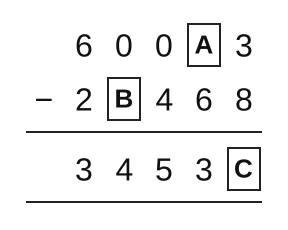
Start with the ones and work left, column by column, remembering any carried or exchanged digits. In \(5\square 8 + 264 = 802\), the ones give \(8 + 4 = 12\), so write 2 and carry 1. The answer has 0 tens, so the tens column must make 10: write 0 and carry 1 again. So \(\square + 6 + 1 = 10\), and the missing digit is 3.
Problems with more than one step
Read the problem carefully and decide what to work out first. Write down what each answer means before you use it in the next step.
A zoo had 186,420 visitors last year. This year it had 23,875 more than that. How many visitors came in the two years altogether?
Step 1, this year's visitors: \(186{,}420 + 23{,}875 = 210{,}295\)
Step 2, both years together: \(186{,}420 + 210{,}295 = 396{,}715\)
The zoo had 396,715 visitors in the two years.
Common mistakes
- Lining up the first digits instead of the ones digits.
- Forgetting to add a carried digit.
- Taking whichever digit is smaller away from the other one. In \(52 - 17\), the ones are \(12 - 7\) after exchanging, not \(7 - 2\).
- Forgetting that each 0 you exchange across becomes 9.
Top tip
Estimate first. 274,586 + 158,937 is about 270,000 + 160,000 = 430,000, so an answer of 433,523 looks right.