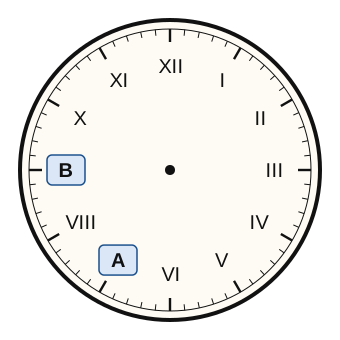
The big idea
The Romans wrote numbers with letters instead of digits. These are called Roman numerals. You still see them today on clock faces, in the names of kings and queens (Henry VIII), on chapter numbers and in the years shown at the end of films and TV programmes.
The seven symbols
| Symbol | I | V | X | L | C | D | M |
|---|
| Value | 1 | 5 | 10 | 50 | 100 | 500 | 1,000 |
Most Roman numerals are written with the biggest symbols first and the smallest last, and you add the values. LXII is \(50 + 10 + 1 + 1 = 62\).
- I, X, C and M can be repeated, but at most three times running: III is 3, XXX is 30, MMM is 3,000.
- V, L and D are never repeated. Ten is X, not VV.
The subtraction rule
When a smaller symbol comes before a bigger one, you subtract it. IV means "1 less than 5", so IV is 4. There are only six pairs like this:
Each pair uses I, X or C in front of one of the next two symbols up. You cannot put I in front of L or C, or X in front of D or M.
Writing a number in Roman numerals
Partition the number into thousands, hundreds, tens and ones. Change each part into Roman numerals, then join them up. Here is 3,648:
So 3,648 is MMMDCXLVIII. If a number has no tens (or no hundreds), just leave that part out. There is no Roman numeral for zero.
The biggest number you can write with these rules is 3,999 (MMMCMXCIX).
Reading Roman numerals
Work from left to right. Add each symbol, but look out for a smaller symbol just before a bigger one: treat that pair as one part.
MCMLXV is M + CM + LX + V, which is \(1{,}000 + 900 + 60 + 5 = 1{,}965\). Years are read the same way, so MCMLXV is the year 1965.
The pages of an old book are numbered in Roman numerals. What is the number of the page after page CXCIX? Write it in Roman numerals.
CXCIX is C + XC + IX, which is \(100 + 90 + 9 = 199\).
The next page is \(199 + 1 = 200\).
200 is two hundreds, so we write CC.
Comparing and calculating
To compare or calculate with Roman numerals, change them into ordinary numbers first. Do not judge by length: VIII (8) is longer than X (10), but it is smaller.
What is double CDXLV? Give the answer as a Roman numeral.
Change to a number: CD + XL + V is \(400 + 40 + 5 = 445\).
Double it: \(445 \times 2 = 890\).
Change back: 890 is \(500 + 300 + 90\), which is D + CCC + XC.
The answer is DCCCXC.
Stretch: Roman numerals and place value
Our digits change value when they move to a new column: the 3 in 30 is worth ten times the 3 in 3. That is why we need 0, to fill an empty column. A Roman symbol keeps its value wherever it appears: X means 10 every time.
Remember
- I = 1, V = 5, X = 10, L = 50, C = 100, D = 500, M = 1,000.
- A smaller symbol before a bigger one is subtracted: IV, IX, XL, XC, CD, CM.
- No symbol appears four times running.
Common mistakes
- Writing IIII for 4. Four is IV.
- Swapping the order: XL is 40, but LX is 60.
- Taking I away from a symbol that is too big. 99 is XCIX (90 + 9), not IC.
- Reading CM as 1,100. A C before an M means 100 less than 1,000, which is 900.
Top tip
Turn Roman numerals into ordinary numbers one part at a time: thousands, then hundreds, then tens, then ones. Write each part's value underneath before you add them.