Level:
Correct: 0
Incorrect: 0
Marks: 0/0
Practice
Course:
Topics:
Year 6 Maths Smart practice A mixed round aimed at your weak spots
Unit 1
Place value
Number and place value
Numbers up to ten million
Quick practice5 skills
Rounding whole numbers
Quick practice5 skills
Negative numbers
Quick practice5 skills
Roman numerals
Quick practice4 skills
Unit 2
Calculating
Unit 3
Fractions
Unit 4
Decimals
Unit 5
Fractions, decimals and percentages
Unit 6
Ratio and proportion
Unit 7
Algebra
Unit 8
Measurement
Unit 9
Shapes and angles
Unit 10
Position and direction
Geometry: position and direction
Coordinates in four quadrants
Quick practice5 skills
Translations
Quick practice4 skills
Reflections
Quick practice4 skills
Unit 11
Statistics
Statistics
Tables, timetables and bar charts
Quick practice4 skills
Line graphs
Quick practice4 skills
Pie charts
Quick practice5 skills
The mean
Quick practice5 skills
Avg
score:
–
Topics
done:
0/60

Multiplying and dividing by 10, 100 and 1,000

Practise 22 questions on Multiplying and dividing by 10, 100 and 1,000 for Year 6 Maths. Tap your answer and find out straight away if you are right, with the Study Helper on hand if you get stuck.

  • 22 questions
  • 1–4 marks each
  • Instant marking
  • No sign-up needed
20 questions, marked as you go

Sample questions with model answers

Here are 4 of the questions in this topic, each with a model answer, an explanation of why it earns the marks and the mark scheme.

Question 1

1 mark

Work out \(0.58 \times 100\)

Model answer

Multiplying by 100 moves each digit two places to the left.
5 tenths become 5 tens, 8 hundredths become 8 ones.
\(0.58 \times 100 = 58\)

Explanation

Multiplying by 100 makes every digit 100 times bigger, so each digit moves two places to the left. The 5 tenths become 5 tens and the 8 hundredths become 8 ones. A common mistake is to add two zeros and write 0.5800.

Mark scheme
  1. 1 mark

    58

    Do not accept 0.5800, 5.8 or 580.

Question 2

2 marks

A red ribbon is 2.3 m long. What is its length in centimetres?

A blue ribbon is 85 cm long. What is its length in metres?

Model answer

1 m = 100 cm
Red: \(2.3 \times 100 = 230\) cm
Blue: \(85 \div 100 = 0.85\) m

Explanation

There are 100 cm in 1 m. To change metres to centimetres, multiply by 100; to change centimetres to metres, divide by 100. Changing to a smaller unit gives a bigger number. A common mistake is to write 23 cm for 2.3 m, moving the digits only one place.

Mark scheme
  1. 1 mark

    Red ribbon: 230 cm

    The unit is given in the question, so 230 alone is fine. Do not accept 23 cm or 2.30 cm.

  2. 1 mark

    Blue ribbon: 0.85 m

    The unit is given in the question, so 0.85 alone is fine. Do not accept 8.5 m or 0.085 m. If the answers are not labelled, accept them in the order asked.

Question 3

2 marks

Here are six numbers.

0.045   45   450   4,500   0.45   4.05

Five of them can be changed into 4.5 by multiplying or dividing by 10, 100 or 1,000.

Which number cannot? How do you know?

Model answer

4.05 cannot be changed into 4.5.
Multiplying or dividing by 10, 100 or 1,000 moves all the digits together, so their order stays the same.
4.05 has a 0 between the 4 and the 5, so it can never become 4.5.

Explanation

When you multiply or divide by 10, 100 or 1,000, the digits all move together and the decimal point stays still. The digits never swap or disappear. The other numbers all have a 4 followed straight away by a 5, but 4.05 has a 0 in between, so it can only make numbers like 40.5 or 0.405.

Mark scheme
  1. 1 mark

    4.05, with a relevant but incomplete reason

    '4.05' alone scores 0, because the question asks for an explanation.

  2. 1 mark

    A complete correct reason, e.g. multiplying or dividing by 10, 100 or 1,000 only moves the digits, it does not change their order, and 4.05 has a 0 between the 4 and the 5; or every other number has the digits 4 then 5 next to each other

    A complete correct reason on its own scores both marks. Showing how each of the other five numbers makes 4.5 (\(0.045 \times 100\), \(45 \div 10\), \(450 \div 100\), \(4{,}500 \div 1{,}000\), \(0.45 \times 10\)) is also a complete reason.

Question 4

4 marks

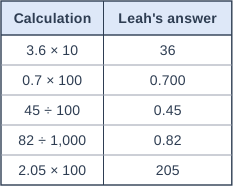
Leah does five calculations. The table shows her answers. Some of her answers are wrong.

What is the correct answer to each calculation?

Table with columns "Calculation", "Leah's answer". Calculation: 3.6 × 10; Leah's answer: 36 | Calculation: 0.7 × 100; Leah's answer: 0.700 | Calculation: 45 ÷ 100; Leah's answer: 0.45 | Calculation: 82 ÷ 1,000; Leah's answer: 0.82 | Calculation: 2.05 × 100; Leah's answer: 205.

Model answer

\(3.6 \times 10 = 36\): right
\(0.7 \times 100 = 0.700\): wrong, it should be 70
\(45 \div 100 = 0.45\): right
\(82 \div 1{,}000 = 0.82\): wrong, it should be 0.082
\(2.05 \times 100 = 205\): right

Explanation

Check each answer by moving the digits the right number of places. Leah added zeros for \(0.7 \times 100\), but 0.700 is the same as 0.7; the 7 tenths should move two places left to become 7 tens. For \(82 \div 1{,}000\) she moved the digits only two places instead of three. Checking whether an answer should be bigger or smaller helps you spot mistakes.

Mark scheme
  1. 1 mark

    \(0.7 \times 100\) (Leah's answer 0.700) is wrong

  2. 1 mark

    \(0.7 \times 100 = 70\)

  3. 1 mark

    \(82 \div 1{,}000\) (Leah's answer 0.82) is wrong

  4. 1 mark

    \(82 \div 1{,}000 = 0.082\)

    Take off 1 mark for each correct answer (\(3.6 \times 10\), \(45 \div 100\) or \(2.05 \times 100\)) said to be wrong, lowest total 0. A correct answer with no working scores full marks.

Ready to try the rest? Tap your answers and see straight away how you did.

Topic notes

Multiplying and dividing by 10, 100 and 1,000

The big idea

Multiplying by 10, 100 or 1,000 shifts the digits into new place value columns, and so does dividing. The decimal point stays put. Once you know which way the digits go and how far, you can do these calculations in your head, with whole numbers and with decimals.

Multiplying: the digits move left

\(\times 10\) makes each digit worth 10 times more, so it shifts one column left. \(\times 100\) shifts the digits two columns left, and \(\times 1{,}000\) shifts them three. Count the zeros to know how many columns.

CalculationThe digits moveAnswer
2.65 × 101 place left26.5
2.65 × 1002 places left265
2.65 × 1,0003 places left2,650

In \(2.65 \times 100\), the 2 ones become 2 hundreds, the 6 tenths become 6 tens and the 5 hundredths become 5 ones.

If a column in the answer is left empty, fill it with a place holder zero: \(1.4 \times 1{,}000 = 1{,}400\).

Dividing: the digits move right

\(\div 10\), \(\div 100\) and \(\div 1{,}000\) make each digit worth less, so the digits shift right: one, two or three columns.

CalculationThe digits moveAnswer
914 ÷ 101 place right91.4
914 ÷ 1002 places right9.14
914 ÷ 1,0003 places right0.914

Again, empty columns between the decimal point and the digits need zeros: \(3 \div 100 = 0.03\), because the 3 ones move to the hundredths column and the tenths column is empty.

Why "add a zero" goes wrong

With whole numbers, multiplying by 10 looks like sticking a 0 onto the end: \(12 \times 10 = 120\). But that is only because the digits have moved left and the 0 fills the empty ones column.

With decimals it does not work. \(1.2 \times 10\) is not 1.20, because 1.20 is the same as 1.2: the number has not changed at all. The 1 one becomes 1 ten and the 2 tenths become 2 ones, so \(1.2 \times 10 = 12\).

One packet of stickers costs £0.85. How much do 10 packets, 100 packets and 1,000 packets cost?

10 packets: \(0.85 \times 10\). The digits move 1 place left: 8.5, so £8.50.

100 packets: \(0.85 \times 100\). The digits move 2 places left: £85.

1,000 packets: \(0.85 \times 1{,}000\). The digits move 3 places left, with a zero in the ones column: £850.

Remember that money has two digits after the point, so 8.5 pounds is written £8.50.

Measures

1 metre is 100 centimetres. Metres to centimetres: \(\times 100\). Centimetres to metres: \(\div 100\). (See also: converting units.)

A model car is 100 times smaller than the real car. The model is 4.3 cm long. Find the length of the real car in centimetres and in metres.

The real car is 100 times bigger, so multiply by 100: \(4.3 \times 100 = 430\) cm.

In metres: \(430 \div 100 = 4.3\) m, because every 100 cm make 1 m.

The real car is 430 cm, or 4.3 m, long.

Working backwards

To find a missing number, use the inverse (the opposite operation): dividing by 100 undoes multiplying by 100.

Sam wanted to work out a number ÷ 100. He pressed × 100 by mistake, and his calculator showed 4,060. What answer should he have got?

First find Sam's starting number. Undo the × 100 by dividing by 100: \(4{,}060 \div 100 = 40.6\)

Now do what he meant to do: \(40.6 \div 100 = 0.406\)

Sam should have got 0.406. Check: \(0.406 \times 100 = 40.6\), and \(40.6 \times 100 = 4{,}060\).

Remember

  • × 10, × 100, × 1,000: the digits move 1, 2 or 3 places left.
  • ÷ 10, ÷ 100, ÷ 1,000: the digits move 1, 2 or 3 places right.
  • The decimal point stays put.
  • Fill empty columns with place holder zeros.

Common mistakes

  • Adding a zero to a decimal. \(3.4 \times 10\) is 34, not 3.40.
  • Moving the digits the wrong way. Dividing makes a number smaller: \(56 \div 100 = 0.56\), not 5,600.
  • Moving the wrong number of places. \(7.2 \div 100\) is 0.072 (two places), not 0.72 (one place).
  • Forgetting place holders. \(5 \div 100 = 0.05\), not 0.5.

Top tip

Before you start, ask: should the answer be bigger or smaller? Multiplying by 10, 100 or 1,000 makes a number bigger and dividing makes it smaller. If your answer goes the wrong way, check which way the digits moved.

Study Helper Hints first, answers after you try

Stuck on this one? Ask for a hint and I’ll point you in the right direction, without giving the answer away. Once you’ve checked your answer, I’ll show you how the marks are awarded.