Level:
Correct: 0
Incorrect: 0
Marks: 0/0
Practice
Course:
Topics:
Year 6 Maths Smart practice A mixed round aimed at your weak spots
Unit 1
Place value
Number and place value
Numbers up to ten million
Quick practice5 skills
Rounding whole numbers
Quick practice5 skills
Negative numbers
Quick practice5 skills
Roman numerals
Quick practice4 skills
Unit 2
Calculating
Unit 3
Fractions
Unit 4
Decimals
Unit 5
Fractions, decimals and percentages
Unit 6
Ratio and proportion
Unit 7
Algebra
Unit 8
Measurement
Unit 9
Shapes and angles
Unit 10
Position and direction
Unit 11
Statistics
Statistics
Tables, timetables and bar charts
Quick practice4 skills
Line graphs
Quick practice4 skills
Pie charts
Quick practice5 skills
The mean
Quick practice5 skills
Avg
score:
–
Topics
done:
0/60

Translations

Practise 18 questions on Translations for Year 6 Maths. Tap your answer and find out straight away if you are right, with the Study Helper on hand if you get stuck.

  • 18 questions
  • 1–4 marks each
  • Instant marking
  • No sign-up needed
18 questions, marked as you go

Sample questions with model answers

Here are 4 of the questions in this topic, each with a model answer, an explanation of why it earns the marks and the mark scheme.

Question 1

1 mark

Shape A is translated to make shape B.

Which of these sentences is true?

Model answer

B is the same size and shape as A.

Explanation

A translation slides a shape left, right, up or down. It does not turn it, flip it or change its size, so the new shape is exactly the same size and shape, and faces the same way. Only its position changes.

Mark scheme
  1. 1 mark

    B is the same size and shape as A.

    Accept 'the same size and shape' or the third option.

Question 2

2 marks

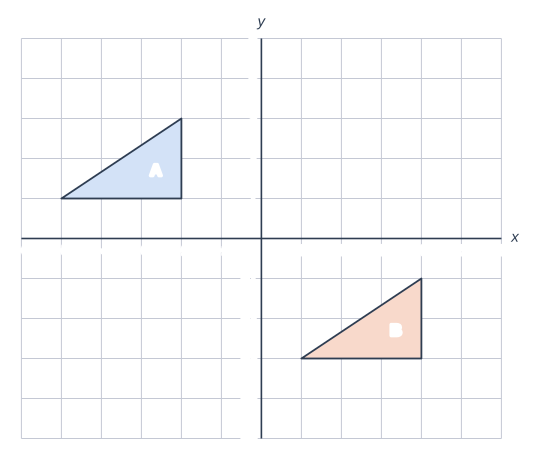
The diagram shows two triangles, A and B.

Describe the translation that moves triangle A onto triangle B.

A coordinate grid with x from −6 to 6 and y from −5 to 5; each grid square is 1 unit across, and the axes cross at the origin O. Shape A is a shaded triangle with vertices (−5, 1), (−2, 1) and (−2, 3). Shape B is a shaded triangle with vertices (1, −3), (4, −3) and (4, −1).

Model answer

6 squares to the right and 4 squares down

Explanation

Pick one corner of A and find the matching corner of B. The corner at \((-2, 1)\) moves to \((4, -3)\): that is 6 squares right and 4 squares down. Every corner moves the same way. A common mistake is to count the gap between the shapes instead of the move of one corner.

Mark scheme
  1. 1 mark

    6 squares to the right

    Accept '6 right', 'right 6'.

  2. 1 mark

    4 squares down

    Accept '4 down', 'down 4'. The two parts can be in either order. Do not accept movements from B to A (6 left and 4 up) for either mark.

Question 3

2 marks

A shape is translated 2 squares to the right and 4 squares up. Then it is translated 5 squares to the left and 1 square down.

Describe the single translation that would move the shape straight from where it started to where it finished.

Model answer

Across: 2 right then 5 left is 3 left.
Up and down: 4 up then 1 down is 3 up.
3 squares left and 3 squares up

Explanation

Deal with across and up-and-down separately. Going 2 right and then 5 left leaves you 3 to the left. Going 4 up and then 1 down leaves you 3 up. A common mistake is to add the numbers without thinking about the directions.

Mark scheme
  1. 1 mark

    3 squares to the left

    Accept '3 left', 'left 3'.

  2. 1 mark

    3 squares up

    Accept '3 up', 'up 3'. The two parts can be in either order. Common wrong answers: 7 left, 5 up.

Question 4

4 marks

Shape A is translated 3 squares to the right and 2 squares down to make shape B.

Shape B is translated 5 squares to the left and 6 squares up to make shape C.

One corner of shape A is at \((1, -1)\). What are the coordinates of this corner on shape B and on shape C?

Describe the translation that moves shape C back to shape A.

Model answer

B: \((1 + 3, -1 - 2) = (4, -3)\)
C: \((4 - 5, -3 + 6) = (-1, 3)\)
From \((-1, 3)\) back to \((1, -1)\) is 2 right and 4 down.

Explanation

Follow the corner one translation at a time: right adds to x, down takes from y, left takes from x and up adds to y. Then compare C's corner with A's corner: from \(-1\) to 1 is 2 right, and from 3 to \(-1\) is 4 down. A common mistake is to describe the move from A to C instead of from C back to A.

Mark scheme
  1. 1 mark

    On shape B: \((4, -3)\)

  2. 1 mark

    On shape C: \((-1, 3)\)

    Follow through from a wrong point on B.

  3. 1 mark

    C to A: 2 squares to the right

  4. 1 mark

    C to A: 4 squares down

    Follow through from their point on C (the move from it back to \((1, -1)\)). Common wrong answers: 2 left and 4 up (A to C).

Ready to try the rest? Tap your answers and see straight away how you did.

Topic notes

Translations

The big idea

A translation slides a shape to a new place. Every point of the shape slides by the same amount, the same way. Nothing turns, flips, stretches or shrinks, so the new shape, called the image, matches the original exactly: same size, same shape, pointing the same way. The only thing that changes is where it is.

Describing a translation

We describe a translation with two moves: how many squares left or right, and how many squares up or down. For example, "6 squares right, 5 squares down".

To describe a translation from a picture, pick one corner of the shape and look for the same corner on the image. Count how far that corner moves across, then how far it moves up or down. Every other corner makes that same move.

A coordinate grid with x from 0 to 11 and y from 0 to 9; each grid square is 1 unit across, and the axes cross at the origin O. Shape A is a shaded quadrilateral with vertices (1, 6), (3, 6), (4, 8) and (1, 8). (Trapezium; area 5 square units.) Shape B is a shaded quadrilateral with vertices (7, 1), (9, 1), (10, 3) and (7, 3). (Trapezium; area 5 square units.) A dot is marked at (4, 8). A dot is marked at (10, 3). A dashed straight line segment joins (4, 8) to (10, 8), labelled "6 right". (Length 6; midpoint (7, 8); gradient 0.) A dashed straight line segment joins (10, 8) to (10, 3), labelled "5 down". (Length 5; midpoint (10, 5.5); vertical, so no gradient.) (Shape B is the image of shape A under a translation by the column vector (6, −5) (6 right, 5 down).)
Shape A slides 6 squares right, then 5 squares down, to make B. Follow one corner (the dots): every corner makes the same move.

Translating coordinates

MoveWhat changes
rightthe x-coordinate goes up by that many
leftthe x-coordinate goes down by that many
upthe y-coordinate goes up by that many
downthe y-coordinate goes down by that many

So a move left or right changes only the first number, and a move up or down changes only the second. When a move crosses an axis, count through 0. The point \((-1, 3)\) moved 4 right and 5 down lands on \((3, -2)\).

A shape is moved. The corner that was at \((1, 1)\) ends up at \((4, 3)\), and the corner that was at \((2, 1)\) ends up at \((5, 2)\). Could this move be a translation?

First corner: from 1 to 4 across is 3 right, and from 1 to 3 is 2 up.

Second corner: from 2 to 5 across is 3 right, but from 1 to 2 is only 1 up.

The two corners moved in different ways. In a translation every point makes the same move, so this is not a translation: the shape has been turned or stretched.

A square has corners at \((-4, -3)\), \((-2, -3)\), \((-2, -1)\) and \((-4, -1)\). It is translated so that it sits in the top-right quadrant with one corner on the origin. Describe the translation and give the new corners.

The whole square must end up above and to the right of the origin, so its bottom-left corner, \((-4, -3)\), goes to \((0, 0)\).

Across: \(-4\) to 0 means 4 squares right. Up: \(-3\) to 0 means 3 squares up. The translation is 4 squares right and 3 squares up.

Do the same move to every corner: add 4 to each x-coordinate and 3 to each y-coordinate. The new corners are \((0, 0)\), \((2, 0)\), \((2, 2)\) and \((0, 2)\).

Stretch: translations with letters

If a point is \((a, b)\), a move right adds to \(a\) and a move left takes away from \(a\). A move up adds to \(b\) and a move down takes away from \(b\).

Use \((a, b)\) to write where a point goes after the translation "5 squares left and 2 squares up".

Left 5: the x-coordinate becomes \(a - 5\). Up 2: the y-coordinate becomes \(b + 2\).

The point moves from \((a, b)\) to \((a - 5, b + 2)\).

Check with the point \((7, 1)\): \(7 - 5 = 2\) and \(1 + 2 = 3\), so it lands on \((2, 3)\). That is 5 left and 2 up, as it should be.

Common mistakes

  • Changing the wrong number. Moving right or left changes the first number of the pair, not the second.
  • Counting the empty squares between the shape and its image. Follow one corner to its matching corner instead.
  • Describing the move backwards, from the image to the shape. Start from the shape you were given.
  • Losing the minus sign when crossing 0: 3 squares left from 1 is \(-2\), not 2.

Top tip

Check your answer by moving one corner of the image back the opposite way. If you land where you started, your translation is right.

Study Helper Hints first, answers after you try

Stuck on this one? Ask for a hint and I’ll point you in the right direction, without giving the answer away. Once you’ve checked your answer, I’ll show you how the marks are awarded.