Level:
Correct: 0
Incorrect: 0
Marks: 0/0
Practice
Course:
Topics:
Year 6 Maths Smart practice A mixed round aimed at your weak spots
Unit 1
Place value
Number and place value
Numbers up to ten million
Quick practice5 skills
Rounding whole numbers
Quick practice5 skills
Negative numbers
Quick practice5 skills
Roman numerals
Quick practice4 skills
Unit 2
Calculating
Unit 3
Fractions
Unit 4
Decimals
Unit 5
Fractions, decimals and percentages
Unit 6
Ratio and proportion
Unit 7
Algebra
Unit 8
Measurement
Unit 9
Shapes and angles
Unit 10
Position and direction
Geometry: position and direction
Coordinates in four quadrants
Quick practice5 skills
Translations
Quick practice4 skills
Reflections
Quick practice4 skills
Unit 11
Statistics
Statistics
Tables, timetables and bar charts
Quick practice4 skills
Line graphs
Quick practice4 skills
Pie charts
Quick practice5 skills
The mean
Quick practice5 skills
Avg
score:
–
Topics
done:
0/60

Angles on a line, around a point and vertically opposite

Practise 22 questions on Angles on a line, around a point and vertically opposite for Year 6 Maths. Tap your answer and find out straight away if you are right, with the Study Helper on hand if you get stuck.

  • 22 questions
  • 1–4 marks each
  • Instant marking
  • No sign-up needed
20 questions, marked as you go

Sample questions with model answers

Here are 4 of the questions in this topic, each with a model answer, an explanation of why it earns the marks and the mark scheme.

Question 1

1 mark

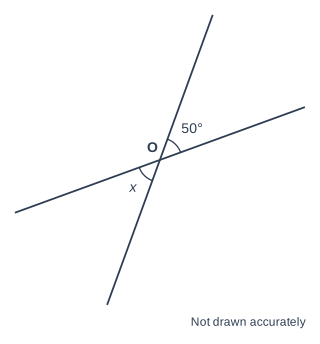
The diagram shows two straight lines that cross at O.

What is the size of angle x?

Geometry diagram, marked "Not drawn accurately". A sloping line with no labelled ends is drawn. A sloping line with no labelled ends is drawn. O lies on an unlabelled line going to the left and an unlabelled line going downwards. The angle at O between the line going to the right from O and the line going upwards from O is marked 50°. The angle at O between the line going to the left from O and the line going downwards from O is marked x.

Model answer

Vertically opposite angles are equal.
x = 50°

Explanation

When two straight lines cross, the angles opposite each other are equal. They are called vertically opposite angles. Angle x is opposite the 50° angle, so x is also 50°. A common mistake is to take 50 away from 180, which gives the angle next to it instead.

Mark scheme
  1. 1 mark

    50°

    Accept 50 or x = 50, with or without the degree sign. Do not accept 130 (the angle next to 50°).

Question 2

2 marks

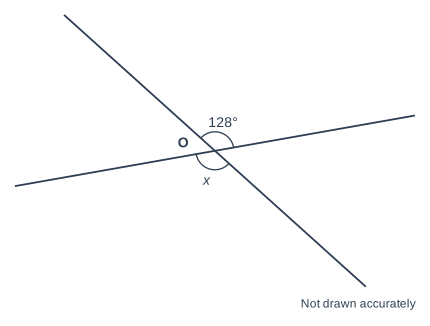
The diagram shows two straight lines that cross at O.

Work out the size of angle x. Give a reason for your answer.

Geometry diagram, marked "Not drawn accurately". A sloping line with no labelled ends is drawn. A sloping line with no labelled ends is drawn. O lies on an unlabelled line going to the left and an unlabelled line going down and to the right. The angle at O between the line going to the right from O and the line going up and to the left from O is marked 128°. The angle at O between the line going to the left from O and the line going down and to the right from O is marked x.

Model answer

x = 128°, because vertically opposite angles are equal.

Explanation

Angle x is opposite the 128° angle where the two straight lines cross. Vertically opposite angles are always equal, so x = 128°. When you give a reason, name the angle fact you used, not just what the diagram looks like (the diagram is not drawn accurately).

Mark scheme
  1. 1 mark

    x = 128°

    Accept 128 with or without the degree sign.

  2. 1 mark

    Reason: vertically opposite angles are equal

    Accept 'opposite angles are equal', or 'angles opposite each other where two lines cross are the same'. Do not accept 'it looks the same' or 'because it is opposite' with no mention of the angles being equal. This mark can be awarded with a wrong value of x if the reason is correct.

Question 3

2 marks

Ravi cuts a round pizza into 5 slices. Every cut goes from the centre to the edge.

The angles at the centre of four of the slices are 45°, 60°, 80° and 95°.

What is the angle at the centre of the fifth slice?

Model answer

The angles at the centre add up to 360°.
\(45 + 60 + 80 + 95 = 280\)
\(360 - 280 = 80\)
The fifth slice has an angle of 80°.

Explanation

All the slices meet at the centre of the pizza, so their angles go all the way round a point and add up to 360°. The four angles you know add up to 280°, so the last one is \(360 - 280 = 80\)°. A common mistake is to divide 360 by 5, but the slices are not all the same size.

Mark scheme
  1. 1 mark

    \(45 + 60 + 80 + 95 = 280\), or 360 used as the total; or the correct answer 80° with no working

  2. 1 mark

    80°

    Accept 80 with or without the degree sign. Do not accept 72 (360 ÷ 5: the slices are not equal). A correct answer with no working scores full marks.

Question 4

4 marks

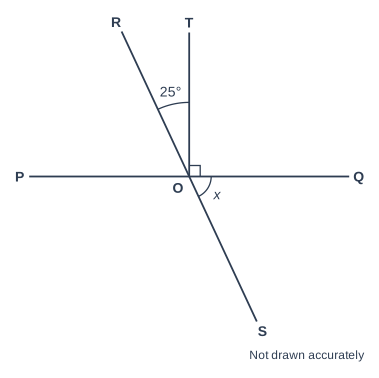
In the diagram, PQ and RS are straight lines that cross at O. Angle TOQ is a right angle.

Work out the size of angle x. Give reasons for your answer.

Geometry diagram, marked "Not drawn accurately". Line segments PQ, RS and OT are drawn. O lies on PQ and RS. Angle TOQ is marked as a right angle (90°). Angle ROT is marked 25°. Angle QOS is marked x.

Model answer

Angle POT = 180 − 90 = 90°, because angles on a straight line add up to 180°.
Angle POR = 90 − 25 = 65°.
x = 65°, because x and angle POR are vertically opposite, and vertically opposite angles are equal.

Explanation

Angle TOQ is 90°, so angle POT is also 90°, because together they make the straight line PQ. Take away the 25° to get angle POR = 65°. Angle x is vertically opposite angle POR, so x = 65°. A common mistake is to think x is opposite the 25° angle.

Mark scheme
  1. 1 mark

    Angle POR = 65° found, e.g. angle POT = 90° so \(90 - 25 = 65\), or angle ROQ = 115° so \(180 - 115 = 65\)

    Also award for angle ROQ = 115° (90 + 25) seen.

  2. 1 mark

    A correct reason for finding angle POR, e.g. angles on a straight line (PQ) add up to 180°

    Another correct method uses only one angle fact: angle ROQ = 25 + 90 = 115°, then x = 180 - 115 = 65° because angles on the straight line RS add up to 180°. For that method, the reason 'angles on a straight line add up to 180°' earns this mark and the last mark, so a complete correct answer by this method scores all 4 marks.

  3. 1 mark

    x = 65°

    Accept 65 with or without the degree sign. Do not accept 25 or 115.

  4. 1 mark

    Reason: vertically opposite angles are equal (x is opposite angle POR)

    Also accept: x = 180 − 115 because angles on the straight line RS add up to 180° (angle ROQ = 115°). 'They look the same' is not a reason.

Ready to try the rest? Tap your answers and see straight away how you did.

Topic notes

Angles on a line, around a point and vertically opposite

The big idea

When lines meet at a point, the angles there always follow three simple facts. If you know some of the angles, these facts let you work out the others without measuring. That matters because diagrams are often not drawn accurately.

The three angle facts

Geometry diagram, drawn accurately to scale. A horizontal line with no labelled ends is drawn. A sloping line with no labelled ends is drawn. A vertical line with no labelled ends is drawn. A sloping line with no labelled ends is drawn. A sloping line with no labelled ends is drawn. A sloping line with no labelled ends is drawn. A sloping line with no labelled ends is drawn. The angle at an unlabelled point is marked a (it measures 60° on the drawing). The angle at an unlabelled point is marked b (it measures 120° on the drawing). The angle at an unlabelled point is marked a (it measures 120° on the drawing). The angle at an unlabelled point is marked b (it measures 120° on the drawing). The angle at an unlabelled point is marked c (it measures 120° on the drawing). The angle at an unlabelled point is marked a (it measures 60° on the drawing). The angle at an unlabelled point is marked a (it measures 60° on the drawing). The angle at an unlabelled point is marked b (with a double arc) (it measures 120° on the drawing). The angle at an unlabelled point is marked b (with a double arc) (it measures 120° on the drawing). The text "a + b = 180°" is written. The text "a + b + c = 360°" is written. The text "opposite angles are equal" is written.
Left: angles on a straight line. Middle: angles around a point. Right: vertically opposite angles.
FactWhat it says
Angles on a straight lineadd up to 180°, because a straight line is half a turn
Angles around a pointadd up to 360°, because they make a full turn
Vertically opposite anglesare equal. If two straight lines cross, each angle matches the one facing it across the crossing point

"Vertically" here means "at the vertex", the point where the lines meet. It has nothing to do with up and down.

To find a missing angle, add up the angles you know and subtract their total from 180° or 360°. Write the angle fact you used as your reason: a sentence that says which fact makes your answer true.

Geometry diagram, drawn accurately to scale. A sloping line with no labelled ends is drawn. A sloping line with no labelled ends is drawn. A sloping line with no labelled ends is drawn. A vertical line with no labelled ends is drawn. The angle at an unlabelled point is marked as a right angle (90°). The angle at an unlabelled point is marked 160°. The angle at an unlabelled point is marked x (it measures 55° on the drawing). The angle at an unlabelled point is marked x (it measures 55° on the drawing).
Four paths meet at a fountain. The two angles marked x are equal.

Find the size of each angle marked x at the fountain.

The four angles fill a whole turn at the fountain. Their total is 360° (angles around a point).

Take away the angles you know: \(360 - 90 - 160 = 110\)

The two equal angles share 110° between them: \(110 \div 2 = 55\)

x = 55°. Check: \(55 + 55 + 90 + 160 = 360\)

Ella says that angles of 125°, 95° and 150° fit exactly round a point. Is she right?

Angles around a point add up to 360°.

\(125 + 95 + 150 = 370\)

370° is more than 360°, so she is wrong. The angles overlap by \(370 - 360 = 10\)°.

Using letters

Sometimes the angles are written with letters. Use the facts to write down what the letters add up to, then work out each one.

Two straight lines cross. One of the angles is a. The angle next to it is 24° bigger than a. Find all four angles.

The two neighbouring angles make a straight line, so a and a + 24° add up to 180°.

Take away the extra 24°: \(180 - 24 = 156\), which is two lots of a.

\(156 \div 2 = 78\), so a = 78° and the angle next to it is \(78 + 24 = 102\)°.

The other two angles are vertically opposite these, so the four angles are 78°, 102°, 78° and 102°.

Remember

  • Angles on a straight line add up to 180°.
  • Angles around a point add up to 360°.
  • Vertically opposite angles are equal.
  • A small square in a corner means a right angle, 90°.

Common mistakes

  • Subtracting from 360° when the angles sit on a straight line, or from 180° when they go round a point.
  • Forgetting to count a right angle that is marked only with a small square.
  • Thinking the angle next to a given angle is vertically opposite it. Vertically opposite angles share only the crossing point, not an arm.
  • Giving a reason such as "it looks the same". Name the angle fact instead.

Top tip

Write the reason next to each step, for example "angles on a straight line add up to 180°". Then check that all the angles round the point make 360°.

Study Helper Hints first, answers after you try

Stuck on this one? Ask for a hint and I’ll point you in the right direction, without giving the answer away. Once you’ve checked your answer, I’ll show you how the marks are awarded.