Practise 15 questions on Parts of a circle for Year 6 Maths. Tap your answer and find out straight away if you are right, with the Study Helper on hand if you get stuck.
15 questions
1–4 marks each
Instant marking
No sign-up needed
15 questions, marked as you go
Sample questions with model answers
Here are 4 of the questions in this topic, each with a model answer, an explanation of why it earns the marks and the mark scheme.
Question 1
1 mark
A round mirror has a diameter of 18 cm.
What is the radius of the mirror?
Model answer
The radius is half the diameter. \(18 \div 2 = 9\) cm
Explanation
The radius goes from the centre to the edge, which is half of the way across. Halve the diameter: \(18 \div 2 = 9\) cm. A common mistake is to double it instead.
Mark scheme
1 mark
9 cm
The unit is given in the question, so 9 on its own scores. Do not accept 36 (doubling instead of halving).
Question 2
2 marks
A round rug has a diameter of 1.5 m.
What is the radius of the rug in centimetres?
Model answer
1.5 m = 150 cm Radius = \(150 \div 2 = 75\) cm
Explanation
First change metres to centimetres: 1 m = 100 cm, so 1.5 m = 150 cm. The radius is half the diameter, so \(150 \div 2 = 75\) cm. A common mistake is to double instead of halve.
Mark scheme
1 mark
Changes 1.5 m to 150 cm, or finds the radius in metres, 0.75 m; or the correct answer 75 with no working
1 mark
75 (cm)
0.75 m on its own scores the first mark only, because the question asks for centimetres. A common wrong answer is 300 (doubling 150). A correct answer with no working scores full marks.
Question 3
3 marks
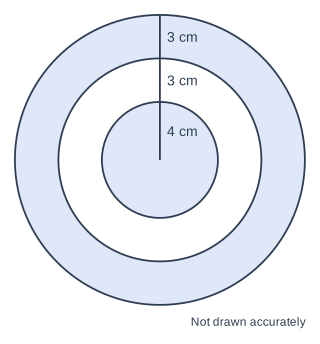
A target is made of three circles with the same centre, as shown in the diagram.
The smallest circle has a radius of 4 cm. Each ring around it is 3 cm wide.
Work out the diameter of the largest circle.
Model answer
Radius of the largest circle: \(4 + 3 + 3 = 10\) cm Diameter: \(10 \times 2 = 20\) cm
Explanation
Go out from the centre: 4 cm to the edge of the smallest circle, then 3 cm and 3 cm across the two rings. That gives the radius of the largest circle, 10 cm. The diameter is twice the radius, 20 cm. A common mistake is to count the rings on only one side of the centre.
Mark scheme
1 mark
Radius of the largest circle: \(4 + 3 + 3 = 10\); or the correct answer 20 with no working
1 mark
Doubles their radius of the largest circle (e.g. \(10 \times 2\)), or adds across the whole circle: \(3 + 3 + 8 + 3 + 3\)
Follow through from a wrong radius.
1 mark
20 (cm)
10 on its own is the radius: it scores the first mark only. A common wrong answer is 14 (\(8 + 3 + 3\), counting each ring only once). A correct answer with no working scores full marks.
Question 4
4 marks
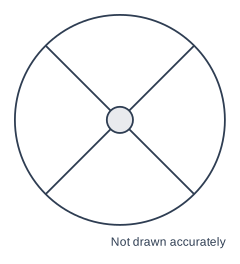
The diagram shows a bicycle wheel with only 4 of its spokes. The wheel has a diameter of 64 cm.
In the middle is a hub. The hub is a circle with a radius of 4 cm. The hub and the wheel have the same centre.
Each spoke goes in a straight line from the edge of the hub to the edge of the wheel. The wheel has 32 spokes.
Work out the total length of all 32 spokes.
Model answer
Radius of the wheel: \(64 \div 2 = 32\) cm One spoke: \(32 - 4 = 28\) cm \(28 \times 32 = 28 \times 30 + 28 \times 2 = 840 + 56 = 896\) Total: 896 cm
Explanation
A spoke runs from the hub to the rim, so it is the wheel's radius take away the hub's radius: \(32 - 4 = 28\) cm. Then multiply by the number of spokes: \(28 \times 32 = 896\) cm. A common mistake is to use the diameter of the wheel, or to forget to take away the hub.
Mark scheme
1 mark
Radius of the wheel: \(64 \div 2 = 32\); or the correct answer 896 cm with no working
1 mark
Length of one spoke: \(32 - 4 = 28\)
Follow through from their radius.
1 mark
A correct method to multiply their spoke length by 32, e.g. \(28 \times 30 + 28 \times 2\) or \(28 \times 32\) set out as long multiplication
Accept any clear record of the partial products (e.g. 840 + 56). Allow one arithmetic error.
1 mark
896 cm
Accept 8.96 m. Common wrong answers: 1,024 (\(32 \times 32\), forgetting the hub), 768 (\(24 \times 32\), taking away the hub's diameter) and 1,920 (\(60 \times 32\), using the wheel's diameter). A correct answer with no working scores full marks.
Ready to try the rest? Tap your answers and see straight away how you did.
Ctrl + Enter to check
Study HelperHints first, answers after you try
Stuck on this one? Ask for a hint and I’ll point you in the right direction, without giving the answer away. Once you’ve checked your answer, I’ll show you how the marks are awarded.