Practise 20 questions on Reflections for Year 6 Maths. Tap your answer and find out straight away if you are right, with the Study Helper on hand if you get stuck.
20 questions
1–5 marks each
Instant marking
No sign-up needed
20 questions, marked as you go
Sample questions with model answers
Here are 4 of the questions in this topic, each with a model answer, an explanation of why it earns the marks and the mark scheme.
Question 1
1 mark
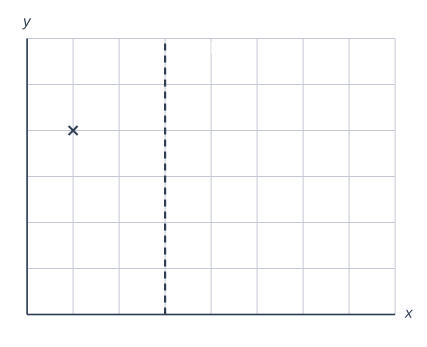
The diagram shows point A and a mirror line on a coordinate grid.
Point A is reflected in the mirror line.
What are the coordinates of the image of A?
Model answer
A is at \((1, 4)\). The mirror line goes through 3 on the x-axis. A is 2 squares to the left of the mirror line, so the image is 2 squares to the right of it. \(3 + 2 = 5\), so the image is at \((5, 4)\)
Explanation
Count the squares from the point to the mirror line: A is 2 squares to the left of it. The image is the same distance on the other side, 2 squares to the right. The mirror line is vertical, so the point moves straight across and its y-coordinate stays 4. A common mistake is to count from the y-axis instead of from the mirror line.
Mark scheme
1 mark
\((5, 4)\)
The coordinates must be in the order (x, y). Accept 5, 4 without brackets. Do not accept \((4, 5)\) or \((3, 4)\).
Question 2
2 marks
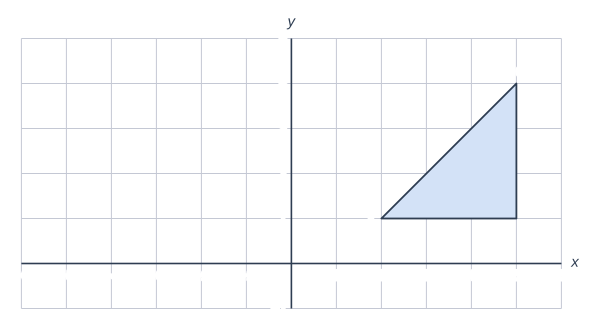
The diagram shows triangle ABC on a coordinate grid.
Triangle ABC is reflected in the y-axis.
What are the coordinates of the images of A, B and C?
Model answer
A \((2, 1)\) becomes \((-2, 1)\) B \((5, 1)\) becomes \((-5, 1)\) C \((5, 4)\) becomes \((-5, 4)\)
Explanation
Reflect one corner at a time. Each corner moves straight across the y-axis to the same distance on the other side, so the x-coordinate changes to its negative and the y-coordinate stays the same. For example, B is 5 squares right of the y-axis, so its image is 5 squares left of it. Check that the image is the same size and shape as ABC but flipped.
Mark scheme
1 mark
Two of the three images correct: A \((-2, 1)\), B \((-5, 1)\), C \((-5, 4)\); or all three correct with no working
Coordinates must be in the order (x, y).
1 mark
All three correct: A \((-2, 1)\), B \((-5, 1)\), C \((-5, 4)\)
The images may be called A', B', C'. A correct answer with no working scores full marks.
Question 3
2 marks
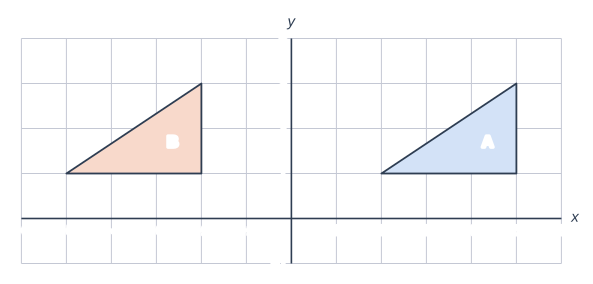
The diagram shows shape A and shape B on a coordinate grid.
Sam says, "Shape B is the reflection of shape A in the y-axis."
Is Sam right? How do you know?
Model answer
No. Shape B faces the same way as shape A, so A has just slid 7 squares to the left (a translation). A reflection in the y-axis would flip A, giving corners \((-2, 1)\), \((-5, 1)\) and \((-5, 3)\).
Explanation
A reflection flips a shape, so the image faces the opposite way, like your reflection in a mirror. Here the right angle of A is on the right-hand side and the right angle of B is also on the right-hand side, so B has not been flipped. Each corner of a reflection must also be the same distance from the mirror line as the corner it came from.
Mark scheme
1 mark
No, with a relevant but incomplete reason, e.g. 'B is the wrong way round' or 'B is in the wrong place'
'No' alone scores 0.
1 mark
No, with a complete correct reason, e.g. B faces the same way as A, so it is a translation (7 squares to the left), not a reflection; or the corner of A at \((5, 1)\) is 5 squares right of the y-axis, but the matching corner of B, \((-2, 1)\), is only 2 squares left of it; or the reflection of A in the y-axis would have corners \((-2, 1)\), \((-5, 1)\) and \((-5, 3)\)
A complete correct reason on its own scores both marks. Accept 'B is a translation of A', 'A has slid along to B' or 'B has been moved but not flipped' as a complete reason.
Question 4
4 marks
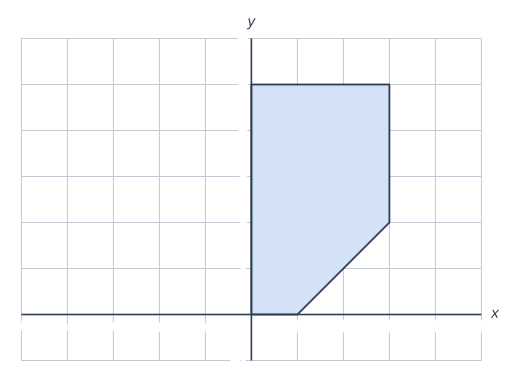
The diagram shows half of a symmetrical shape. The y-axis is its mirror line.
The other half of the shape is made by reflecting this half in the y-axis.
What are the coordinates of the three new corners that are not on the y-axis? How many sides does the whole shape have?
Model answer
The half has corners \((3, 5)\), \((3, 2)\) and \((1, 0)\) off the y-axis. Their images are \((-3, 5)\), \((-3, 2)\) and \((-1, 0)\). The whole shape has corners \((3, 5)\), \((3, 2)\), \((1, 0)\), \((-1, 0)\), \((-3, 2)\), \((-3, 5)\). The top and the bottom are straight lines across, so the shape has 6 sides.
Explanation
Reflect each corner that is not on the mirror line: it moves to the same distance on the other side of the y-axis. The corners on the y-axis do not move, and in the whole shape they are not corners any more, because the top edge and the bottom edge carry straight on across the y-axis. So the whole shape is a hexagon with 6 sides. A common mistake is to add the sides of the two halves and get 10.
Mark scheme
1 mark
\((-3, 5)\)
The three corners may be given in any order. Coordinates must be in the order (x, y).
1 mark
\((-3, 2)\)
1 mark
\((-1, 0)\)
1 mark
6 (sides)
Do not accept 8 or 10: the top side and the bottom side each run straight across the y-axis, so they are one side each, and the side along the y-axis is no longer a side. A correct answer with no working scores full marks.
Ready to try the rest? Tap your answers and see straight away how you did.
Ctrl + Enter to check
Study HelperHints first, answers after you try
Stuck on this one? Ask for a hint and I’ll point you in the right direction, without giving the answer away. Once you’ve checked your answer, I’ll show you how the marks are awarded.