Practise 20 questions on Scale factors and similar shapes for Year 6 Maths. Tap your answer and find out straight away if you are right, with the Study Helper on hand if you get stuck.
20 questions
1–5 marks each
Instant marking
No sign-up needed
20 questions, marked as you go
Sample questions with model answers
Here are 4 of the questions in this topic, each with a model answer, an explanation of why it earns the marks and the mark scheme.
Question 1
1 mark
A shape was enlarged by scale factor 3. One side of the new shape is 18 cm long.
How long was this side on the original shape?
Model answer
\(18 \div 3 = 6\) 6 cm
Explanation
The enlargement multiplied every length by 3, so to get back to the original you divide by 3: \(18 \div 3 = 6\) cm. Check: \(6 \times 3 = 18\). A common mistake is to multiply by 3 again, which makes the original side longer than the new one.
Mark scheme
1 mark
6 cm
Accept 6 with or without 'cm'. 54 cm (\(18 \times 3\)) or 15 cm (\(18 - 3\)) scores 0.
Question 2
2 marks
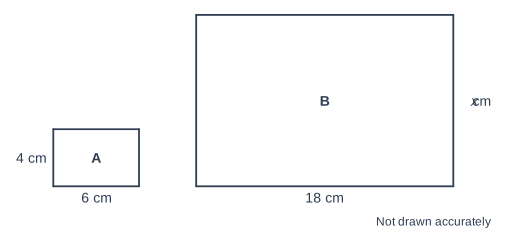
The diagram shows two rectangles, A and B. Rectangle B is an enlargement of rectangle A.
Find the scale factor from a pair of matching sides: the long sides are 6 cm and 18 cm, so the scale factor is \(18 \div 6 = 3\). Multiply the short side by 3 as well: \(4 \times 3 = 12\) cm. A common mistake is to add 12 cm to the short side because 18 is 12 more than 6.
Mark scheme
1 mark
Scale factor 3 (\(18 \div 6\)); or the correct answer 12 cm with no working
1 mark
12 (cm)
16 (4 + 12, adding the difference between the long sides) scores 0. A correct answer with no working scores full marks.
Question 3
2 marks
Mo has a rectangle that is 2 cm wide and 5 cm long.
He says, 'If I add 3 cm to each side, I get a similar rectangle that is 5 cm wide and 8 cm long.'
Is Mo right? How do you know?
Model answer
No. The width goes from 2 cm to 5 cm, which is \(2 \times 2.5\). For a similar rectangle, the length must also be multiplied by 2.5: \(5 \times 2.5 = 12.5\) cm, not 8 cm. Adding 3 cm to each side changes the shape.
Explanation
Similar shapes are enlargements: every side is multiplied by the same scale factor. Adding the same amount to each side does not do that. Here the width more than doubles, from 2 cm to 5 cm, but the length does not even double, from 5 cm to 8 cm, so the new rectangle is a different shape. A common mistake is to think that changing every side by the same amount keeps the shape the same.
Mark scheme
1 mark
No, with a relevant but incomplete reason, e.g. 'you have to multiply, not add'
1 mark
No, with a complete correct reason that shows the sides are not multiplied by the same number, e.g. the width more than doubles (2 cm to 5 cm) but the length does not double (5 cm to 8 cm); or a similar rectangle 5 cm wide would be 12.5 cm long; or \(2 \times 2.5 = 5\) but \(5 \times 2.5 = 12.5\), not 8
A complete correct reason on its own scores both marks. 'No' alone scores 0. 'Yes' scores 0.
Question 4
4 marks
Ella draws a plan of a rectangular garden. On the plan, 1 cm represents 2 m. The garden is 6 cm long and 4 cm wide on the plan.
A fence goes all the way round the real garden. Fencing costs £5 for each metre.
How much does the fence cost?
Model answer
Real length: \(6 \times 2 = 12\) m Real width: \(4 \times 2 = 8\) m Perimeter: \(12 + 8 + 12 + 8 = 40\) m Cost: \(40 \times 5 = 200\), so £200
Explanation
First turn the plan lengths into real lengths: each 1 cm is 2 m, so the garden is 12 m long and 8 m wide. The fence goes all the way round, so you need the perimeter: \(12 + 8 + 12 + 8 = 40\) m. At £5 a metre, the fence costs \(40 \times 5 = 200\) pounds. A common mistake is to work out the area instead of the perimeter.
Mark scheme
1 mark
One real length correct (12 m or 8 m), or the perimeter on the plan is 20 cm; or the correct answer £200 with no working
1 mark
The real perimeter is 40 m
1 mark
\(40 \times 5\) (their real perimeter multiplied by 5)
1 mark
£200
Accept 200 or £200.00. £100 (using the 20 cm on the plan as 20 m) scores the first mark only. £480 (using the area, 96 m²) scores the first mark only. A correct answer with no working scores full marks.
Ready to try the rest? Tap your answers and see straight away how you did.
Ctrl + Enter to check
Study HelperHints first, answers after you try
Stuck on this one? Ask for a hint and I’ll point you in the right direction, without giving the answer away. Once you’ve checked your answer, I’ll show you how the marks are awarded.