Level:
Correct: 0
Incorrect: 0
Marks: 0/0
Practice
Course:
Topics:
Year 6 Maths Smart practice A mixed round aimed at your weak spots
Unit 1
Place value
Number and place value
Numbers up to ten million
Quick practice5 skills
Rounding whole numbers
Quick practice5 skills
Negative numbers
Quick practice5 skills
Roman numerals
Quick practice4 skills
Unit 2
Calculating
Unit 3
Fractions
Unit 4
Decimals
Unit 5
Fractions, decimals and percentages
Unit 6
Ratio and proportion
Unit 7
Algebra
Unit 8
Measurement
Unit 9
Shapes and angles
Unit 10
Position and direction
Geometry: position and direction
Coordinates in four quadrants
Quick practice5 skills
Translations
Quick practice4 skills
Reflections
Quick practice4 skills
Unit 11
Statistics
Statistics
Tables, timetables and bar charts
Quick practice4 skills
Line graphs
Quick practice4 skills
Pie charts
Quick practice5 skills
The mean
Quick practice5 skills
Avg
score:
–
Topics
done:
0/60

Decimals up to three decimal places

Practise 23 questions on Decimals up to three decimal places for Year 6 Maths. Tap your answer and find out straight away if you are right, with the Study Helper on hand if you get stuck.

  • 23 questions
  • 1–5 marks each
  • Instant marking
  • No sign-up needed
20 questions, marked as you go

Sample questions with model answers

Here are 4 of the questions in this topic, each with a model answer, an explanation of why it earns the marks and the mark scheme.

Question 1

1 mark

What is 0.71 as a fraction?

Model answer

0.71 is 7 tenths and 1 hundredth, which is 71 hundredths.
\(0.71 = \dfrac{71}{100}\)

Explanation

The last digit of 0.71 is in the hundredths column, so the number is 71 hundredths. That means the denominator is 100 and the numerator is 71. A common mistake is to write \(\dfrac{71}{10}\), which is more than 7.

Mark scheme
  1. 1 mark

    \(\dfrac{71}{100}\)

    Accept an equivalent fraction such as \(\dfrac{710}{1000}\). Do not accept \(\dfrac{71}{10}\), \(\dfrac{7}{10}\) or \(\dfrac{71}{1000}\).

Question 2

2 marks

Put these numbers in order, starting with the smallest.

3.4   3.04   3.404   3.044   3.44

Model answer

Write them all with 3 decimal places:
3.400, 3.040, 3.404, 3.044, 3.440
Smallest to largest:
3.04, 3.044, 3.4, 3.404, 3.44

Explanation

Writing every number with the same number of decimal places makes them easier to compare. Then compare the tenths first, then the hundredths, then the thousandths. A common mistake is to think 3.404 is bigger than 3.44 because it has more digits.

Mark scheme
  1. 1 mark

    Four of the numbers in the correct order, or one pair of numbers swapped; or the correct order with no working

    Do not award for the correct order written largest first.

  2. 1 mark

    3.04, 3.044, 3.4, 3.404, 3.44

    Accept numbers written with extra zeros, e.g. 3.040 or 3.400. A correct answer with no working scores full marks.

Question 3

2 marks

The numbers in this sequence go up by the same amount each time.

What are the two missing numbers?

4.097   4.098   \(\square\)   \(\square\)   4.101

Model answer

The sequence goes up by 0.001 each time.
\(4.098 + 0.001 = 4.099\)
\(4.099 + 0.001 = 4.100\), which is 4.1
Check: \(4.100 + 0.001 = 4.101\)

Explanation

Each number is one thousandth more than the one before. After 4.099, adding one more thousandth makes 10 thousandths in the thousandths column, which is exchanged for one hundredth; then 10 hundredths is exchanged for one tenth. So 4.099 becomes 4.100, which is 4.1. A common mistake is to write 4.0910, as if the thousandths column could hold 10.

Mark scheme
  1. 1 mark

    4.099

    Do not accept 4.0910 or 4.0099.

  2. 1 mark

    4.1

    Accept 4.100 or 4.10. Do not accept 4.0100, 4.0910 or 4.010. If the two answers are given in the wrong order, award 1 mark only.

Question 4

4 marks

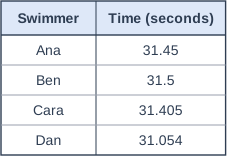
The table shows the times of four swimmers in a race. The fastest swimmer has the smallest time.

Put the names in the order the swimmers finished, starting with the fastest.

Joe says Cara was the slowest, because 31.405 has more digits than 31.45 and 31.5. Why is Joe wrong?

Table with columns "Swimmer", "Time (seconds)". Swimmer: Ana; Time (seconds): 31.45 | Swimmer: Ben; Time (seconds): 31.5 | Swimmer: Cara; Time (seconds): 31.405 | Swimmer: Dan; Time (seconds): 31.054.

Model answer

With 3 decimal places: Ana 31.450, Ben 31.500, Cara 31.405, Dan 31.054
Fastest first: Dan, Cara, Ana, Ben
Joe is wrong because the number of digits does not tell you which decimal is bigger. Compare the tenths: 31.405 has 4 tenths and 31.5 has 5 tenths, so 31.5 is bigger. Ben was the slowest, not Cara.

Explanation

In a race, the smallest time is the fastest. To compare the times, write them all with three decimal places, then compare tenths, then hundredths, then thousandths. More digits after the decimal point does not make a number bigger: 31.5 is the same as 31.500, so it beats 31.405. This is a very common mistake when ordering decimals.

Mark scheme
  1. 1 mark

    Three of the swimmers in the correct order, or one pair swapped; or the correct order Dan, Cara, Ana, Ben

  2. 1 mark

    Dan, Cara, Ana, Ben

    Do not accept the order slowest first. A correct order with no working scores both of these marks.

  3. 1 mark

    A relevant but incomplete reason why Joe is wrong, e.g. 'Ben was the slowest' or 'more digits does not mean bigger'

  4. 1 mark

    A complete correct reason, e.g. you compare the tenths first, and 31.405 has 4 tenths but 31.5 has 5 tenths, so Ben's time is bigger and Ben was the slowest; or 31.5 = 31.500, which is bigger than 31.405

    A complete correct reason on its own scores both explanation marks. 'Joe is wrong' alone scores 0.

Ready to try the rest? Tap your answers and see straight away how you did.

Topic notes

Decimals up to three decimal places

The big idea

Decimals let you write numbers that sit between whole numbers, such as a time of 12.8 seconds or a weight of 0.375 kg. The decimal point separates the whole number from the parts of one. After the point, the first digit is tenths, the second is hundredths and the third is thousandths.

Place value after the decimal point

Each column is 10 times smaller than the column on its left. One tenth is one whole split into 10 equal parts. One hundredth is a tenth split into 10, and one thousandth is a hundredth split into 10.

Here is the number 8.536:

DigitColumnValue
8ones8
5tenths0.5 (or \(\dfrac{5}{10}\))
3hundredths0.03 (or \(\dfrac{3}{100}\))
6thousandths0.006 (or \(\dfrac{6}{1000}\))

So 8.536 can be partitioned (split up) as \(8 + 0.5 + 0.03 + 0.006\). You can also split it in other ways, such as \(8 + 0.53 + 0.006\) or \(7 + 1.5 + 0.036\). The total is still 8.536.

A place holder zero holds an empty column open. In 3.05 the 0 shows there are no tenths, so the 5 is worth 5 hundredths. Without it, 3.5 is a much bigger number.

Decimals as fractions

The last digit of the decimal tells you the denominator (the bottom number). If it is a tenth, use 10; a hundredth, use 100; a thousandth, use 1,000.

DecimalLast digit is in theFraction
0.9tenths\(\dfrac{9}{10}\)
0.43hundredths\(\dfrac{43}{100}\)
0.218thousandths\(\dfrac{218}{1000}\)
0.051thousandths\(\dfrac{51}{1000}\)

A decimal bigger than 1 becomes a mixed number, with a whole number part and a fraction part: \(3.27 = 3\dfrac{27}{100}\).

Comparing and ordering decimals

Begin with the column worth the most and work to the right: ones first, then tenths, then hundredths, then thousandths. Putting zeros on the end so that all the numbers are the same length makes this easier. Zeros at the end do not change the value: 0.5 = 0.50 = 0.500.

A horizontal scale from 0.4 to 0.5, with a long mark at each end, split into 10 small divisions by short marks. Every long mark is numbered (0.4 and 0.5). Long marks are every 0.1 and each small division is 0.01. Arrow 0.45 points to 0.45.
Each small step is one hundredth. 0.45 is halfway between 0.4 and 0.5, so 0.45 is less than 0.5.

The symbol < means "is less than" and > means "is greater than". So \(0.45 < 0.5\), even though 45 is bigger than 5.

Here are five numbers: 0.35, 0.035, 0.4, 0.309 and 0.43. Which of them are between 0.3 and 0.4?

Write every number with 3 decimal places: 0.350, 0.035, 0.400, 0.309, 0.430.

All have 0 ones, so compare the tenths. A number between 0.3 and 0.4 has 3 tenths (and is not 0.3 itself).

0.035 has 0 tenths, so it is smaller than 0.3. 0.430 has 4 tenths and 3 hundredths, so it is bigger than 0.4. 0.400 is equal to 0.4, so it is not between them.

0.350 and 0.309 both have 3 tenths. So 0.35 and 0.309 are between 0.3 and 0.4. In order: \(0.3 < 0.309 < 0.35 < 0.4\).

What number is exactly halfway between 6.2 and 6.21?

Write both with 3 decimal places: 6.200 and 6.210.

The gap between them is 10 thousandths.

Half of 10 thousandths is 5 thousandths, so add 0.005 to 6.200.

The number halfway is 6.205.

Which is bigger, 0.6 or \(\dfrac{58}{100}\)?

Write 0.6 in hundredths: \(0.6 = 0.60 = \dfrac{60}{100}\).

60 hundredths is more than 58 hundredths.

So 0.6 is bigger: \(0.6 > \dfrac{58}{100}\).

Remember

  • Tenths, hundredths, thousandths: the first three places after the point.
  • Each column is 10 times smaller than the one on its left.
  • The last digit gives the denominator: 10, 100 or 1,000.
  • Zeros at the end of a decimal do not change its value.

Common mistakes

  • Thinking more digits means a bigger number. 0.274 is less than 0.3, because it has only 2 tenths.
  • Leaving out place holder zeros. Six thousandths is 0.006, not 0.6 or 0.06.
  • Mixing up thousands and thousandths. Thousands are to the left of the point; thousandths are three places to the right of it.
  • Using the wrong denominator. 0.029 is \(\dfrac{29}{1000}\), not \(\dfrac{29}{100}\): its last digit, 9, is 9 thousandths.
  • Assuming every small step on a number line is 0.1. Work out the size of a step first.

Top tip

Write the numbers in a column with the points in a line, and put zeros on the end until they are all the same length. Then compare them one digit at a time, starting on the left.

Study Helper Hints first, answers after you try

Stuck on this one? Ask for a hint and I’ll point you in the right direction, without giving the answer away. Once you’ve checked your answer, I’ll show you how the marks are awarded.