Level:
Correct: 0
Incorrect: 0
Marks: 0/0
Practice
Course:
Topics:
Year 6 Maths Smart practice A mixed round aimed at your weak spots
Unit 1
Place value
Number and place value
Numbers up to ten million
Quick practice5 skills
Rounding whole numbers
Quick practice5 skills
Negative numbers
Quick practice5 skills
Roman numerals
Quick practice4 skills
Unit 2
Calculating
Unit 3
Fractions
Unit 4
Decimals
Unit 5
Fractions, decimals and percentages
Unit 6
Ratio and proportion
Unit 7
Algebra
Unit 8
Measurement
Unit 9
Shapes and angles
Unit 10
Position and direction
Geometry: position and direction
Coordinates in four quadrants
Quick practice5 skills
Translations
Quick practice4 skills
Reflections
Quick practice4 skills
Unit 11
Statistics
Statistics
Tables, timetables and bar charts
Quick practice4 skills
Line graphs
Quick practice4 skills
Pie charts
Quick practice5 skills
The mean
Quick practice5 skills
Avg
score:
–
Topics
done:
0/60

Dividing with decimal answers

Practise 20 questions on Dividing with decimal answers for Year 6 Maths. Tap your answer and find out straight away if you are right, with the Study Helper on hand if you get stuck.

  • 20 questions
  • 1–5 marks each
  • Instant marking
  • No sign-up needed
20 questions, marked as you go

Sample questions with model answers

Here are 4 of the questions in this topic, each with a model answer, an explanation of why it earns the marks and the mark scheme.

Question 1

1 mark

Work out \(19.36 \div 4\)

Model answer

Short division, keeping the decimal point in line:
\(19 \div 4 = 4\) remainder 3
\(33 \div 4 = 8\) remainder 1 (tenths)
\(16 \div 4 = 4\) (hundredths)
Answer: 4.84

Explanation

Use short division and put the decimal point in the answer directly above the decimal point in 19.36. Carry each remainder into the next column: 3 ones become 30 tenths, so you divide 33 tenths next. Check with an estimate: \(20 \div 4 = 5\), so 4.84 is sensible. A common mistake is to lose the decimal point and write 484.

Mark scheme
  1. 1 mark

    4.84

    Do not accept 48.4 or 484 (decimal point in the wrong place).

Question 2

2 marks

Sam has £15. He spends £3.60 on a comic. He shares the rest of his money equally between his 3 sisters.

How much does each sister get?

Model answer

Money left: \(15 - 3.60 = 11.40\)
Each sister: \(11.40 \div 3 = 3.80\)
Answer: £3.80

Explanation

First take away what Sam spends, then share what is left. With short division, \(11 \div 3 = 3\) remainder 2, then 24 tenths divided by 3 is 8 tenths, so each sister gets £3.80. Check: \(3.80 \times 3 = 11.40\). A common mistake is to share the whole £15 and forget about the comic.

Mark scheme
  1. 1 mark

    Money left: \(15 - 3.60 = 11.40\) (£11.40); or the correct answer £3.80 with no working

  2. 1 mark

    £3.80

    Accept 3.80, 3.8 or 380p. Do not accept £5 (the £15 shared without taking off the comic) or £1.20. A correct answer with no working scores full marks.

Question 3

2 marks

Dev has 12.5 litres of rainwater in a water butt. He uses 2.3 litres to wash his bike. He pours the rest equally into 6 watering cans.

How much water goes into each watering can?

Model answer

Water left: \(12.5 - 2.3 = 10.2\) litres
Each can: \(10.2 \div 6 = 1.7\) litres
Answer: 1.7 litres

Explanation

First subtract the water Dev uses, then share what is left between 6 cans. With short division, \(10 \div 6 = 1\) remainder 4, then 42 tenths divided by 6 is 7 tenths, so each can gets 1.7 litres. Check: \(1.7 \times 6 = 10.2\). A common mistake is to share all 12.5 litres before taking away the water used.

Mark scheme
  1. 1 mark

    Water left: \(12.5 - 2.3 = 10.2\) litres; or the correct answer 1.7 litres with no working

  2. 1 mark

    1.7 litres

    Accept 1.70, or 1700 ml (with the unit). The unit is not needed for an answer in litres. A correct answer with no working scores full marks.

Question 4

4 marks

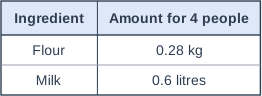
The table shows how much flour and milk Jamal needs to make pancakes for 4 people.

Jamal wants to make pancakes for 6 people.

How much flour and how much milk does he need?

Table with columns "Ingredient", "Amount for 4 people". Ingredient: Flour; Amount for 4 people: 0.28 kg | Ingredient: Milk; Amount for 4 people: 0.6 litres.

Model answer

Flour for 1 person: \(0.28 \div 4 = 0.07\) kg
Flour for 6 people: \(0.07 \times 6 = 0.42\) kg
Milk for 1 person: \(0.6 \div 4 = 0.15\) litres
Milk for 6 people: \(0.15 \times 6 = 0.9\) litres
Answer: 0.42 kg of flour and 0.9 litres of milk

Explanation

Find the amount for 1 person by dividing by 4, then multiply by 6. Another way: 6 people is 4 people plus 2 people, and 2 people need half as much as 4, so flour is \(0.28 + 0.14 = 0.42\) kg. A common mistake is to add 2 to each amount because there are 2 more people; the amounts must grow in proportion.

Mark scheme
  1. 1 mark

    Flour for 1 person, 0.07 kg (\(0.28 \div 4\)), or for 2 people, 0.14 kg; or the correct answer (0.42 kg of flour and 0.9 litres of milk) with no working

  2. 1 mark

    0.42 kg of flour

    Accept 420 g (with the unit).

  3. 1 mark

    Milk for 1 person, 0.15 litres (\(0.6 \div 4\)), or for 2 people, 0.3 litres

  4. 1 mark

    0.9 litres of milk

    Accept 0.90 litres, or 900 ml (with the unit). A correct answer with no working scores full marks.

Ready to try the rest? Tap your answers and see straight away how you did.

Topic notes

Dividing with decimal answers

The big idea

When you share an amount equally, the answer is often not a whole number. Sharing £5 between 2 people gives £2.50 each, not "2 remainder 1". In this topic you divide decimals by a whole number, and you carry on dividing whole numbers past the decimal point, so the answer comes out as a decimal.

Using facts you know

2.4 is 24 tenths. You know \(24 \div 6 = 4\), so 24 tenths divided by 6 is 4 tenths: \(2.4 \div 6 = 0.4\).

You can also partition (split) the number into parts that are easy to divide:

\[ 12.6 \div 3 = (12 \div 3) + (0.6 \div 3) = 4 + 0.2 = 4.2 \]

Short division with decimals

Use short division as you would for whole numbers. The answer's decimal point sits straight above the one in the number being shared. A remainder moves on into the next column to the right: 1 one becomes 10 tenths, and 1 tenth becomes 10 hundredths.

A bar model: one bar, labelled "Walk" split into 3 equal boxes; written in the boxes (counting from the left): box 1: 8.8 km, box 2: 8.8 km, box 3: 8.8 km. A brace above the bar spans the whole bar and is labelled 26.4 km. (The brace labelled 26.4 km covers 3 units, so one unit = 8.8 km.)
26.4 km shared equally between 3 days is 8.8 km a day.

A family walks 26.4 km over 3 days. They walk the same distance each day. How far do they walk each day?

Work out \(26.4 \div 3\). The answer's point goes above the one in 26.4.

\(26 \div 3 = 8\) remainder 2. Write 8 above the ones.

Carry the 2 ones into the tenths: 2 ones and 4 tenths make 24 tenths. \(24 \div 3 = 8\). Write 8 above the tenths.

\(26.4 \div 3 = 8.8\). They walk 8.8 km each day.

Check by multiplying: \(8.8 \times 3 = 26.4\)

A pack of 5 gel pens costs £4.35. All the pens are the same price. What is the price of one pen?

Work out \(4.35 \div 5\).

\(4 \div 5 = 0\) remainder 4. Write 0 above the ones.

4 ones and 3 tenths make 43 tenths. \(43 \div 5 = 8\) remainder 3. Write 8 above the tenths.

3 tenths and 5 hundredths make 35 hundredths. \(35 \div 5 = 7\). Write 7 above the hundredths.

\(4.35 \div 5 = 0.87\). One pen costs £0.87, which is 87p.

Whole numbers with decimal answers

If a whole number does not divide exactly, write it with a decimal point and zeros (23 = 23.00) and keep dividing. The zeros do not change the number, but they give the remainder somewhere to go.

A builder has 23 kg of sand. He fills 4 buckets with the same amount. How much sand goes in each bucket?

Write 23 as 23.00 and divide by 4.

\(23 \div 4 = 5\) remainder 3. Write 5 above the ones.

3 ones make 30 tenths. \(30 \div 4 = 7\) remainder 2. Write 7 above the tenths.

2 tenths make 20 hundredths. \(20 \div 4 = 5\). Write 5 above the hundredths.

\(23 \div 4 = 5.75\). Each bucket holds 5.75 kg.

Another way to see it: the 3 left over, shared by 4, is three quarters of a whole, and \(\dfrac{3}{4} = 0.75\).

Checking with the inverse

Multiplication is the inverse (the opposite) of division, so you can always check a division by multiplying back. If \(5.75 \times 4 = 23\), then \(23 \div 4 = 5.75\) is right. An estimate helps too: 23 is a bit less than 24, and \(24 \div 4 = 6\), so expect an answer just under 6.

Stretch: answers with three decimal places

Some divisions need three decimal places. For \(13 \div 8\), write 13 as 13.000. First, 13 ones \(\div\) 8 = 1 remainder 5. Then 50 tenths \(\div\) 8 = 6 remainder 2, 20 hundredths \(\div\) 8 = 2 remainder 4, and 40 thousandths \(\div\) 8 = 5. So \(13 \div 8 = 1.625\).

Common mistakes

  • Writing the remainder as the decimal. \(23 \div 4\) is 5 remainder 3, but that is not 5.3. The 3 must be shared between the 4 buckets too, which gives 5.75.
  • Leaving out a place holder zero. \(6.12 \div 6 = 1.02\), not 1.2: 1 tenth cannot be shared by 6, so write 0 in the tenths.
  • Forgetting to carry a remainder into the next column.
  • Losing track of the point. \(9.6 \div 3\) is 3.2, not 32: 32 is far bigger than 9.6.
  • Stopping when there is a remainder. Add zeros after the decimal point and keep going.

Top tip

Write the point in your answer before you start dividing, straight above the point in the question. Then check your answer by multiplying it back.

Study Helper Hints first, answers after you try

Stuck on this one? Ask for a hint and I’ll point you in the right direction, without giving the answer away. Once you’ve checked your answer, I’ll show you how the marks are awarded.