Practise 22 questions on Properties of 2D shapes for Year 6 Maths. Tap your answer and find out straight away if you are right, with the Study Helper on hand if you get stuck.
22 questions
1–4 marks each
Instant marking
No sign-up needed
20 questions, marked as you go
Sample questions with model answers
Here are 4 of the questions in this topic, each with a model answer, an explanation of why it earns the marks and the mark scheme.
Question 1
1 mark
Which of these shapes is a regular polygon?
Model answer
An equilateral triangle
Explanation
A regular polygon has all its sides equal and all its angles equal. An equilateral triangle has three equal sides and three equal angles of \(60^\circ\). A common mistake is to choose the rectangle: its angles are all right angles, but its sides are not all the same length, so it is not regular.
Mark scheme
1 mark
an equilateral triangle
Accept 'equilateral' or 'equilateral triangle'. Do not accept the rectangle: its angles are all equal but its sides are not.
Question 2
2 marks
Which two different quadrilaterals have exactly two lines of symmetry?
Model answer
A rectangle and a rhombus
Explanation
A rectangle (not a square) folds in half across its length and across its width: 2 lines. A rhombus (not a square) folds along both of its diagonals: 2 lines. A common mistake is to choose a square, but a square has 4 lines of symmetry.
Mark scheme
1 mark
rectangle
Accept oblong. Either order.
1 mark
rhombus
Do not accept square (4 lines of symmetry), kite (1 line), parallelogram (0 lines) or 'diamond'. If more than two shapes are given and any of them is wrong, max 1.
Question 3
2 marks
Oliver says, "A triangle can have two right angles."
Is Oliver right? How do you know?
Model answer
No. Two right angles make \(90^\circ + 90^\circ = 180^\circ\). The angles in a triangle add up to \(180^\circ\), so the third angle would be \(0^\circ\). That is not possible.
Explanation
The three angles in a triangle always add up to \(180^\circ\). Two right angles already use all \(180^\circ\), so there is nothing left for the third corner. You can also see that the two sides standing up from the right angles would be parallel and never meet.
Mark scheme
1 mark
No, with a reason that is relevant but incomplete, e.g. 'the angles would be too big' / 'there would be no room for the third angle'
'No' alone scores 0. 'Yes' scores 0.
1 mark
No, with a complete correct reason, e.g. 'two right angles add up to 180 degrees, and the three angles of a triangle add up to 180 degrees, so there is nothing left for the third angle' / 'the two sides at the right angles would be parallel, so they would never meet'
A complete correct reason on its own scores both marks.
Question 4
4 marks
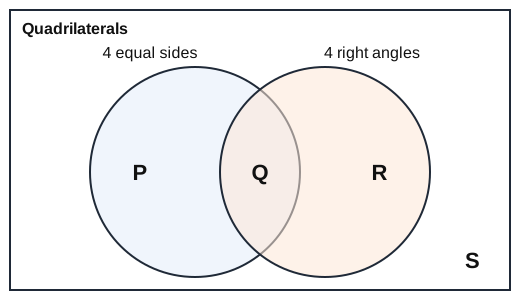
The Venn diagram sorts quadrilaterals. It has four regions, P, Q, R and S.
Which region does each of these shapes go in?
Shape 1: a square Shape 2: a rhombus with no right angles Shape 3: a rectangle that is not a square Shape 4: a kite with two short sides and two long sides
Model answer
Square: Q Rhombus: P Rectangle: R Kite: S
Explanation
A square has 4 equal sides and 4 right angles, so it goes in the overlap, Q. A rhombus with no right angles has only the equal sides, so it goes in P. A rectangle that is not a square has only the right angles, so it goes in R. The kite has neither, so it goes outside both circles, in S.
Mark scheme
1 mark
Shape 1 (square): Q
1 mark
Shape 2 (rhombus): P
1 mark
Shape 3 (rectangle): R
1 mark
Shape 4 (kite): S
Each mark is for one shape. Accept a description of the region instead of its letter (e.g. 'in both circles' for the square, 'outside both circles' for the kite).
Ready to try the rest? Tap your answers and see straight away how you did.
Ctrl + Enter to check
Study HelperHints first, answers after you try
Stuck on this one? Ask for a hint and I’ll point you in the right direction, without giving the answer away. Once you’ve checked your answer, I’ll show you how the marks are awarded.