Practise 22 questions on Angles in triangles for Year 6 Maths. Tap your answer and find out straight away if you are right, with the Study Helper on hand if you get stuck.
22 questions
1–4 marks each
Instant marking
No sign-up needed
20 questions, marked as you go
Sample questions with model answers
Here are 4 of the questions in this topic, each with a model answer, an explanation of why it earns the marks and the mark scheme.
Question 1
1 mark
An equilateral triangle has three equal sides and three equal angles.
What is the size of each angle in an equilateral triangle?
Model answer
\(180 \div 3 = 60\) Each angle is 60°.
Explanation
The three angles add up to 180°, and in an equilateral triangle they are all the same size. So share 180° into 3 equal parts: \(180 \div 3 = 60\)°. A common mistake is to divide 360 by 3.
Mark scheme
1 mark
60°
Accept 60 with or without the degree sign. Do not accept 120 (360 ÷ 3).
Question 2
2 marks
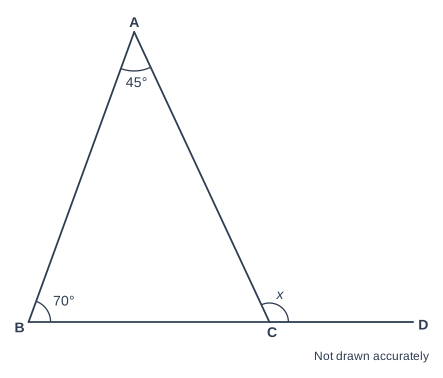
The diagram shows triangle ABC. The side BC is extended to D, so BCD is a straight line.
Work out the size of angle x.
Model answer
Angle ACB = 180 − 45 − 70 = 65° (angles in a triangle) x = 180 − 65 = 115° (angles on a straight line) x = 115°
Explanation
First find the third angle inside the triangle: \(180 - 45 - 70 = 65\)°. Angle x sits next to it on the straight line BCD, and angles on a straight line add up to 180°, so \(x = 180 - 65 = 115\)°. A common mistake is to give the angle inside the triangle, 65°, as the answer.
Mark scheme
1 mark
Angle ACB = 65° (\(180 - 45 - 70\)); or the correct answer 115° with no working
Also award for 45 + 70 = 115 seen as the answer method.
1 mark
115°
Accept 115 or x = 115, with or without the degree sign. Do not accept 65 (the angle inside the triangle). A correct answer with no working scores full marks.
Question 3
2 marks
Ben says, "Every triangle has at least two acute angles."
Is Ben right? How do you know?
Model answer
Yes. The three angles add up to 180°. If two angles were each 90° or more, they would make at least 180° on their own, and there would be nothing left for the third angle. So only one angle can be 90° or more, and the other two must be acute.
Explanation
Think about what would happen if a triangle had two angles that were not acute (each 90° or more). Together they would make 180° or more, but all three angles must add up to exactly 180°, so the third angle would be 0° or less, which is impossible. That is why every triangle has at least two acute angles. A common mistake is to give one example and say it is always true.
Mark scheme
1 mark
Yes, with a relevant but incomplete reason, e.g. one or more examples of triangles that have two acute angles, or 'a triangle can only have one big angle'
'Yes' alone scores 0. Examples alone show it works sometimes, not always.
1 mark
Yes, with a complete correct reason, e.g. if a triangle had two angles of 90° or more, those two would add up to 180° or more, leaving nothing for the third angle; so at most one angle can be right or obtuse, and the other two must be acute
A complete correct reason on its own scores both marks.
Question 4
4 marks
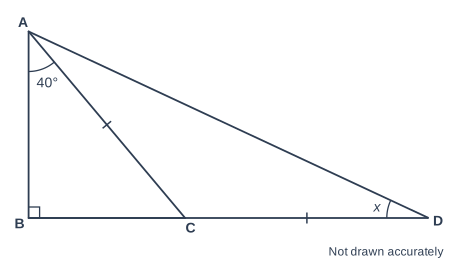
In the diagram, B, C and D lie on a straight line. Triangle ABC has a right angle at B. CA and CD are equal.
Work out the size of angle x.
Model answer
Angle ACB = 180 − 90 − 40 = 50° (angles in triangle ABC) Angle ACD = 180 − 50 = 130° (angles on a straight line) Triangle ACD is isosceles, so angle CAD = angle CDA. \(x = (180 - 130) \div 2 = 25\) x = 25°
Explanation
Work step by step. In triangle ABC, angle ACB is \(180 - 90 - 40 = 50\)°. On the straight line BCD, angle ACD is \(180 - 50 = 130\)°. CA = CD, so triangle ACD is isosceles and its two other angles are equal: they share \(180 - 130 = 50\)°, so x = 25°. A common mistake is to stop after finding 50°.
Mark scheme
1 mark
Angle ACB = 50° (\(180 - 90 - 40\)); or the correct answer 25° with no working
1 mark
Angle ACD = 130° (\(180 - 50\), angles on a straight line)
Follow through from their angle ACB.
1 mark
\((180 - 130) \div 2\), or \(50 \div 2\), using the equal angles of isosceles triangle ACD
Follow through from their angle ACD.
1 mark
25°
Accept 25 or x = 25, with or without the degree sign. Do not accept 50 or 65. A correct answer with no working scores full marks.
Ready to try the rest? Tap your answers and see straight away how you did.
Ctrl + Enter to check
Study HelperHints first, answers after you try
Stuck on this one? Ask for a hint and I’ll point you in the right direction, without giving the answer away. Once you’ve checked your answer, I’ll show you how the marks are awarded.