Practise 22 questions on Fraction, decimal and percentage equivalents for Year 6 Maths. Tap your answer and find out straight away if you are right, with the Study Helper on hand if you get stuck.
22 questions
1–5 marks each
Instant marking
No sign-up needed
20 questions, marked as you go
Sample questions with model answers
Here are 4 of the questions in this topic, each with a model answer, an explanation of why it earns the marks and the mark scheme.
Question 1
1 mark
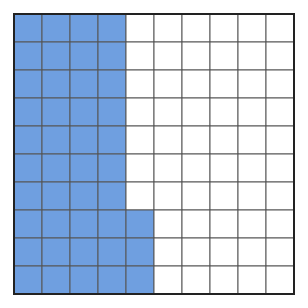
The diagram shows a 100-square. Some of the small squares are shaded.
What percentage of the 100-square is shaded?
Model answer
4 columns of 10 = 40 squares, and 3 more = 43 squares shaded. 43 out of 100 = 43% Answer: 43%
Explanation
A 100-square has 100 small squares, so each small square is 1%. Count the shaded squares: 4 columns of 10 and 3 more make 43, so 43% is shaded. A common mistake is to count the squares that are not shaded and give 57%.
Mark scheme
1 mark
43%
Accept 43 (the question asks for a percentage). Do not accept 57% (the part that is not shaded) or 4.3%.
Question 2
2 marks
What is 35% as a fraction in its simplest form?
Model answer
35% = \(\dfrac{35}{100}\) Divide the numerator and the denominator by 5: \(\dfrac{35}{100} = \dfrac{7}{20}\) Answer: \(\dfrac{7}{20}\)
Explanation
Per cent means 'out of 100', so 35% is \(\dfrac{35}{100}\). Both numbers are in the 5 times table, so divide them both by 5. 7 and 20 have no other common factor, so \(\dfrac{7}{20}\) is the simplest form. A common mistake is to stop at \(\dfrac{35}{100}\).
Mark scheme
1 mark
\(\dfrac{35}{100}\), or another correct fraction that is not fully simplified; or the correct answer \(\dfrac{7}{20}\) with no working
1 mark
\(\dfrac{7}{20}\)
Accept 7/20 typed. Only \(\dfrac{7}{20}\) scores this mark. A correct answer with no working scores full marks.
Question 3
2 marks
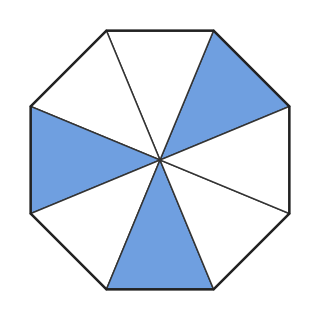
The diagram shows a regular octagon split into 8 equal parts. Some of the parts are shaded.
What percentage of the octagon is shaded?
Model answer
3 of the 8 equal parts are shaded: \(\dfrac{3}{8}\) \(\dfrac{1}{8}\) = 12.5%, so \(\dfrac{3}{8}\) = \(3 \times 12.5\) = 37.5% Answer: 37.5%
Explanation
The shaded part is 3 out of 8 equal parts, \(\dfrac{3}{8}\). One eighth is 12.5% (half of 25%), so three eighths is \(12.5 + 12.5 + 12.5 = 37.5\)%. You can also divide: \(3 \div 8 = 0.375\), which is 37.5%. A common mistake is to write 3% or 38%.
Mark scheme
1 mark
\(\dfrac{3}{8}\) seen, or each part is 12.5%; or the correct answer 37.5% with no working
1 mark
37.5%
Accept 37.5 or \(37\dfrac{1}{2}\)%. Do not accept 38% (rounded), 3% or 0.375%. A correct answer with no working scores full marks.
Question 4
4 marks
Four classes did a survey about pets.
In Class A, 18 of the 25 pupils have a pet. In Class B, 0.7 of the pupils have a pet. In Class C, \(\dfrac{3}{4}\) of the pupils have a pet. In Class D, 74% of the pupils have a pet.
What percentage of the pupils in Class A, Class B and Class C have a pet? Which class has the greatest percentage of pupils with a pet?
Model answer
Class A: \(\dfrac{18}{25} = \dfrac{72}{100}\) = 72% Class B: 0.7 = 70% Class C: \(\dfrac{3}{4}\) = 75% Class D: 74% Answer: Class C, because 75% is the greatest.
Explanation
Change each class's value into a percentage so that you can compare them. For Class A, make the denominator 100 by multiplying top and bottom by 4. A quarter is 25%, so three quarters is 75%. A common mistake is to choose Class A because 18 is the biggest number, but 18 out of 25 is only 72%.
Mark scheme
1 mark
Class A: \(\dfrac{18}{25}\) = 72% (or 0.72)
Any correct comparison in one form is fine (all percentages, all decimals or all hundredths).
1 mark
Class B: 0.7 = 70% (or 0.70)
1 mark
Class C: \(\dfrac{3}{4}\) = 75% (or 0.75)
1 mark
Class C, from a correct comparison of all four classes
'Class C' with no working scores 0. If a value is wrong, award this mark for the correct choice from the values given.
Ready to try the rest? Tap your answers and see straight away how you did.
Ctrl + Enter to check
Study HelperHints first, answers after you try
Stuck on this one? Ask for a hint and I’ll point you in the right direction, without giving the answer away. Once you’ve checked your answer, I’ll show you how the marks are awarded.