Level:
Correct: 0
Incorrect: 0
Marks: 0/0
Practice
Course:
Topics:
Year 6 Maths Smart practice A mixed round aimed at your weak spots
Unit 1
Place value
Number and place value
Numbers up to ten million
Quick practice5 skills
Rounding whole numbers
Quick practice5 skills
Negative numbers
Quick practice5 skills
Roman numerals
Quick practice4 skills
Unit 2
Calculating
Unit 3
Fractions
Unit 4
Decimals
Unit 5
Fractions, decimals and percentages
Unit 6
Ratio and proportion
Unit 7
Algebra
Unit 8
Measurement
Unit 9
Shapes and angles
Unit 10
Position and direction
Geometry: position and direction
Coordinates in four quadrants
Quick practice5 skills
Translations
Quick practice4 skills
Reflections
Quick practice4 skills
Unit 11
Statistics
Statistics
Tables, timetables and bar charts
Quick practice4 skills
Line graphs
Quick practice4 skills
Pie charts
Quick practice5 skills
The mean
Quick practice5 skills
Avg
score:
–
Topics
done:
0/60

Adding and subtracting decimals

Practise 22 questions on Adding and subtracting decimals for Year 6 Maths. Tap your answer and find out straight away if you are right, with the Study Helper on hand if you get stuck.

  • 22 questions
  • 1–5 marks each
  • Instant marking
  • No sign-up needed
20 questions, marked as you go

Sample questions with model answers

Here are 4 of the questions in this topic, each with a model answer, an explanation of why it earns the marks and the mark scheme.

Question 1

1 mark

What is \(4.6 + 0.25\)?

Model answer

Write 4.6 as 4.60 and line up the decimal points.
\(4.60 + 0.25 = 4.85\)
Answer: 4.85

Explanation

Line up the decimal points so that tenths are added to tenths and hundredths to hundredths. Writing 4.6 as 4.60 helps, because then both numbers have two decimal places: 6 tenths and 2 tenths make 8 tenths, and 0 and 5 hundredths make 5 hundredths. A common mistake is to add 6 and 25 as whole numbers and get 4.31.

Mark scheme
  1. 1 mark

    4.85

    More than one answer chosen scores 0. 4.31 comes from adding 6 and 25 as if they were whole numbers. 7.1 and 0.71 come from lining up the last digits instead of the decimal points.

Question 2

2 marks

Maya buys a book for £3.65 and a pen for £1.80. She pays with a £10 note.

How much change does she get?

Model answer

Total cost: \(3.65 + 1.80 = 5.45\)
Change: \(10 - 5.45 = 4.55\)
Answer: £4.55

Explanation

First add the two prices to find how much Maya spends. Then take that total away from £10 to find her change. You can count on from £5.45: 55p makes £6, and £4 more makes £10, so the change is £4.55. A common mistake is to stop after the first step and give the total, £5.45.

Mark scheme
  1. 1 mark

    The total cost, £5.45, or one price correctly subtracted from £10 (e.g. \(10 - 3.65 = 6.35\)); or the correct answer £4.55 with no working

    The total may be written as 5.45 or 545p.

  2. 1 mark

    £4.55

    Accept 4.55 or 455p. Do not accept £5.45 (the total cost, not the change). A correct answer with no working scores full marks.

Question 3

2 marks

Jack works out \(5.2 - 1.75\). He gets 4.55.

Is Jack right? How do you know?

Model answer

No. Write 5.2 as 5.20.
\(5.20 - 1.75 = 3.45\)
Check: \(3.45 + 1.75 = 5.20\)
Jack took 0 from 5 in the hundredths instead of exchanging. The answer is 3.45.

Explanation

You cannot take 5 hundredths from 0 hundredths, so you must exchange: 5.20 becomes 4 ones, 11 tenths and 10 hundredths. Then \(10 - 5 = 5\), \(11 - 7 = 4\) and \(4 - 1 = 3\), which gives 3.45. Jack took the smaller digit from the larger digit in each column, which is a common mistake. An estimate also helps: 5.2 take away 1.75 is about \(5 - 2 = 3\), so 4.55 is too big.

Mark scheme
  1. 1 mark

    No, with a relevant but incomplete reason, e.g. 'he has done the hundredths wrong', or the correct answer 3.45 given with no other explanation

    'No' alone scores 0. 'Yes' scores 0 for both marks.

  2. 1 mark

    No, with a complete correct reason, e.g.
    the correct answer is 3.45, shown by working such as \(5.20 - 1.75 = 3.45\) or the check \(3.45 + 1.75 = 5.2\);
    or a check that shows his answer is wrong: \(4.55 + 1.75 = 6.3\), not 5.2;
    or an estimate: \(5 - 2 = 3\), so 4.55 is too big;
    or he took the smaller digit from the larger one (5 hundredths take away 0) instead of exchanging.

    A complete correct reason on its own scores both marks.

Question 4

4 marks

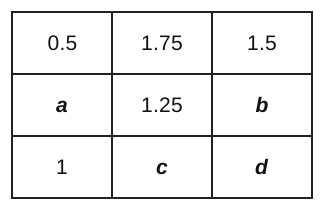
In a magic square, the numbers in every row, every column and both diagonals add up to the same total.

The diagram shows a magic square with some numbers missing.

Work out the values of a, b, c and d.

A 3 by 3 magic square. Top row: 0.5, 1.75, 1.5. Middle row: a, 1.25, b. Bottom row: 1, c, d.

Model answer

Top row: \(0.5 + 1.75 + 1.5 = 3.75\), so every line adds up to 3.75.
First column: \(a = 3.75 - 0.5 - 1 = 2.25\)
Middle row: \(b = 3.75 - 2.25 - 1.25 = 0.25\)
Middle column: \(c = 3.75 - 1.75 - 1.25 = 0.75\)
Bottom row: \(d = 3.75 - 1 - 0.75 = 2\)
Answer: a = 2.25, b = 0.25, c = 0.75, d = 2

Explanation

First use the complete line, the top row, to find the magic total, 3.75. Then look for a line with only one missing number and take the numbers you know away from 3.75. Check your answers with a diagonal: \(0.5 + 1.25 + 2 = 3.75\). A common mistake is to try to find a letter from a line that still has another missing number in it.

Mark scheme
  1. 1 mark

    \(a = 2.25\); or the correct values of a, b, c and d with no working

    The total of every line is 3.75 (from the top row).

  2. 1 mark

    \(b = 0.25\)

    If a is wrong, award this mark for b worked out correctly from their a.

  3. 1 mark

    \(c = 0.75\)

  4. 1 mark

    \(d = 2\)

    Accept 2.00. If c is wrong, award this mark for d worked out correctly from their c. A correct answer with no working scores full marks.

Ready to try the rest? Tap your answers and see straight away how you did.

Topic notes

Adding and subtracting decimals

The big idea

You add and subtract decimals in the same way as whole numbers, using columns. The one big rule is to line up the decimal points. Then ones go with ones, tenths with tenths, and hundredths with hundredths. It matters every time you work with money, weights or lengths.

Line up the decimal points

  1. Write the numbers one above the other with the decimal points in a straight line.
  2. If one number is shorter, fill the gaps with place holder zeros: 2.9 is the same as 2.90.
  3. Start with the right-hand column. If a column comes to 10 or more, carry 1 into the next column on the left: 10 hundredths make 1 tenth, and 10 tenths make 1 one.

A puppy weighs 5.38 kg. Over the next month it puts on 2.9 kg. How much does it weigh now?

Write 2.9 as 2.90, with the points in a line:

OnesTenthsHundredths
538
+290
=828

Hundredths: \(8 + 0 = 8\)

Tenths: \(3 + 9 = 12\) tenths. Write 2, and carry 1 one.

Ones: \(5 + 2 + 1 = 8\)

The puppy weighs 8.28 kg. Check with an estimate: \(5 + 3 = 8\), so 8.28 kg is sensible.

Subtracting and exchanging

When the top digit in a column is too small, exchange: take 1 from the next column on the left and turn it into 10 of the column you are working on.

A bag of flour weighs 2.5 kg. A baker uses 1.68 kg of it. How much flour is left?

Write 2.5 as 2.50, so the two numbers are the same length: \(2.50 - 1.68\)

Hundredths: you cannot take 8 from 0. Swap 1 of the 5 tenths for 10 hundredths. Now there are 4 tenths, and 10 hundredths take away 8 leaves 2 hundredths.

Tenths: you cannot take 6 from 4. Swap 1 of the 2 ones for 10 tenths. Now there is 1 one, and 14 tenths take away 6 leaves 8 tenths.

Ones: \(1 - 1 = 0\)

There is 0.82 kg of flour left. Check by adding: \(0.82 + 1.68 = 2.5\)

Making 1 and 10

A complement is the number you add to make a total. 46 hundredths and 54 hundredths make 100 hundredths, so \(0.46 + 0.54 = 1\).

To make 10, count on in jumps: from 7.3, jump first to 8, then on to 10.

A horizontal scale from 7 to 10, divided into 3 equal parts by long marks, each split into 10 small divisions by short marks. Every long mark is numbered (7, 8, 9 and 10). Long marks are every 1 and each small division is 0.1. Words under the scale: "+ 0.7" at 7.6 and "+ 2" at 9. Arrow 7.3 points to 7.3.
From 7.3 it is 0.7 to get to 8, then 2 more to get to 10. So 7.3 + 2.7 = 10.

Money

Write pence as pounds before you add or subtract: 75p is £0.75 and 5p is £0.05. Counting on is a quick way to find a difference or work out change.

A game costs £24.50. Kit has saved £17.85. How much more does he need to save?

Count on from £17.85 to £24.50:

£17.85 to £18: 15p

£18 to £24: £6

£24 to £24.50: 50p

Add the jumps: \(0.15 + 6 + 0.50 = 6.65\). Kit needs to save £6.65 more.

Problems with more than one step

Read the question carefully, decide what to work out first, and keep the points in line at every step.

Three children run a relay. Their total time is 43.65 seconds. The first child takes 14.6 seconds and the second child takes 13.85 seconds. How long does the third child take?

First add the two times you know: \(14.60 + 13.85 = 28.45\) seconds.

Then take this away from the total: \(43.65 - 28.45 = 15.20\) seconds.

The third child takes 15.2 seconds. Check by adding all three: \(14.6 + 13.85 + 15.2 = 43.65\)

Common mistakes

  • Lining up the right-hand ends of the numbers, not the points. \(4.5 + 0.32\) is 4.82, not 0.77.
  • Not carrying. \(0.7 + 0.6\) is 13 tenths, which is 1.3, not 0.13.
  • Swapping digits round to avoid exchanging. In \(6.3 - 2.48\) you need to exchange; the answer is 3.82, not 4.18.
  • Making every column total 10. \(0.46 + 0.64\) is 1.1, not 1. The partner of 0.46 is 0.54.
  • Writing pence the wrong way: 5p is £0.05, not £0.5.

Top tip

Make every number the same length before you start: write 6 as 6.00 and 2.9 as 2.90. Then estimate with whole numbers, so you can tell straight away if your answer is far out.

Study Helper Hints first, answers after you try

Stuck on this one? Ask for a hint and I’ll point you in the right direction, without giving the answer away. Once you’ve checked your answer, I’ll show you how the marks are awarded.