Level:
Correct: 0
Incorrect: 0
Marks: 0/0
Practice
Course:
Topics:
Year 6 Maths Smart practice A mixed round aimed at your weak spots
Unit 1
Place value
Number and place value
Numbers up to ten million
Quick practice5 skills
Rounding whole numbers
Quick practice5 skills
Negative numbers
Quick practice5 skills
Roman numerals
Quick practice4 skills
Unit 2
Calculating
Unit 3
Fractions
Unit 4
Decimals
Unit 5
Fractions, decimals and percentages
Unit 6
Ratio and proportion
Unit 7
Algebra
Unit 8
Measurement
Unit 9
Shapes and angles
Unit 10
Position and direction
Geometry: position and direction
Coordinates in four quadrants
Quick practice5 skills
Translations
Quick practice4 skills
Reflections
Quick practice4 skills
Unit 11
Statistics
Statistics
Tables, timetables and bar charts
Quick practice4 skills
Line graphs
Quick practice4 skills
Pie charts
Quick practice5 skills
The mean
Quick practice5 skills
Avg
score:
–
Topics
done:
0/60

Rounding decimals

Practise 20 questions on Rounding decimals for Year 6 Maths. Tap your answer and find out straight away if you are right, with the Study Helper on hand if you get stuck.

  • 20 questions
  • 1–4 marks each
  • Instant marking
  • No sign-up needed
20 questions, marked as you go

Sample questions with model answers

Here are 4 of the questions in this topic, each with a model answer, an explanation of why it earns the marks and the mark scheme.

Question 1

1 mark

Round 4.276 to two decimal places.

Model answer

4.276 is between 4.27 and 4.28.
The thousandths digit is 6, so round up.
4.28

Explanation

Two decimal places means rounding to the nearest hundredth. Look at the thousandths digit: it is 6, which is 5 or more, so the hundredths digit goes up from 7 to 8. A common mistake is to round to one decimal place by mistake and write 4.3.

Mark scheme
  1. 1 mark

    4.28

    Do not accept 4.27, 4.3 or 4.280.

Question 2

2 marks

A parcel weighs 2.465 kg.

Round its mass to the nearest whole kilogram. Then round its mass to one decimal place.

Model answer

Nearest kilogram: the tenths digit is 4, so round down: 2 kg
One decimal place: the hundredths digit is 6, so round up: 2.5 kg

Explanation

Each time, look at the digit just after the place you are rounding to. For the nearest whole number that is the tenths digit (4, so round down). For one decimal place it is the hundredths digit (6, so round up). A common mistake is to look at the last digit, 5, every time.

Mark scheme
  1. 1 mark

    Nearest whole kilogram: 2 kg

    The unit is given in the question, so 2 alone is fine. Do not accept 3 kg.

  2. 1 mark

    One decimal place: 2.5 kg

    Do not accept 2.4 kg or 2.47 kg. If the answers are not labelled, accept them in the order asked. A correct answer with no working scores full marks.

Question 3

2 marks

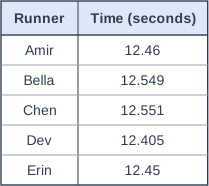
The table shows the times of five runners in a race.

Which runners' times round to 12.5 seconds, to one decimal place?

Table with columns "Runner", "Time (seconds)". Runner: Amir; Time (seconds): 12.46 | Runner: Bella; Time (seconds): 12.549 | Runner: Chen; Time (seconds): 12.551 | Runner: Dev; Time (seconds): 12.405 | Runner: Erin; Time (seconds): 12.45.

Model answer

Amir: 12.46 rounds to 12.5
Bella: 12.549 rounds to 12.5
Chen: 12.551 rounds to 12.6
Dev: 12.405 rounds to 12.4
Erin: 12.45 rounds to 12.5
Amir, Bella and Erin

Explanation

For each time, look at the hundredths digit to decide whether the tenths digit stays the same or goes up. Bella's 12.549 has a hundredths digit of 4, so it rounds down to 12.5, but Chen's 12.551 has a hundredths digit of 5, so it rounds up to 12.6. Erin's 12.45 has a hundredths digit of 5, so it rounds up to 12.5. A common mistake is to round 12.549 in two steps and get 12.6.

Mark scheme
  1. 1 mark

    Two of Amir, Bella and Erin, with no more than one wrong name; or all three with one wrong name

  2. 1 mark

    Amir, Bella and Erin (and no others)

    There are exactly three runners. Chen (12.551 rounds to 12.6) and Dev (12.405 rounds to 12.4) are wrong. A correct answer with no working scores full marks.

Question 4

4 marks

Here are five prices.

£2.45   £2.54   £2.95   £3.05   £2.49

Which prices round to £2.50 to the nearest 10p?

Which prices round to £3 to the nearest pound?

Model answer

Nearest 10p:
£2.45 to £2.50, £2.54 to £2.50, £2.95 to £3.00, £3.05 to £3.10, £2.49 to £2.50
So £2.45, £2.54 and £2.49.
Nearest pound:
£2.45 to £2, £2.54 to £3, £2.95 to £3, £3.05 to £3, £2.49 to £2
So £2.54, £2.95 and £3.05.

Explanation

For the nearest 10p, look at the pennies digit: 5 or more rounds up. So £2.45 rounds up to £2.50, but £2.54 rounds down to £2.50. For the nearest pound, look at whether the pence are 50p or more: £2.54 rounds up to £3, but £2.49 rounds down to £2. A common mistake is to think £3.05 cannot round to £3 because it is more than £3.

Mark scheme
  1. 1 mark

    Nearest 10p: two of £2.45, £2.54 and £2.49 with no more than one wrong price, or all three with one wrong price

  2. 1 mark

    Nearest 10p: £2.45, £2.54 and £2.49 (and no others)

    There are exactly three. £2.95 rounds to £3.00 and £3.05 rounds to £3.10.

  3. 1 mark

    Nearest pound: two of £2.54, £2.95 and £3.05 with no more than one wrong price, or all three with one wrong price

  4. 1 mark

    Nearest pound: £2.54, £2.95 and £3.05 (and no others)

    There are exactly three. £2.45 and £2.49 round to £2. If the two lists are not labelled, accept them in the order asked. A correct answer with no working scores full marks.

Ready to try the rest? Tap your answers and see straight away how you did.

Topic notes

Rounding decimals

The big idea

Rounding means swapping a number for a simpler one that is close to it. A puppy that weighs 3.68 kg weighs "about 3.7 kg". Rounding makes numbers easier to say, compare and work with, and it gives sensible answers for money and measures.

Which is it closer to?

To round 3.68 to one decimal place (one digit after the point), ask: is it closer to 3.6 or to 3.7?

A horizontal scale from 3.6 to 3.7, with a long mark at each end, split into 10 small divisions by short marks. Every long mark is numbered (3.6 and 3.7). Long marks are every 0.1 and each small division is 0.01. Words under the scale: "halfway" at 3.65. Arrow 3.68 points to 3.68.
3.68 is past halfway (3.65), so it is closer to 3.7.

You do not need to draw a number line every time. Use the decider: the next digit along, straight after the last place you want to keep.

  1. Find the last place you are keeping.
  2. Look at the decider. If it is 5, 6, 7, 8 or 9, round up: the place you keep goes up by 1. If it is below 5, round down: the place you keep stays the same.
  3. Leave out every digit after the place you keep.

A number exactly halfway, such as 3.65, rounds up to 3.7.

Whole numbers, one and two decimal places

Round to the nearestThe decider is theExample
whole numbertenths digit8.61 rounds to 9
one decimal place (tenth)hundredths digit0.734 rounds to 0.7
two decimal places (hundredth)thousandths digit12.098 rounds to 12.10

Look at the last row. The hundredths digit is 9, and it must go up by 1. 9 hundredths and 1 more hundredth make 10 hundredths, which is 1 tenth. So 12.09 becomes 12.10. Keep the final 0: two decimal places means two digits after the point.

Round 5.997 to two decimal places.

We keep two decimal places, so the last place we keep is the hundredths. The hundredths digit is 9.

The decider is the thousandths digit, which is 7. That is at least 5, so round up.

5.99 and 1 more hundredth is 6.00, because 10 hundredths make 1 tenth and 10 tenths make 1 whole.

5.997 rounds to 6.00 to two decimal places.

Money and measures

With money and measures, the unit tells you how many decimal places to keep.

Rounding to the nearestis the same as
pound (£1)a whole number of pounds
10pone decimal place in pounds
penny (1p)two decimal places in pounds
kilogram, metre or litrea whole number
10 cmone decimal place in metres
centimetretwo decimal places in metres

A petrol station shows the price of petrol as £1.479 a litre. What is this to the nearest penny? What is it to the nearest 10p?

Nearest penny (two decimal places): the hundredths digit is 7 and the decider is 9. Round up: £1.48.

Nearest 10p (one decimal place): the tenths digit is 4 and the decider is 7. Round up: £1.5, which we write as £1.50.

Money is always written with two digits after the point.

Stretch: the smallest and largest numbers

Many numbers round to the same answer. To find them all, work out the two halfway points on either side.

Zac thinks of a number with one decimal place. It rounds to 8 to the nearest whole number. Find the smallest and the largest numbers Zac could be thinking of.

The halfway point between 7 and 8 is 7.5. Numbers from 7.5 upwards round up to 8, so the smallest is 7.5.

The halfway point between 8 and 9 is 8.5. But 8.5 rounds up to 9, so it is not allowed. The largest number with one decimal place below 8.5 is 8.4.

Check: 7.4 rounds to 7 and 8.5 rounds to 9, so 7.5 and 8.4 really are the smallest and largest.

Common mistakes

  • Using the final digit as the decider. For 6.248 to one decimal place, the decider is the hundredths digit (4), not the 8. The answer is 6.2.
  • Rounding in steps. 2.349 to one decimal place is 2.3. Rounding to 2.35 first and then to 2.4 is wrong.
  • Chopping digits off instead of rounding. 2.47 to one decimal place is 2.5, not 2.4.
  • Writing 6.10 when 6.98 rounds up to one decimal place. The tenths digit is 9, and 10 tenths make 1 whole, so the answer is 7.0.
  • Rounding to the wrong place, for example to the nearest 10p instead of the nearest pound.

Top tip

Underline the last digit you are keeping, and circle the decider next to it. Only the circled digit decides whether you round up or down.

Study Helper Hints first, answers after you try

Stuck on this one? Ask for a hint and I’ll point you in the right direction, without giving the answer away. Once you’ve checked your answer, I’ll show you how the marks are awarded.