Level:
Correct: 0
Incorrect: 0
Marks: 0/0
Practice
Course:
Topics:
Year 6 Maths Smart practice A mixed round aimed at your weak spots
Unit 1
Place value
Unit 2
Calculating
Unit 3
Fractions
Unit 4
Decimals
Unit 5
Fractions, decimals and percentages
Unit 6
Ratio and proportion
Unit 7
Algebra
Unit 8
Measurement
Unit 9
Shapes and angles
Unit 10
Position and direction
Geometry: position and direction
Coordinates in four quadrants
Quick practice5 skills
Translations
Quick practice4 skills
Reflections
Quick practice4 skills
Unit 11
Statistics
Statistics
Tables, timetables and bar charts
Quick practice4 skills
Line graphs
Quick practice4 skills
Pie charts
Quick practice5 skills
The mean
Quick practice5 skills
Avg
score:
–
Topics
done:
0/60

Negative numbers

Practise 22 questions on Negative numbers for Year 6 Maths. Tap your answer and find out straight away if you are right, with the Study Helper on hand if you get stuck.

  • 22 questions
  • 1–4 marks each
  • Instant marking
  • No sign-up needed
20 questions, marked as you go

Sample questions with model answers

Here are 4 of the questions in this topic, each with a model answer, an explanation of why it earns the marks and the mark scheme.

Question 1

1 mark

Start at 2. Count back 5.

What number do you reach?

Model answer

2, 1, 0, \(-1\), \(-2\), \(-3\)
\(2 - 5 = -3\)

Explanation

Count back one at a time and remember to count 0: from 2 you go to 1, 0, \(-1\), \(-2\), \(-3\). That is 5 steps back. Numbers below zero are written with a minus sign. A common mistake is to miss out 0 and land on \(-4\).

Mark scheme
  1. 1 mark

    \(-3\)

    Accept -3 or minus 3. Do not accept 3, -2 or -4.

Question 2

2 marks

Put these temperatures in order, starting with the coldest.

\(3^\circ\text{C}\)   \(-8^\circ\text{C}\)   \(0^\circ\text{C}\)   \(-1^\circ\text{C}\)   \(-12^\circ\text{C}\)

Model answer

\(-12^\circ\text{C}\), \(-8^\circ\text{C}\), \(-1^\circ\text{C}\), \(0^\circ\text{C}\), \(3^\circ\text{C}\)

Explanation

The coldest temperature is the one furthest below zero, so \(-12^\circ\text{C}\) comes first, then \(-8^\circ\text{C}\) and \(-1^\circ\text{C}\). Then come 0 and the temperature above zero. It helps to picture a thermometer or a number line. A common mistake is to put \(-1\) before \(-8\) because 1 is smaller than 8.

Mark scheme
  1. 1 mark

    The order is correct except for one pair of temperatures swapped; or all five in the correct order from warmest to coldest; or the fully correct order

    For example, -12, -1, -8, 0, 3 scores 1 mark.

  2. 1 mark

    \(-12\), \(-8\), \(-1\), 0, 3

    Units are not needed. This mark needs all five in the correct order, coldest first.

Question 3

2 marks

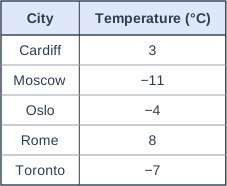
The table shows the temperature in five cities at midday on one day in January.

Which city was the coldest?

What is the difference between the temperature in the warmest city and the temperature in the coldest city?

Table with columns "City", "Temperature (°C)". City: Cardiff; Temperature (°C): 3 | City: Moscow; Temperature (°C): −11 | City: Oslo; Temperature (°C): −4 | City: Rome; Temperature (°C): 8 | City: Toronto; Temperature (°C): −7.

Model answer

Coldest: Moscow, \(-11^\circ\text{C}\)
Warmest: Rome, \(8^\circ\text{C}\)
From \(-11\) up to 0 is 11, and from 0 up to 8 is 8.
\(11 + 8 = 19\) degrees

Explanation

The coldest temperature is the one furthest below zero: \(-11^\circ\text{C}\) in Moscow. The warmest is \(8^\circ\text{C}\) in Rome. The difference crosses zero, so add the two parts: 11 degrees up to 0 and 8 degrees more makes 19. A common mistake is to subtract, \(11 - 8 = 3\).

Mark scheme
  1. 1 mark

    Moscow

    Accept -11 °C. Do not accept Rome.

  2. 1 mark

    19 (degrees)

    Do not accept 3, -3 or -19. Follow through: the difference between the warmest temperature (8 °C) and their coldest city's temperature.

Question 4

4 marks

A football club has £240 in its bank account.

It pays £400 for new kits. Then it pays in £75 from a cake sale.

A balance below £0 means the club owes the bank money. It is written with a minus sign, for example −£20.

What is the balance after paying for the kits?

What is the balance after the cake sale?

How much more money must the club pay in to make its balance £100?

Model answer

\(240 - 400 = -160\), so the balance is −£160.
\(-160 + 75 = -85\), so the balance is −£85.
From −£85 to £0 is £85, and then £100 more.
\(85 + 100 = 185\), so the club must pay in £185.

Explanation

Paying £400 out of £240 uses up the £240 and leaves £160 still to pay, so the balance is −£160. Paying in £75 brings it 75 closer to zero: −£85. To reach £100, the club first needs £85 to get back to £0, then £100 more. A common mistake is to work out \(100 - 85 = 15\).

Mark scheme
  1. 1 mark

    −£160 after the kits

    Accept -160, minus £160, or 'owes £160'. Do not accept £160 without a minus sign or a word showing it is below zero.

  2. 1 mark

    −£85 after the cake sale

    Accept -85, minus £85, or 'owes £85'. Follow through: their first balance + 75.

  3. 1 mark

    A correct method for the last part, e.g. 85 to reach £0 and 100 more, or \(100 + 85\); or the correct answer £185 with no working

  4. 1 mark

    £185

    Accept 185. Follow through: 100 + the size of their second balance. Do not accept £15. A correct answer with no working scores full marks.

Ready to try the rest? Tap your answers and see straight away how you did.

Topic notes

Negative numbers

The big idea

Numbers below zero are called negative numbers. They have a minus sign in front: −5 is said "negative five" or "minus five". Numbers above zero are positive numbers. We use negative numbers for temperatures below freezing, floors below the ground and depths below the sea.

Negative numbers on a number line

Along a number line, the numbers grow as you go right and shrink as you go left. On a thermometer, they grow as you go up.

A horizontal scale from −10 to 10, divided into 10 equal parts by long marks, each split into 2 small divisions by short marks. Every long mark is numbered (−10, −8, −6, −4, −2, 0, 2, 4, 6, 8 and 10). Long marks are every 2 and each small division is 1. Words under the scale: "← smaller" at −7 and "bigger →" at 7. Arrow A points to −4. Arrow B points to 7.
Arrow A points to −4 and arrow B points to 7. From −4 to 0 is 4 steps, and from 0 to 7 is 7 more, so they are 11 apart.

A number far below zero is smaller than a number just below zero. So \(-9 < -2\), even though 9 is bigger than 2. A temperature of −9 °C is colder than −2 °C.

To put numbers in order, picture them on a number line. The smallest is the one furthest to the left.

Counting through zero

When you count across zero in ones, zero is a step too: counting back from 3 goes 2, 1, 0, −1, −2. Counting in bigger steps works the same way. Counting back in 2s from 5 goes 3, 1, −1, −3, −5.

Rises and falls

A rise means move up (or right) on the number line. A fall means move down (or left). Use zero as a stepping stone.

For −5 °C rising by 9 degrees: 5 degrees takes you up to 0, then 4 more takes you to 4 °C.

A submarine is 40 m below the surface of the sea, at −40 m. It rises 25 m, then dives 30 m. Where is it now?

Rising 25 m from −40 m: 25 m up takes it to −15 m (still 15 m below the surface).

Diving 30 m from −15 m: 30 m further down takes it to −45 m.

The submarine is at −45 m, which is 45 m below the surface.

The difference across zero

The difference between two numbers is how far apart they are. When one number is negative and the other is positive, split the jump at zero and add the two parts.

From −4 to 7 is 4 steps up to 0, then 7 more: \(4 + 7 = 11\).

When both numbers are negative, just count the steps between them: −9 and −3 are 6 apart.

In a quiz, the Red team ends with −35 points. The Blue team ends with 20 points. How many more points did the Blue team score?

Jump from −35 up to 0: that is 35 points.

Jump from 0 up to 20: that is 20 more points.

\(35 + 20 = 55\). The Blue team scored 55 points more.

Sequences that cross zero

A sequence is a list of numbers that follow a rule. Keep using the rule as you pass through zero. In 8, 5, 2, ..., the rule is "take away 3", so the next numbers are −1, −4, −7.

A sequence starts at −10 and goes up by 3 each time. What is the first positive number in the sequence?

Keep adding 3: −10, −7, −4, −1, 2.

−1 is still negative, but the next number, 2, is above zero.

The first positive number is 2.

Stretch: money in the bank

A bank balance shows how much money is in an account. A balance below zero means you owe the bank money. If you have £45 and spend £60, you spend £45 to reach £0 and then £15 more, so your balance is −£15.

Common mistakes

  • Thinking −9 is bigger than −2 because 9 is bigger than 2. Further below zero means smaller.
  • Missing out zero when you count across it.
  • Subtracting to find a difference across zero. From −4 to 7 is 11, not \(7 - 4 = 3\).
  • Losing the minus sign: 3 degrees below zero is −3 °C, not 3 °C.

Top tip

Sketch a quick number line, or a thermometer, and draw the jumps on it. Always stop at zero on the way.

Study Helper Hints first, answers after you try

Stuck on this one? Ask for a hint and I’ll point you in the right direction, without giving the answer away. Once you’ve checked your answer, I’ll show you how the marks are awarded.