Practise 22 questions on Simple formulae and function machines for Year 6 Maths. Tap your answer and find out straight away if you are right, with the Study Helper on hand if you get stuck.
22 questions
1–5 marks each
Instant marking
No sign-up needed
20 questions, marked as you go
Sample questions with model answers
Here are 4 of the questions in this topic, each with a model answer, an explanation of why it earns the marks and the mark scheme.
Question 1
1 mark
The formula for the diameter \(d\) of a circle is \(d = 2r\), where \(r\) is the radius.
A circle has a radius of 13 cm. Work out its diameter.
Model answer
\(d = 2 \times 13 = 26\) The diameter is 26 cm.
Explanation
\(2r\) means \(2 \times r\). Put 13 in place of \(r\): \(d = 2 \times 13 = 26\). The diameter goes all the way across the circle through the centre, so it is twice the radius. A common mistake is to halve the radius instead of doubling it.
Mark scheme
1 mark
26 cm
Accept 26 (the unit is given in the question). Do not accept 6.5 or 15.
Question 2
2 marks
Here is a function machine.
The output is 50. Work out the input.
Model answer
Work backwards using inverses. \(50 - 8 = 42\) \(42 \div 3 = 14\) The input is 14.
Explanation
To work backwards, start at the output and undo each step in reverse order. The last step was add 8, so subtract 8 first to get 42. The first step was multiply by 3, so divide by 3 to get 14. Check: \(14 \times 3 + 8 = 50\). A common mistake is to undo the steps in the wrong order.
Mark scheme
1 mark
\(50 - 8 = 42\) seen; or the correct answer 14 with no working
Undoing the + 8 first.
1 mark
14
A correct answer with no working scores full marks. Do not accept 158 (putting 50 through the machine forwards: 50 × 3 + 8).
Question 3
2 marks
The area \(A\) of a triangle is given by the formula
\(A = b \times h \div 2\)
where \(b\) is the base and \(h\) is the perpendicular height.
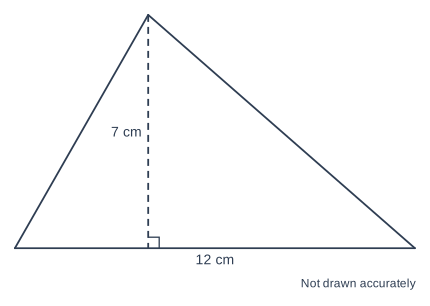
Use the formula to work out the area of the triangle in the diagram.
Model answer
\(A = 12 \times 7 \div 2\) \(= 84 \div 2 = 42\) The area is 42 cm².
Explanation
The base is 12 cm and the perpendicular height (the dashed line, at right angles to the base) is 7 cm. Multiply them, \(12 \times 7 = 84\), then divide by 2 to get 42 cm². A triangle is half of a rectangle with the same base and height, which is why you halve. A common mistake is to forget to divide by 2.
Mark scheme
1 mark
\(12 \times 7 = 84\) seen; or the correct answer 42 cm² with no working
1 mark
42 cm²
Accept 42 with no unit, 42 cm2 or 42 square cm. A correct answer with no working scores full marks. Do not accept 84 (forgetting to halve) or 19 / 38 (adding).
Question 4
4 marks
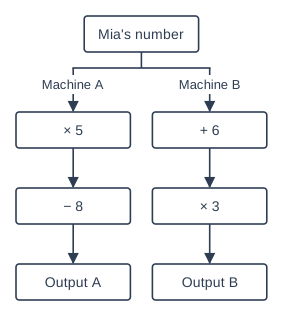
The diagram shows two function machines, A and B.
Mia puts the same number into both machines. The two outputs are the same.
Find Mia's number. What are the outputs of machines A and B for Mia's number?
Model answer
Try 10: A gives \(10 \times 5 - 8 = 42\). B gives \((10 + 6) \times 3 = 48\). B is bigger. Try 14: A gives 62. B gives 60. A is bigger. Try 13: A gives \(13 \times 5 = 65\), \(65 - 8 = 57\). B gives \(13 + 6 = 19\), \(19 \times 3 = 57\). Both give 57, so Mia's number is 13.
Explanation
Try a number in both machines and compare the outputs, then use what you see to choose the next number. At 10, machine B gives more; at 14, machine A gives more, so the answer is between them. Trying 13 gives 57 from both machines. Working in a table keeps your trials organised. A common mistake is to do the steps in machine B in the wrong order (multiplying before adding 6).
Mark scheme
1 mark
One trial number put correctly through both machines, e.g. 10 gives 42 from A and 48 from B; or the correct answer 13 with both outputs 57 shown
Any whole-number trial counts, e.g. 5 gives 17 and 33, 12 gives 52 and 54, 14 gives 62 and 60.
1 mark
13
Mia's number is 13.
1 mark
Machine A: \(13 \times 5 = 65\), \(65 - 8 = 57\)
Accept 57 shown as the output of machine A for 13.
1 mark
Machine B: \(13 + 6 = 19\), \(19 \times 3 = 57\)
Accept 57 shown as the output of machine B for 13. 13 with both outputs 57 shown scores all 4 marks (the check counts as the trial). 13 with no working scores 1 mark (the second point).
Ready to try the rest? Tap your answers and see straight away how you did.
Ctrl + Enter to check
Study HelperHints first, answers after you try
Stuck on this one? Ask for a hint and I’ll point you in the right direction, without giving the answer away. Once you’ve checked your answer, I’ll show you how the marks are awarded.